Uniform polarization and linear dielectrics

Click For Summary
SUMMARY

A sphere with a frozen-in uniform polarization vector, denoted as ## \vec P ##, cannot be classified as a linear dielectric. According to Griffiths' definition, the electric field inside the sphere is given by ## \vec E = \frac {-P}{3 \epsilon_0} ##, which indicates that ## \vec P ≠ ε_0 χ_e \vec E ## since ## ε_0 χ_e ## cannot be negative. Outside the dielectric, while ## \vec P ## is zero, the electric field ## \vec E ## remains non-zero, confirming that a sphere with uniform polarization does not meet the criteria for linear dielectrics. This conclusion aligns with the behavior of ferroelectrics, which exhibit spontaneous polarization in the absence of an electric field.

PREREQUISITES
  • Understanding of dielectric materials and their properties
  • Familiarity with Griffiths' definitions of electric fields and polarization
  • Knowledge of the relationship between electric field, polarization, and susceptibility
  • Basic concepts of ferroelectrics and spontaneous polarization
NEXT STEPS
  • Study Griffiths' treatment of dielectrics in detail, focusing on Chapter 4
  • Research the properties and applications of ferroelectric materials
  • Explore the mathematical derivation of electric fields in polarized materials
  • Investigate the implications of non-linear dielectrics in practical applications
USEFUL FOR

Physicists, electrical engineers, and materials scientists interested in the behavior of dielectrics and ferroelectrics, particularly in applications involving polarization and electric fields.

Pushoam
Messages
961
Reaction score
53
Can a sphere with a frozen - in uniform polarization ## \vec P ## be considered a linear dielectrics?

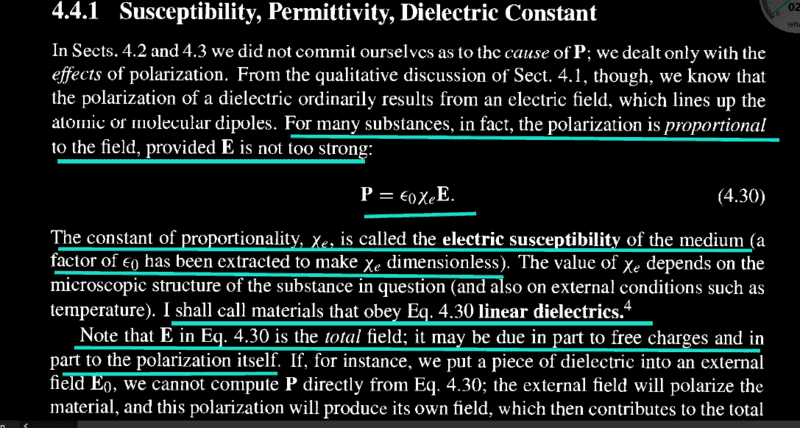
Following the definition of dielectrics given in Griffiths:
upload_2017-8-12_19-59-16.png
The electric field inside the sphere,
## \vec E = \frac {-P}{3 \epsilon_0} ##
So, ## \vec P ≠ ε_0 χ_e \vec E ## as ## ε_0 χ_e## can't be negative?

On the other hand, outside the dielectrics, ## \vec P is 0## , but ## \vec E is non-zero ## and ## ε_0 χ_e## can't be 0.
Hence, acc. to eq. 4.30,
A sphere with uniform polarization is not linear dielectrics.
Is this correct?
 
Physics news on Phys.org
There are cases of spontaneous polarization ## \vec{P} ## in the absence of an electric field. I believe these materials are known as ferroelectrics. In general, you can not assign a dielectric constant to this spontaneous polarization. I believe what you have concluded is also correct=when in the shape of a sphere, the material inside will still retain the spontaneous polarization, and will not be appreciably affected by the electric field due to the surface polarization charge that has an electric field opposite the polarization of ## \vec{E}_p=-\vec{P}/(3 \epsilon_o ) ##.
 
Last edited:
  • Like
Likes Pushoam
Thread 'Colors in a plasma globe'
I have a common plasma globe with blue streamers and orange pads at both ends. The orange light is emitted by neon and the blue light is presumably emitted by argon and xenon. Why are the streamers blue while the pads at both ends are orange? A plasma globe's electric field is strong near the central electrode, decreasing with distance, so I would not expect the orange color at both ends.

Similar threads

  • · Replies 6 ·
Replies
6
Views
1K
  • · Replies 6 ·
Replies
6
Views
5K
  • · Replies 3 ·
Replies
3
Views
1K
Replies
5
Views
2K
  • · Replies 5 ·
Replies
5
Views
3K
  • · Replies 3 ·
Replies
3
Views
3K
  • · Replies 2 ·
Replies
2
Views
3K
  • · Replies 2 ·
Replies
2
Views
2K
  • · Replies 0 ·
Replies
0
Views
2K
Replies
5
Views
3K