What fun could you have with a fountain design in artificial gravity?
- Level: High School
- Thread starter DaveC426913
- Start date
Join the discussion
Registration is free. Ask a follow-up in this thread, or start your own.
44 replies · 5K views
Physics news on Phys.org
DaveC426913
Gold Member
2025 Award
- 24,696
- 9,099
I had thought about that. Different places in the colony would produce different results. Interesting locations might include:A.T. said:I meant an approximate helix winding around the rotation axis. The airspeed would be decreasing as the water is slowed by drag.
- equator (my designs)
- pole (your designs)
- axis (a very long fall, and very wet)
- somewhere between equator and pole (where you'd get planet-like Coriolis curvature)
- 13,926
- 16,804
1250m radius cylinder
0.5g surface gravity
0 altitude (i.e., on the rim of the cylinder)
10m/s fountain velocity
94.8° angle (my 100° was a bit off - probably a messed up degrees-to-radians conversion).
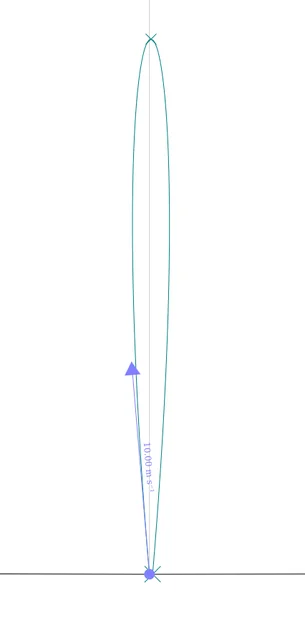
0.5g surface gravity
0 altitude (i.e., on the rim of the cylinder)
10m/s fountain velocity
94.8° angle (my 100° was a bit off - probably a messed up degrees-to-radians conversion).
Last edited:
- 13,926
- 16,804
I've checked the above in Maxima, and I calculate the loop is about 10m high and 60-ish cm wide. That matches the aspect ratio of the loop drawn above. The 40m loop with a ~6m width comes from feeding in 20m/s launch velocity and angle of 99.7°:
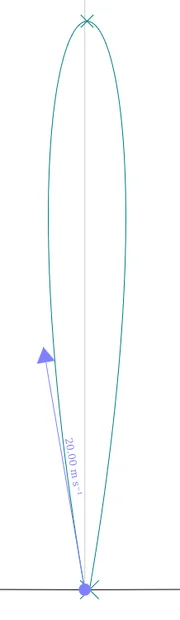
So I probably changed the launch velocity and forgot what I'd done this morning. Sorry.
So I probably changed the launch velocity and forgot what I'd done this morning. Sorry.
- 13,926
- 16,804
And, of course, if you tilt a bit more anti-spinwards (102° in this case, still at 20m/s):
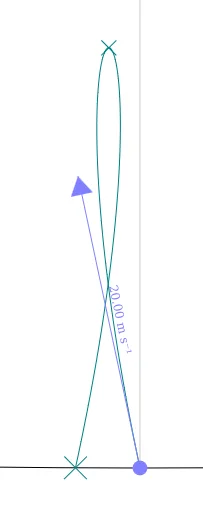
DaveC426913
Gold Member
2025 Award
- 24,696
- 9,099
That's very cool. I like the effect.Ibix said:And, of course, if you tilt a bit more anti-spinwards (102° in this case, still at 20m/s):
View attachment 371712
I'm concerned about the "muzzle velocity".
20m/s is 45mph.
My "research" suggests that 20mph is terminal velocity for water streams/droplets. It would rapidly slow down from 45 to 20mph and, in doing so, break into droplets and probably not complete the arc in the same way.
(That being said, this is for a story, and is therefore is merely described by observation. I could probably get away with some writer's license. Furthermore, if any reader were to go to the trouble of proving me wrong; I would be extremely flattered. The Great Larry Niven had fans who would put his math through the wringer. High praise indeed.)
DaveC426913
Gold Member
2025 Award
- 24,696
- 9,099
Now that I'm playing around with this cool toy, I'm finding other story points to explore:
What would baseball look like?
Pitcher throwing a spinward pitch at 60mph would have to aim up at about 6 degrees to put the ball across the plate in the strike zone.
Ump throwing it back antispinward (at 60mph) would have aim up about 2 degrees to put it in the pitcher's glove.
(or vice versa, depending on which way they orient the baseball diamond)
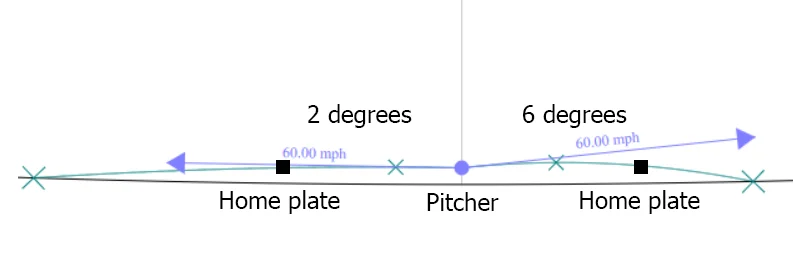
And, of course, every throw across the field would be somewhere between 2 and 6 degrees.
I guess the game would be full of "errors". (That's what they call it when someone misses a catch, right?)
(By comparison, a pitcher/ump in 1g on Earth normally throws a 60mph ball at about 2 degrees above horizontal.)
What would baseball look like?
Pitcher throwing a spinward pitch at 60mph would have to aim up at about 6 degrees to put the ball across the plate in the strike zone.
Ump throwing it back antispinward (at 60mph) would have aim up about 2 degrees to put it in the pitcher's glove.
(or vice versa, depending on which way they orient the baseball diamond)
And, of course, every throw across the field would be somewhere between 2 and 6 degrees.
I guess the game would be full of "errors". (That's what they call it when someone misses a catch, right?)
(By comparison, a pitcher/ump in 1g on Earth normally throws a 60mph ball at about 2 degrees above horizontal.)
Last edited:
- 1,262
- 755
I take it that's an "Ibix original"Ibix said:In Bakerloo did Ali Khan
A stately hippodrome decree
Where Alf the bread deliv'ry man
Collided with a draper's van
While doing sixty three.

- 1,262
- 755
Pandora's box: ex USA a plethora of exotic games: cricket, rugby, soccer etc !DaveC426913 said:Now that I'm playing around with this cool toy, I'm finding other story points to explore:
What would baseball look like?
- 13,926
- 16,804
Can't claim credit - I think I learned it from my mother, but where she got it I don't know.neilparker62 said:I take it that's an "Ibix original"
- 13,926
- 16,804
You can get similar effects at any speed, although the loops are narrower. Use my 10m/s settings and increase the angle a degree or so. Once you go beyond the loops you get funny triangular trajectories for a bit, too.DaveC426913 said:I'm concerned about the "muzzle velocity".
20m/s is 45mph.
My "research" suggests that 20mph is terminal velocity for water streams/droplets. It would rapidly slow down from 45 to 20mph and, in doing so, break into droplets and probably not complete the arc in the same way.
- 16,099
- 9,306
Can you be a bit more specific about the fountain environment?DaveC426913 said:TL;DR: If you were gong to construct a fountain inside a hollow-rotating asteroid colony, what could you do to highlight the weird effects?
I suppose that the asteroid can be modeled as a spherical shell in which the gravitational field is zero. You put a fountain inside as shown in post #30.
Let ##\vec L## be a vector of magnitude 110 m pointing from the base of the fountain to its nozzle. I have two questions:
1. Does ##\vec L## point towards the center of the sphere?
2. What is the angle between ##\vec L## and the angular velocity ##\vec{\omega}## of the asteroid?
DaveC426913
Gold Member
2025 Award
- 24,696
- 9,099
kuruman said:Can you be a bit more specific about the fountain environment?
I suppose that the asteroid can be modeled as a spherical shell in which the gravitational field is zero. You put a fountain inside as shown in post #30.
Gravity due to mass is zero.
Artificial gravity due to rotation is 0.5g.
(see specs, top-left in diagram)
It's a rigid tower, 110m tall. The water shoots out from the top: 15mph at an angle of 55 degrees. (grey vectors)kuruman said:Let ##\vec L## be a vector of magnitude 110 m pointing from the base of the fountain to its nozzle.
(see specs, top-right in diagram)
I think this renders your questions moot, no?
kuruman said:I have two questions:
1. Does ##\vec L## point towards the center of the sphere?
2. What is the angle between ##\vec L## and the angular velocity ##\vec{\omega}## of the asteroid?
You can play with the numbers as you see fit in this calculator. It produced the blue curves seen in the diagram (everything else was added by me).
It will show you relative vectors and absolute vectors.
Last edited:
- 16,099
- 9,306
The calculator assumes that you have a rotating floor such that the angular velocity of rotation is perpendicular to the floor. It provides a path given an initial velocity and position for a mass moving without friction across the floor. It is not the hollow asteroid that you mentioned in post #1.
So when I look in the post #43 figure, the water emerging from the nozzle is moving in the plane of the rotating platform, correct? I am asking because I want to do some trajectory calculations and be sure that I understand the problem correctly.
Is it the case then that we have a rotating platform on which we shoot a puck from some initial position with some initial velocity. If the puck zaps dots on the platform as it moves across it to edge of the platform, what would the path look like when we connect the dots? Is this a fair assessment of the problem?
I should point out that several years ago I did a similar calculation of how a spaceship with thrusters on all sides can move through a rotating tunnel without touching the walls and exit at the opposite side. It should not be too hard to adapt the previous solution to this problem.
So when I look in the post #43 figure, the water emerging from the nozzle is moving in the plane of the rotating platform, correct? I am asking because I want to do some trajectory calculations and be sure that I understand the problem correctly.
Is it the case then that we have a rotating platform on which we shoot a puck from some initial position with some initial velocity. If the puck zaps dots on the platform as it moves across it to edge of the platform, what would the path look like when we connect the dots? Is this a fair assessment of the problem?
I should point out that several years ago I did a similar calculation of how a spaceship with thrusters on all sides can move through a rotating tunnel without touching the walls and exit at the opposite side. It should not be too hard to adapt the previous solution to this problem.
DaveC426913
Gold Member
2025 Award
- 24,696
- 9,099
"The effect is not unlike the acceleration due to real gravity."kuruman said:The calculator assumes that you have a rotating floor such that the angular velocity of rotation is perpendicular to the floor. It provides a path given an initial velocity and position for a mass moving without friction across the floor. It is not the hollow asteroid that you mentioned in post #1.
OK, it's not a 100% match.
The water is emitted in at 55 degrees from horizontal at 15mph.kuruman said:So when I look in the post #43 figure, the water emerging from the nozzle is moving in the plane of the rotating platform, correct?
This is all specified in the diagram.
I am not prepared to say so, no. Not off-hand. But I'm interested to see your simulations.kuruman said:Is it the case then that we have a rotating platform on which we shoot a puck from some initial position with some initial velocity. If the puck zaps dots on the platform as it moves across it to edge of the platform, what would the path look like when we connect the dots? Is this a fair assessment of the problem?
One thing that the sim doesn't factor in is air resistance, which is not insignificant.