Use the graph of f(x) to investigate the limit

  • Thread starter Thread starter nycmathguy
  • Start date Start date
  • Tags Tags
    Graph Limit
Click For Summary
SUMMARY

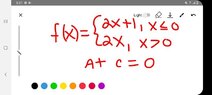
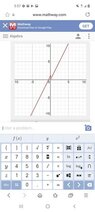
The discussion focuses on investigating the limit of the function f(x) as x approaches c, specifically at c = 0. The left-hand limit (LHL) of lim (2x + 1) as x tends to 0 is determined to be 1, while the right-hand limit (RHL) of lim (2x) as x tends to 0 is 0. Since LHL does not equal RHL, the conclusion is that the limit of f(x) as x approaches 0 does not exist. The conversation also touches on the implications of piecewise-defined functions in this context.

PREREQUISITES
  • Understanding of limits in calculus
  • Familiarity with piecewise-defined functions
  • Knowledge of left-hand and right-hand limits
  • Graphical interpretation of functions
NEXT STEPS
  • Study the properties of piecewise-defined functions
  • Learn about the epsilon-delta definition of limits
  • Explore examples of limits that do not exist
  • Investigate the behavior of functions at discontinuities
USEFUL FOR

Students and educators in calculus, particularly those focusing on limits and piecewise functions, as well as anyone seeking to deepen their understanding of continuity and discontinuity in mathematical functions.

nycmathguy
Homework Statement
Use the graph of f(x) to investigate the limit.
Relevant Equations
Piecewise-defined Function
Use the graph to investigate the limit of f(x) as x tends to c at the number c.

See attachments.

Based on the graph of f(x), here is what I did:

lim (2x + 1) as x tends to 0 from the left is 1.

lim (2x) as x tends to 0 from the right is 0.

LHL does not equal RHL.

I conclude the limit of f(x) as x tends to c at the number c (c = 0) does not exist.
 

Attachments

  • Screenshot_20210615-175108_Drawing Pad.jpg
    Screenshot_20210615-175108_Drawing Pad.jpg
    20.3 KB · Views: 150
  • Screenshot_20210615-175701_Samsung Internet.jpg
    Screenshot_20210615-175701_Samsung Internet.jpg
    21 KB · Views: 177
  • Like
Likes   Reactions: Delta2
Physics news on Phys.org
nycmathguy said:
Homework Statement:: Use the graph of f(x) to investigate the limit.
Relevant Equations:: Piecewise-defined Function

I conclude the limit of f(x) as x tends to c at the number c (c = 0) does not exist.
Um, one of your piecewise continuous definitions includes and "=" sign...
 
nycmathguy said:
I conclude the limit of f(x) as x tends to c at the number c (c = 0) does not exist.
Looks good to me.
 
  • Like
Likes   Reactions: Delta2 and nycmathguy
berkeman said:
Um, one of your piecewise continuous definitions includes and "=" sign...
Meaning?
 
Mark44 said:
Looks good to me.

That's what I thought. I may post one more like this involving a piecewise function in terms of 3 pieces. Let me think about it.
 
berkeman said:
Um, one of your piecewise continuous definitions includes and "=" sign...
nycmathguy said:
Meaning?
Doesn't matter whether one or both or neither of the function definitions has an = in it. The one-sided limits you found are correct, and your conclusion that the two-sided limit doesn't exist is also correct.

Well done.
 
  • Like
Likes   Reactions: nycmathguy and berkeman
Mark44 said:
Doesn't matter whether one or both or neither of the function definitions has an = in it. The one-sided limits you found are correct, and your conclusion that the two-sided limit doesn't exist is also correct.

Well done.

Beautiful. I may post one more but this time, the piecewise function will be three pieces. Stay tune.
 

Similar threads

  • · Replies 7 ·
Replies
7
Views
1K
  • · Replies 6 ·
Replies
6
Views
1K
  • · Replies 2 ·
Replies
2
Views
1K
  • · Replies 11 ·
Replies
11
Views
1K
  • · Replies 15 ·
Replies
15
Views
2K
  • · Replies 10 ·
Replies
10
Views
1K
Replies
3
Views
1K
  • · Replies 2 ·
Replies
2
Views
1K
Replies
1
Views
1K
  • · Replies 11 ·
Replies
11
Views
2K