Using Energy Conservation to solve this problem: Jumping on a spring scale

Click For Summary
SUMMARY

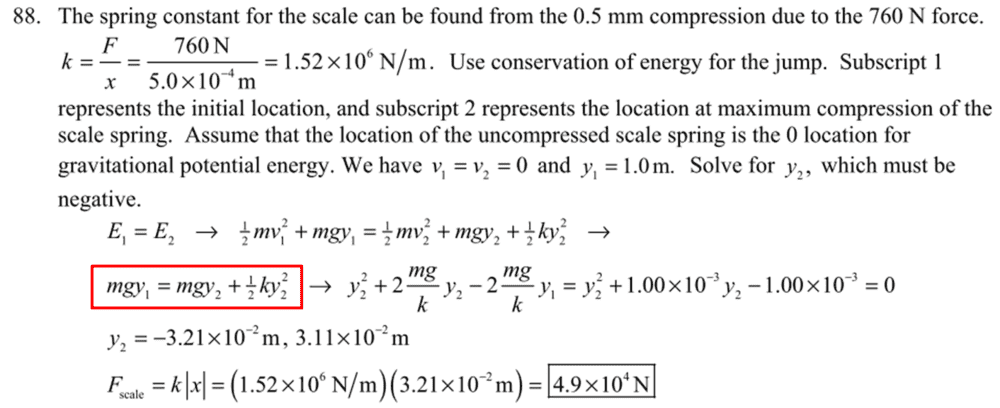
The discussion centers on the algebraic manipulation of the equation related to spring compression when jumping on a spring scale. The initial equation presented is 760(1+X) = 0.5kX², which is correctly transformed to 760 = 0.5kX² - 760X by subtracting 760X from both sides. A typing error in the solution manual is identified, where it incorrectly states the equation as 760 = 0.5kX² + 760X. The conversation also touches on practical limitations, such as the maximum weight capacity of bathroom scales, which is noted to be 150kg or 1,500N.

PREREQUISITES
  • Understanding of gravitational potential energy (mgh)
  • Familiarity with spring constant (k) in Hooke's Law
  • Basic algebraic manipulation techniques
  • Knowledge of units of force (Newtons)
NEXT STEPS
  • Study the principles of Hooke's Law and its applications in physics
  • Learn how to derive equations for energy conservation in mechanical systems
  • Explore the concept of gravitational potential energy in different contexts
  • Investigate the limitations of measurement tools like spring scales in experimental physics
USEFUL FOR

Students studying physics, particularly those focusing on mechanics, as well as educators and anyone interested in understanding the applications of algebra in physical scenarios involving energy conservation and spring dynamics.

r12214001
Messages
24
Reaction score
2
Homework Statement
my cal:760(1+X)=0.5kX²
Relevant Equations
760(1+X)=0.5kX²
I suppose spring compression to be X when jumpping from 1m. Therefore gravational potential mgh=760(1+X) and my cal:760(1+X)=0.5kX²
why the solution manual state that 760=0.5kX²+760X

1584262353555.png

圖片1.png
 
Last edited:
Physics news on Phys.org
r12214001 said:
I suppose spring compression to be X when jumpping from 1m. Therefore gravational potential mgh=760(1+X) and my cal:760(1+X)=0.5kX²
why the solution manual state that 760=0.5kX²-760X
Algebra.

Start with$$760(1+X)=0.5kX^2$$ and subtract ##760X## from both sides to get $$760(1+X)-760X=0.5kX^2-760X$$Now on the left hand side notice that you can cancel that 760X and get $$760=0.5kX^2-760X$$
 
jbriggs444 said:
Algebra.

Start with$$760(1+X)=0.5kX^2$$ and subtract ##760X## from both sides to get $$760(1+X)-760X=0.5kX^2-760X$$Now on the left hand side notice that you can cancel that 760X and get $$760=0.5kX^2-760X$$
typing error
solution manual state that 760=0.5kX²+760X
 
r12214001 said:
typing error
solution manual state that 760=0.5kX²+760X
The solution manual took ##X## to be negative.
 
PS my bathroom scales only go up to about ##150kg## or ##1,500N##. I'm not able to test this out.
 
  • Haha
Likes etotheipi
PeroK said:
PS my bathroom scales only go up to about ##150kg## or ##1,500N##. I'm not able to test this out.
OK i didnt notice that. thanks for correction
 
The book claims the answer is that all the magnitudes are the same because "the gravitational force on the penguin is the same". I'm having trouble understanding this. I thought the buoyant force was equal to the weight of the fluid displaced. Weight depends on mass which depends on density. Therefore, due to the differing densities the buoyant force will be different in each case? Is this incorrect?

Similar threads

  • · Replies 5 ·
Replies
5
Views
2K
  • · Replies 3 ·
Replies
3
Views
2K
  • · Replies 14 ·
Replies
14
Views
3K
Replies
3
Views
1K
Replies
10
Views
2K
Replies
24
Views
4K
  • · Replies 3 ·
Replies
3
Views
2K
  • · Replies 12 ·
Replies
12
Views
3K
Replies
11
Views
3K
  • · Replies 2 ·
Replies
2
Views
10K