Using right hand rule 1 to find direction of magnetic field

Click For Summary
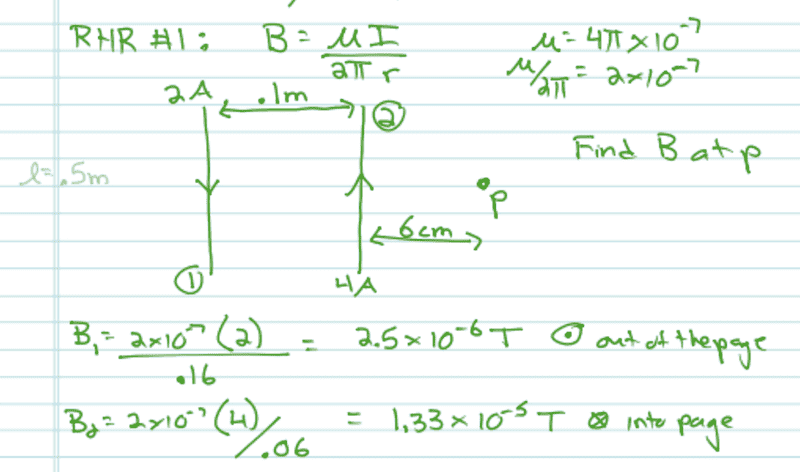
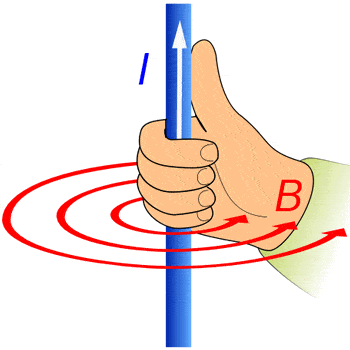
The discussion focuses on using the right-hand rule to determine the direction of the magnetic field generated by currents. To find the direction of B2, the thumb should point upwards in the direction of the current, indicating that the magnetic field at point P is directed into the page. The right-hand rule is reiterated for finding the direction of B1, where the thumb points downwards for current 1, and the fingers curl in the direction of the magnetic field. The clarity of the problem statement is noted as essential for accurate interpretation. Understanding the right-hand rule is crucial for visualizing magnetic field directions in relation to current flow.
Scholar1
Messages
39
Reaction score
0
[Mentor's note: Thread moved from technical sections so no template shown]
33xvmev.png


So the calculations all make sense.

But for example to find the direction of B2= 1.33 X 10⁻⁵T

I believe you should position your right hand like this:

Because your thumb should point in the direction of the current which is upwards in this case?
2mcivqg.gif


Assuming my approach so far is correct I don't understand how this hand image tells me that B2 is into the page.
 
Physics news on Phys.org
I assume that you're looking for the field at point P? (It's hard to tell without a proper problem statement to make clear what it is you're trying to solve). If you picture the right-hand-rule image superimposed on current 2, point P would be in the vicinity of the hand's wrist. The B field arrows are pointing into the wrist, hence into the page.
 
gneill said:
I assume that you're looking for the field at point P? (It's hard to tell without a proper problem statement to make clear what it is you're trying to solve). If you picture the right-hand-rule image superimposed on current 2, point P would be in the vicinity of the hand's wrist. The B field arrows are pointing into the wrist, hence into the page.

Yes I am trying to find the field at point P. I think I understand now. If you don't mind can you also explain how I could find field B1 at point P?
 
You've already done the calculation for the magnitude of the field. The direction is given by the right hand rule. Imagine wrapping your hand around the current as in the figure, with your thumb pointing in the direction of the current (so downwards in the case of current 1). Your fingers curl in the direction of the field (picture your finger nails as arrow heads).
 
The book claims the answer is that all the magnitudes are the same because "the gravitational force on the penguin is the same". I'm having trouble understanding this. I thought the buoyant force was equal to the weight of the fluid displaced. Weight depends on mass which depends on density. Therefore, due to the differing densities the buoyant force will be different in each case? Is this incorrect?

Similar threads

  • · Replies 2 ·
Replies
2
Views
2K
  • · Replies 3 ·
Replies
3
Views
1K
  • · Replies 10 ·
Replies
10
Views
2K
Replies
34
Views
2K
Replies
5
Views
2K
  • · Replies 9 ·
Replies
9
Views
2K
  • · Replies 8 ·
Replies
8
Views
4K
Replies
43
Views
4K
Replies
1
Views
1K
  • · Replies 7 ·
Replies
7
Views
2K