Using the Spaghetti-Twist to Align DNA - Comments

  • Context: Insights 
  • Thread starter Thread starter klotza
  • Start date Start date
  • Tags Tags
    dna gene
Click For Summary
SUMMARY

The discussion centers on the innovative technique of using the Spaghetti-Twist method to align DNA, as presented by Greg Bernhardt. This method contrasts with traditional hydrodynamic flow techniques, commonly used in DNA stretching applications like DNA curtains. Participants emphasize the importance of understanding the three-dimensional architecture of the genome within cells, particularly in the context of the "4D nucleome project," which investigates how DNA organization changes during cell differentiation. The conversation highlights the significance of polymer physics in studying DNA folding and organization.

PREREQUISITES
  • Understanding of DNA molecular structure and behavior
  • Familiarity with hydrodynamic flow techniques in molecular biology
  • Knowledge of the "4D nucleome project" and its implications
  • Basic principles of polymer physics as they relate to DNA
NEXT STEPS
  • Research the Spaghetti-Twist method for DNA alignment
  • Explore hydrodynamic flow techniques in DNA manipulation
  • Investigate the "4D nucleome project" and its findings
  • Study polymer physics principles relevant to DNA folding
USEFUL FOR

Researchers in molecular biology, biophysicists, and anyone interested in advanced DNA manipulation techniques and the structural organization of genomes within cells.

klotza
Science Advisor
Insights Author
Gold Member
Messages
80
Reaction score
113
Greg Bernhardt submitted a new PF Insights post

Using the Spaghetti-Twist to Align DNA
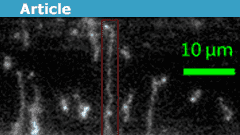
dna_twist.png


Continue reading the Original PF Insights Post.
 

Attachments

  • dna_twist.png
    dna_twist.png
    10 KB · Views: 942
  • Like
Likes   Reactions: jim mcnamara and Greg Bernhardt
Biology news on Phys.org
Neat idea. I wonder how much this differs from the more commonly used method of employing hydrodynamic flow to stretch DNA (e.g. in DNA curtains).

One additional note:
If you look at an image of a DNA molecule in solution or in the cell, two genes that are very far apart along the molecule could appear very close in the image, and not much can be learned from looking at how the molecule is organized.

While I agree with this is true for a DNA molecule in solution, this is definitely not true for DNA in a cell. Biologists are very interested in studying the three dimensional architecture of the genome inside of the cell and how this architecture changes during cell differentiation (scientists have dubbed efforts to study these questions as the "4D nucleome project"). Imaging different regions of DNA to look at some of the scaling laws governing their folding inside of the cell has revealed some interesting polymer physics: https://www.nature.com/articles/nature16496
 
  • Like
Likes   Reactions: Greg Bernhardt

Similar threads

  • · Replies 11 ·
Replies
11
Views
3K
  • · Replies 8 ·
Replies
8
Views
4K
  • · Replies 2 ·
Replies
2
Views
5K
  • · Replies 4 ·
Replies
4
Views
2K
  • · Replies 15 ·
Replies
15
Views
3K
  • · Replies 2 ·
Replies
2
Views
5K
  • · Replies 3 ·
Replies
3
Views
4K
  • · Replies 6 ·
Replies
6
Views
3K
  • · Replies 13 ·
Replies
13
Views
4K
  • · Replies 3 ·
Replies
3
Views
3K