What Does Not Allowed in Quantum Theory Mean Regarding Band Gaps?

Click For Summary
SUMMARY

The discussion focuses on the concept of band gaps in quantum theory, specifically addressing the phrase "is not allowed in quantum theory." This indicates that there are no energy states within the band gap, similar to the discrete energy levels in an atom. The existence of band gaps arises from the periodic potential of the lattice structure in materials. Additionally, the "arches" mentioned in the energy diagrams represent the plunging potential experienced by electrons due to the arrangement of lattice ions.

PREREQUISITES
  • Understanding of quantum mechanics principles
  • Familiarity with energy band theory in solid-state physics
  • Knowledge of lattice structures and periodic potentials
  • Basic concepts of energy levels and gaps in quantum systems
NEXT STEPS
  • Research the implications of band gaps in semiconductor physics
  • Study the role of periodic potentials in solid-state physics
  • Learn about the Coulombic potential and its applications in quantum mechanics
  • Explore advanced topics in quantum theory related to energy states
USEFUL FOR

Physicists, materials scientists, and students studying solid-state physics or quantum mechanics who seek to deepen their understanding of energy band structures and their implications in various materials.

PainterGuy
Messages
938
Reaction score
73
Hi,

Could you please help me with the queries below?

Question 1:
Please have a look on the attachment, conduction_band2, or check the following link for better resolution http://imagizer.imageshack.us/a/img921/4356/vODcjh.jpg

It says, "Figure 1–7 shows energy diagrams for insulators, semiconductors, and conductors. The energy gap or band gap is the difference between two energy levels and is “not allowed” in quantum theory."

What does the part "is not allowed in quantum theory" really mean here? I don't think it means that in quantum theory band gap is not allowed. If it does mean this then why does the gap exist?

Question 2:
Please have a look on the attachment, conduction_band1, or check the following link for better resolution http://imagizer.imageshack.us/a/img924/8813/KsYTN0.jpg

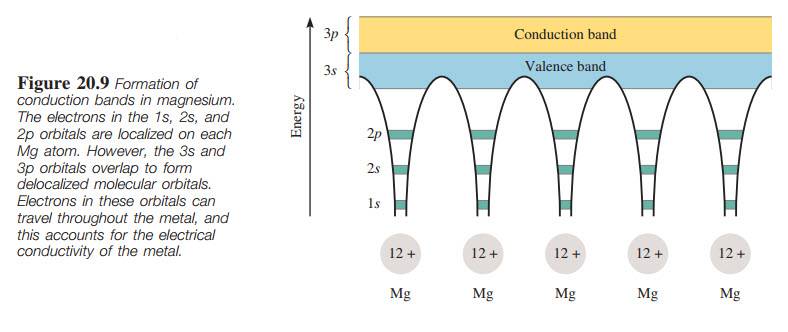
What do these 'arches' mean? Are they really needed? Why would the author use this style?
?temp_hash=eb6bc11b6576c1df5b9341e0e1353b09.jpg


Thank you for the help!
 

Attachments

  • conduction_band3.jpg
    conduction_band3.jpg
    30.4 KB · Views: 664
  • conductionBand1.jpg
    conductionBand1.jpg
    38 KB · Views: 530
  • conduction_band2.jpg
    conduction_band2.jpg
    35.3 KB · Views: 498
  • ?temp_hash=eb6bc11b6576c1df5b9341e0e1353b09.jpg
    ?temp_hash=eb6bc11b6576c1df5b9341e0e1353b09.jpg
    30.4 KB · Views: 1,901
Physics news on Phys.org
PainterGuy said:
Hi,

Could you please help me with the queries below?

Question 1:
Please have a look on the attachment, conduction_band2, or check the following link for better resolution http://imagizer.imageshack.us/a/img921/4356/vODcjh.jpg

It says, "Figure 1–7 shows energy diagrams for insulators, semiconductors, and conductors. The energy gap or band gap is the difference between two energy levels and is “not allowed” in quantum theory."

What does the part "is not allowed in quantum theory" really mean here? I don't think it means that in quantum theory band gap is not allowed. If it does mean this then why does the gap exist?

It means that there are no energy levels in that region. It is similar to the gap between energy levels in an atom where you have discrete energy levels. Here, you have energy BANDS, instead of levels, and there are gaps in the range of energy where no states exist.

It exists because of many reasons, including the periodic nature of the potential.

Question 2:
Please have a look on the attachment, conduction_band1, or check the following link for better resolution http://imagizer.imageshack.us/a/img924/8813/KsYTN0.jpg

What do these 'arches' mean? Are they really needed? Why would the author use this style?

View attachment 236104

Thank you for the help!

Those should not be looked at as "arches", but rather as "plunging potential". Draw the Coulombic potential well, for example. It is -∞ as r→0, and then it approaches 0 as r→∞. This is ONE of those "arches". Now, repeat that when you have many lattice ions at regular intervals. This is the potential that an electron in a solid "sees" due to the regular arrangement of the lattice ions potential as it goes through the solid.

Zz.
 
  • Like
Likes   Reactions: PainterGuy

Similar threads

  • · Replies 5 ·
Replies
5
Views
37K
  • · Replies 7 ·
Replies
7
Views
13K
Replies
3
Views
2K
  • · Replies 105 ·
4
Replies
105
Views
15K
  • · Replies 25 ·
Replies
25
Views
5K
  • · Replies 1 ·
Replies
1
Views
6K
  • · Replies 2 ·
Replies
2
Views
2K
  • · Replies 15 ·
Replies
15
Views
4K
Replies
8
Views
3K
  • · Replies 13 ·
Replies
13
Views
5K