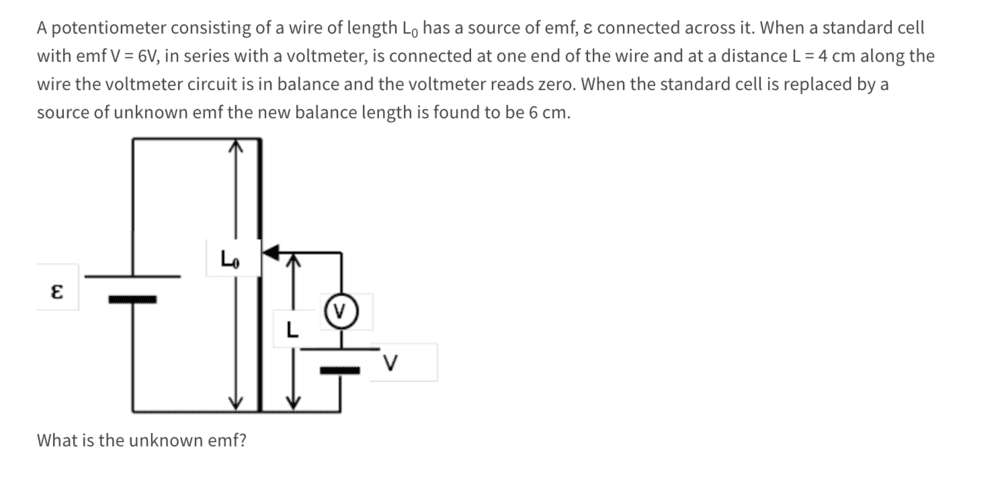
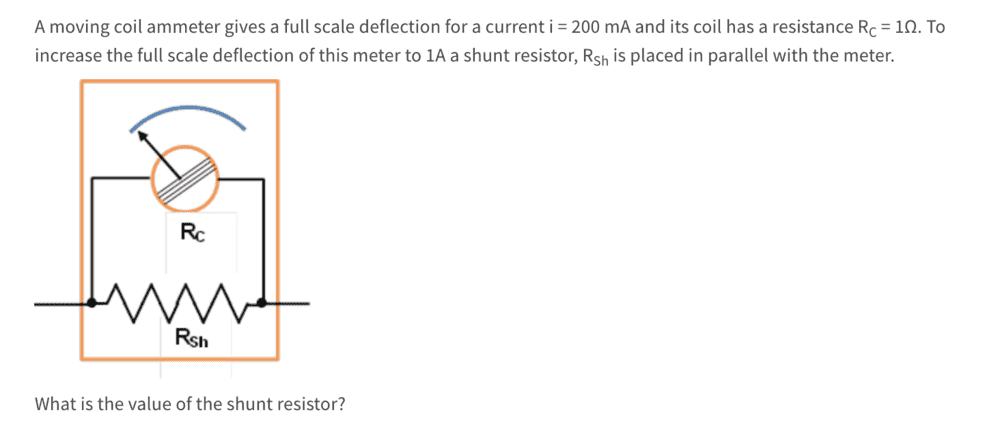
Value of the shunt resistor in this circuit

Click For Summary
SUMMARY

The discussion centers on the calculation of the shunt resistor value in a circuit using Kirchhoff's laws. Participants confirm that the voltage across the shunt and coil is the same due to their parallel connection, leading to a calculated shunt resistance of 0.25 ohms. The current through the shunt is determined to be 800mA, derived from the difference between 1A and 200mA. This method of calculation is recognized as efficient and effective for solving similar problems.

PREREQUISITES
  • Understanding of Kirchhoff's Voltage Law
  • Knowledge of parallel circuit configurations
  • Ability to calculate current and resistance using Ohm's Law
  • Familiarity with basic electrical components like shunt resistors and ammeters
NEXT STEPS
  • Study advanced applications of Kirchhoff's laws in circuit analysis
  • Learn about different types of shunt resistors and their uses in measurement
  • Explore methods for calculating power dissipation in resistors
  • Investigate the impact of shunt resistor values on circuit performance
USEFUL FOR

Electrical engineers, students studying circuit theory, and professionals involved in designing or analyzing electrical measurement systems will benefit from this discussion.

Bolter
Messages
262
Reaction score
31
Homework Statement
Find value of shunt resistor in circuit
Relevant Equations
Ohms law
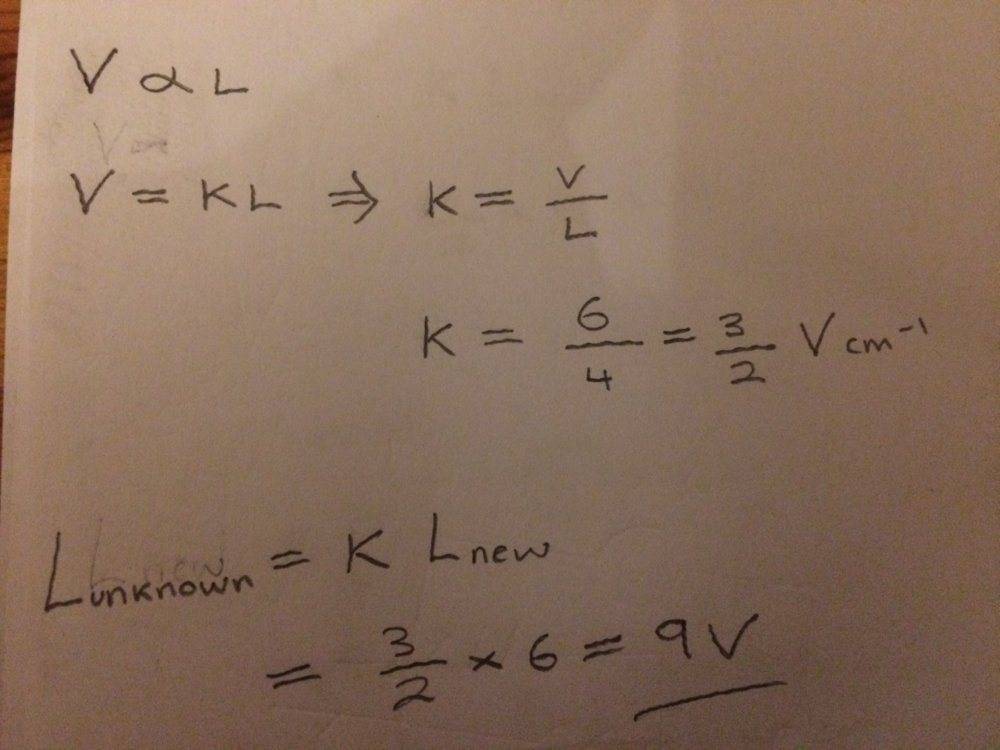
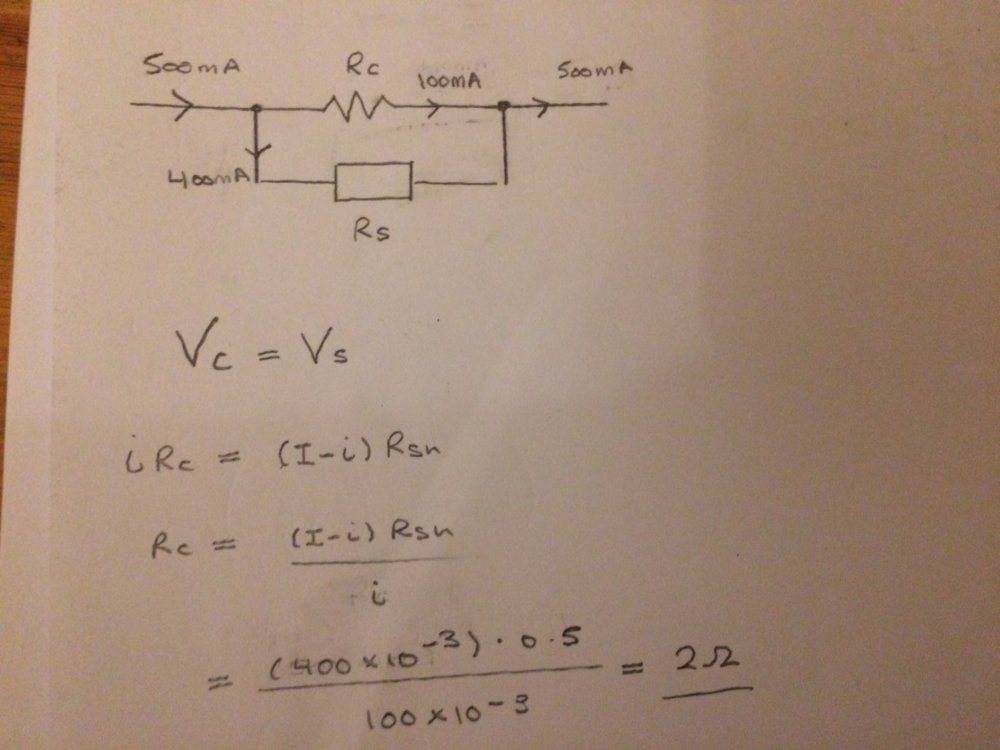
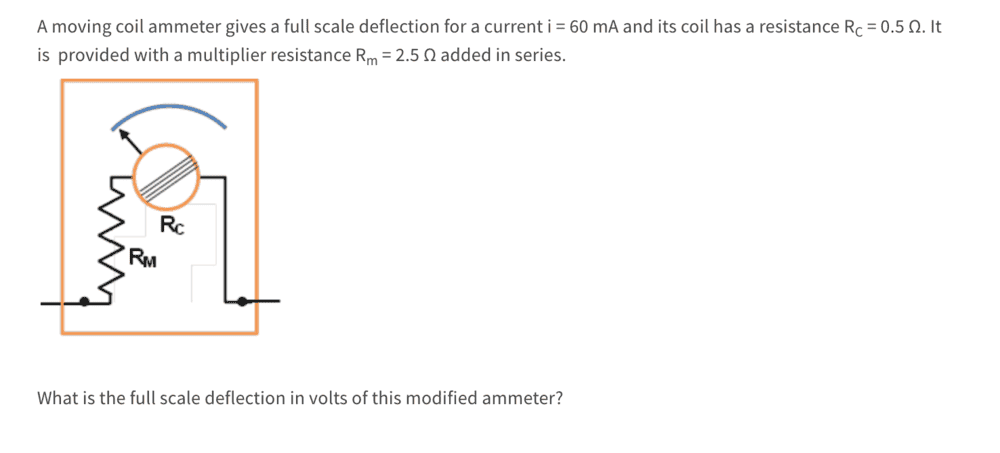
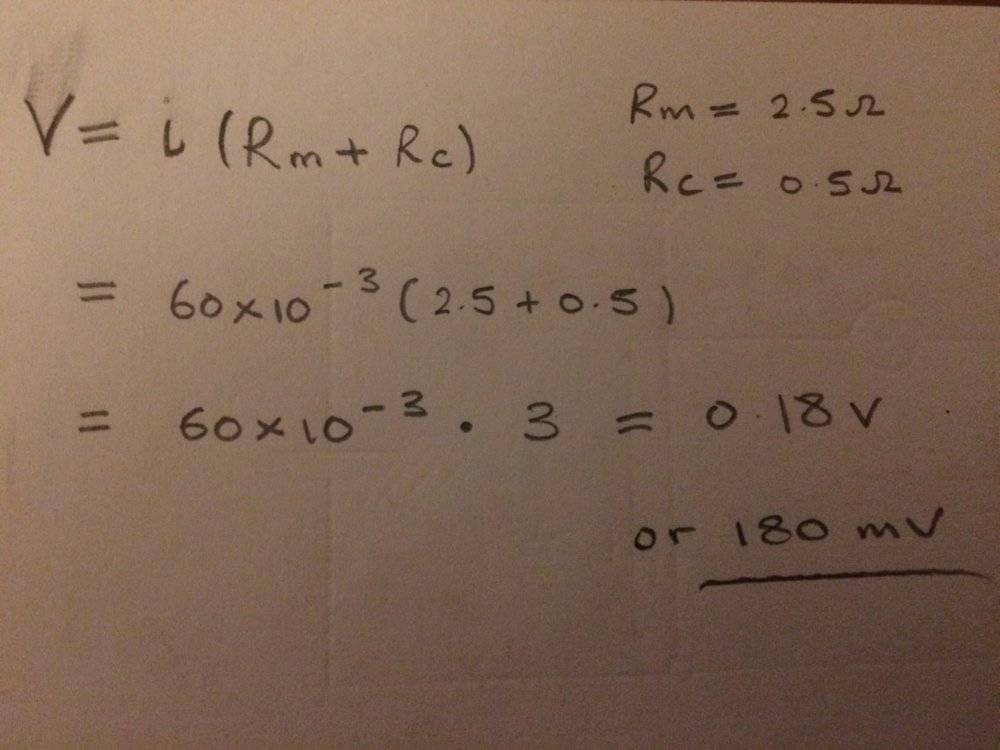
Here are a couple of questions that I have been trying to answer and had a go at it.
Not sure if I answered some incorrectly so was hoping to get some guidance
Screenshot 2020-02-08 at 21.58.52.png

thumbnail_IMG_3814.jpg


Screenshot 2020-02-08 at 21.59.02.png

thumbnail_IMG_3815.jpg


Screenshot 2020-02-08 at 21.59.11.png

thumbnail_IMG_3819.jpg


Screenshot 2020-02-08 at 21.59.21.png


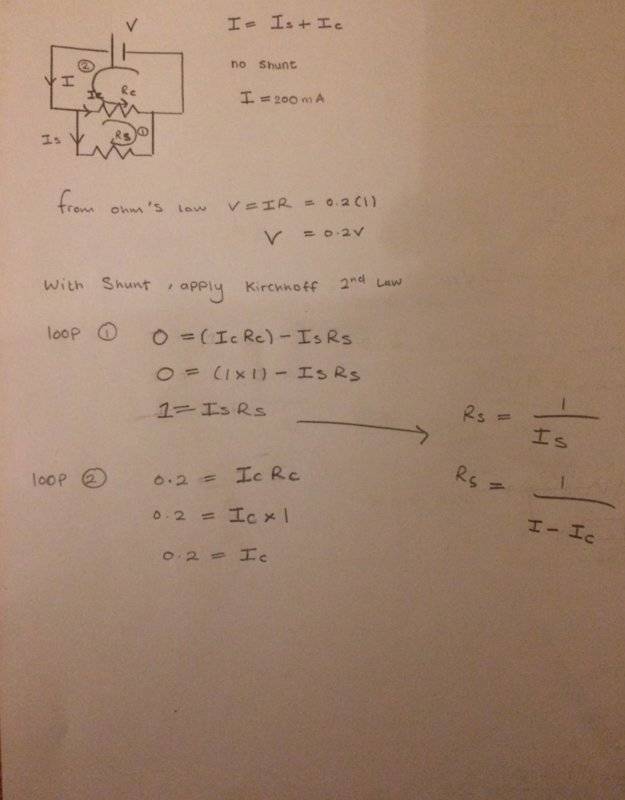
For this one I have tried to make use of Kirchhoff's 2nd law to help me, but this is what I have ended up with when using it
thumbnail_IMG_3822.jpg


Thanks!
 
Physics news on Phys.org
Your work on the first three looks fine.
In the last one, isn't Ic the current through the ammeter? That is not 1A.
Seems to me that the set up is the same as in the third problem, so you can use the same method.
 
Moderator's note: Please post only a single problem per thread. This post should have been broken up into four separate threads.
 
Last edited:
  • Like
Likes   Reactions: jim mcnamara
haruspex said:
Your work on the first three looks fine.
In the last one, isn't Ic the current through the ammeter? That is not 1A.
Seems to me that the set up is the same as in the third problem, so you can use the same method.

Thanks I have realized that voltage across the shunt and coil would be the same as they are connected in parallel. And that current would also split too at the junction.

I did this and get a resistance of 0.25 ohms for the shunt

thumbnail_IMG_3823.jpg
 
gneill said:
Moderator's note: Please post only a single problem per thread. This post should have been broken up into four separate threads.

My apologies, I'll try not to do this again next time
 
Bolter said:
Thanks I have realized that voltage across the shunt and coil would be the same as they are connected in parallel. And that current would also split too at the junction.

I did this and get a resistance of 0.25 ohms for the shunt

View attachment 256866
Yes, but you can get there more quickly. You know that 1A-200mA=800mA is going through the shunt. That's 4 times the current for the same voltage, so a quarter of the resistance.
 
  • Like
Likes   Reactions: Bolter
haruspex said:
Yes, but you can get there more quickly. You know that 1A-200mA=800mA is going through the shunt. That's 4 times the current for the same voltage, so a quarter of the resistance.

Yes this is much more efficient way of doing now that I can see :)
 
  • Like
Likes   Reactions: berkeman

Similar threads

  • · Replies 2 ·
Replies
2
Views
825
Replies
2
Views
2K
Replies
7
Views
2K
Replies
22
Views
4K
  • · Replies 3 ·
Replies
3
Views
2K
  • · Replies 4 ·
Replies
4
Views
1K
Replies
5
Views
5K
  • · Replies 9 ·
Replies
9
Views
2K
  • · Replies 3 ·
Replies
3
Views
3K
  • · Replies 3 ·
Replies
3
Views
1K