Van De Graaf Generator & Gauss's Law

  • Context: Graduate 
  • Thread starter Thread starter matangi7
  • Start date Start date
  • Tags Tags
    Electricty Generator
Join the discussion
Ask a follow-up here, or get your own question answered by working scientists, mathematicians and engineers — people, not an autocomplete.
Real named experts · corrections over time · the nuance an AI answer skips
2 replies · 3K views
matangi7
Messages
7
Reaction score
0
My Textbook states"The same principle behind Faraday’s ice pail experiment is used in a Van de Graaff electrostatic generator (Fig. 22.26). A charged belt continuously carries charge to the inside of a conducting shell. By Gauss’s law, there can never be any charge on the inner surface of this shell, so the charge is immediately carried away to the outside surface of the shell."
How is Gauss's law relevant to the Van De Graaf Generator? Doesn't the situation have to be electrostatic to apply Gauss's law? Doesn't a Van De Graaf Machine have a current flowing, not static charges? Attached is the diagram in my textbook.
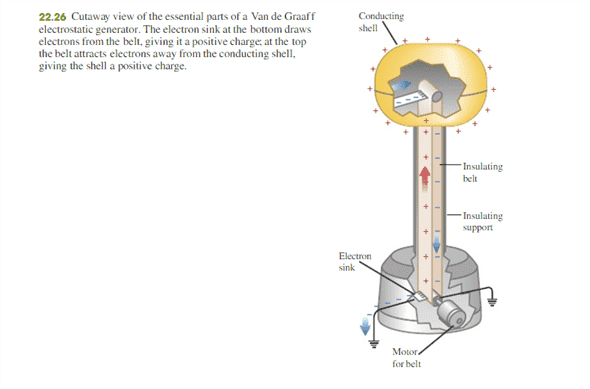
618670-22-10DQEI1.png
 

Attachments

  • 618670-22-10DQEI1.png
    618670-22-10DQEI1.png
    19.7 KB · Views: 2,923
Physics news on Phys.org
The machine that is shown will continue to carry charges to the dome until such time as the accumulated charge will create a potential difference with the surrounding air as to cause coronal discharges or full breakdown of the air with a discharge to ground.reducing the net charge on the sphere. When used as a charged particle accelerator the dome is connected to its base by a string of very high resistance resistors to bleed off charge along with the particle beam while the charge deposited on the belt is carefully regulated to maintain the desired potential on the dome.
 
The Van de Graff generator is actually a demonstration of Gauss law. The fact that no charge is present inside the surface of the shell ( in this case, it is the inner surface of the shell) is one of the results of gauss law. Here's a link to the derivation of how no charge exists inside a shell: https://ucscphysicsdemo.wordpress.c...lectric-field-inside-and-outside-of-a-sphere/
And gauss law can be applied to moving charges too, but also then, in the case of the van de graff generator, the charges are only transferred via the charged belt and distributed on the outer surface of the shell and cannot really be called "moving charges". Also, there is no "current " flowing, its just static electricity.