Van der Pauw sample preparation errors

Click For Summary
SUMMARY

The forum discussion centers on troubleshooting electrical resistivity tests using the Van der Pauw method on a doped ceramic sample. Users identified that issues such as infinite resistivity readings stem from poor mechanical connections between the wires and the sample, often due to oxide build-up or dirt. Solutions include increasing contact pressure, using higher test voltages, and ensuring clean connections. Additionally, coating contact areas with conductive pastes like silver, gold, or platinum can enhance reliability.

PREREQUISITES
  • Understanding of the Van der Pauw method for resistivity measurements
  • Familiarity with electrical resistivity testing techniques
  • Knowledge of sample preparation for electrical measurements
  • Experience with mechanical connections in experimental setups
NEXT STEPS
  • Research methods for improving mechanical connections in electrical testing
  • Learn about the properties and applications of conductive pastes such as silver and gold
  • Investigate the effects of oxide layers on electrical contacts
  • Explore the design and implementation of higher compliance voltage systems for testing
USEFUL FOR

Researchers, materials scientists, and engineers involved in electrical resistivity testing, particularly those utilizing the Van der Pauw method on ceramic materials.

Metallus
Hello,
I'm carrying out electrical resistivity tests with the Van der Pauw method on a round sample (2 mm thick disk) of a doped ceramic but sometimes I have issues in the mounting of the sample.

I'm using a 4-probe tube where each of the 4 wires contacts with the "corners" of the sample. To keep everything together, the sample is mounted on a sample holder made of insulation material that keeps the wire in contact with it. Here's a pic of the set-up, profile view and top view
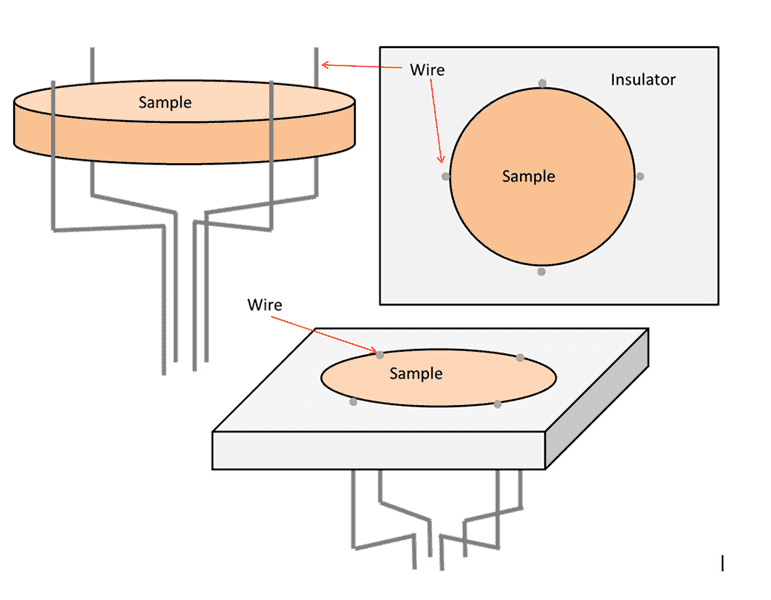
Gg6z5eX.png


Sometimes when I attempt to pass current in any of the 8 configurations (reciprocal measurements and polarity inversion measurements), I get infinite resistivity. Is it due to the wires not being perfectly in contact with the sample? Why does it work in some configuration but give infinite resistivity in the other? And why sometimes the signal remains 0? Does it mean that it's short circuiting somewhere (as if the wires were touching)?

What am I doing wrong exactly? I made it work before, so I guess I'm just screwing up in the preparation of the sample somewhere, but I don't know where exactly, nor I know what could be the source of error. Let me know if you need additional details, as I am new to this technique.

Thanks
 
Engineering news on Phys.org
Sure sounds like a poor mechanical connection between the wires and the sample. Perhaps an oxide build-up breaking electrical contact or a piece of dirt in the contact area. The next time it happens, try moving one wire at a time to localize the problem. Increased contact pressure between the wires and sample is likely to help. A higher test voltage may break through a thin oxide layer. If you are using a constant current excitation, redesign or replace it with a higher compliance voltage (open circuit voltage). Make sure both the sample and the electrical connectors to it are freshly cleaned.

Please let us know what you find / how you solve the problem.
 
  • Like
Likes Metallus
Tom.G said:
Sure sounds like a poor mechanical connection between the wires and the sample. Perhaps an oxide build-up breaking electrical contact or a piece of dirt in the contact area. The next time it happens, try moving one wire at a time to localize the problem. Increased contact pressure between the wires and sample is likely to help. A higher test voltage may break through a thin oxide layer. If you are using a constant current excitation, redesign or replace it with a higher compliance voltage (open circuit voltage). Make sure both the sample and the electrical connectors to it are freshly cleaned.

Please let us know what you find / how you solve the problem.
Yes, it was indeed a fault in the contact between the wire and the sample. One of the wire was loose (sliding easily in the hole of the sample holder and not properly contacting with the sample). I solved this issue by slightly bending the end of the wires inwards, so as to guarantee at least a contact on the edge
IgGtiVd.png

Thanks for your input
 
  • Like
Likes Tom.G
Pure mechanical contacts between metallic wires and ceramic samples are often unreliable. I generally coat the areas of the sample which finally make the contacts with the wires with thin stripes of either conducting silver, gold or platinum paste, depending on the temperature and atmosphere used during the measurements.
 
Most likely this can only be answered by an "old timer". I am making measurements on an uA709 op amp (metal can). I would like to calculate the frequency rolloff curves (I can measure them). I assume the compensation is via the miller effect. To do the calculations I would need to know the gain of the transistors and the effective resistance seen at the compensation terminals, not including the values I put there. Anyone know those values?

Similar threads

Replies
8
Views
2K
  • · Replies 2 ·
Replies
2
Views
2K
  • · Replies 16 ·
Replies
16
Views
5K
  • · Replies 9 ·
Replies
9
Views
4K
Replies
8
Views
3K
  • · Replies 4 ·
Replies
4
Views
2K
  • · Replies 7 ·
Replies
7
Views
2K
  • Sticky
  • · Replies 701 ·
24
Replies
701
Views
117K
  • · Replies 21 ·
Replies
21
Views
4K
  • · Replies 41 ·
2
Replies
41
Views
7K