Vector analysis question. Laplacian of scalar and vector field

Click For Summary
SUMMARY

The discussion centers on the application of the Laplacian operator in curvilinear coordinates, specifically regarding scalar fields and vector fields. It emphasizes the importance of using the covariant derivative to ensure that the transformation properties of vector fields are maintained. The vector identity provided by Arfken, which relates to the vector Laplacian, is highlighted as a crucial tool. The conversation concludes that while the Laplacian can be applied to vector fields, it must account for the non-constant nature of basis vectors in curvilinear coordinates.

PREREQUISITES
  • Understanding of Laplacian operator in curvilinear coordinates
  • Familiarity with covariant derivatives and their properties
  • Knowledge of vector identities, particularly in the context of vector calculus
  • Basic principles of tensor analysis and transformation properties
NEXT STEPS
  • Study the covariant derivative and its applications in differential geometry
  • Learn about the vector Laplacian and its derivation from vector identities
  • Explore the implications of basis vector changes in curvilinear coordinates
  • Review Arfken's work on vector calculus for deeper insights into Laplacians
USEFUL FOR

Mathematicians, physicists, and engineers working with vector calculus, particularly those dealing with curvilinear coordinates and tensor analysis.

LagrangeEuler
Messages
711
Reaction score
22
If we define Laplacian of scalar field in some curvilinear coordinates ## \Delta U## could we then just say what ##\Delta## is in that orthogonal coordinates and then act with the same operator on the vector field ## \Delta \vec{A}##?
 
Physics news on Phys.org
LagrangeEuler said:
If we define Laplacian of scalar field in some curvilinear coordinates ## \Delta U## could we then just say what ##\Delta## is in that orthogonal coordinates and then act with the same operator on the vector field ## \Delta \vec{A}##?

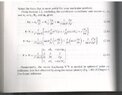
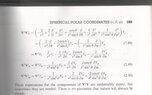
See Arfken on this. For example, in spherical polar coordinates here is the Laplacian acting on a scalar field (first scan) and components, with respect to spherical polar coordinate unit vectors, of the Laplacian acting on a vector field (second scan). Arfken says on the vector Laplacian that "It is best obtained by using the vector identity (Eq. 1.80)". This vector identity is

##
\nabla \times (\nabla \times \vec{V}) = \nabla \nabla \cdot \vec{V} - \nabla \cdot \nabla \vec{V} .
##
 

Attachments

  • laplacescalar.jpg
    laplacescalar.jpg
    49.9 KB · Views: 168
  • laplacevector.jpg
    laplacevector.jpg
    41.2 KB · Views: 168
  • Like
Likes   Reactions: anuttarasammyak
It is expressed in tensor analysis
g^{jk}\frac{\partial}{\partial x^j}\frac{\partial}{\partial x^k} A^i or
g^{jk}A^i_{,j,k}
 
LagrangeEuler said:
If we define Laplacian of scalar field in some curvilinear coordinates ## \Delta U## could we then just say what ##\Delta## is in that orthogonal coordinates and then act with the same operator on the vector field ## \Delta \vec{A}##?
Yes and no. It depends on what you mean by ”act with the same operator on the vector field”. If you mean actually acting on the vector field including taking the fact that the basis vectors are not constant then fine. If you mean applying the operator to the individual components, then no.

The best way is however to work with the covariant derivative, which will always work.
anuttarasammyak said:
It is expressed in tensor analysis
g^{jk}\frac{\partial}{\partial x^j}\frac{\partial}{\partial x^k} A^i or
g^{jk}A^i_{,j,k}
No. This expression is not generally covariant. The result is a vector field and as such its components must show the correct transformation properties. This expression does not.
 
julian said:
See Arfken on this. For example, in spherical polar coordinates here is the Laplacian acting on a scalar field (first scan) and components, with respect to spherical polar coordinate unit vectors, of the Laplacian acting on a vector field (second scan). Arfken says on the vector Laplacian that "It is best obtained by using the vector identity (Eq. 1.80)". This vector identity is

##
\nabla \times (\nabla \times \vec{V}) = \nabla \nabla \cdot \vec{V} - \nabla \cdot \nabla \vec{V} .
##
I must also disagree with Arfken here. That involves taking the curl twice, gradient once, and divergence once, which is a mouthful. Better would be to learn about the covariant derivative or use knowledge about how basis vectors in curvilinear coordinates are affected by derivatives.
 
Orodruin said:
No. This expression is not generally covariant.
Do you mean derivatives should be covariant derivatives, i.e.
g^{jk}A^i_{:j:k}
to include the general cases that ##\Gamma##s are not zero ? I was not sure whether OP deals with such general cases.
 
Last edited:
anuttarasammyak said:
Do you mean derivatives should be covariant derivatives, i.e.
g^{jk}A^i_{:j:k}
to include the general cases that ##\Gamma##s are not zero ? I was not sure whether OP deals with such general cases.
OP has stated that the question is about general curvilinear coordinates. In such coordinates the basis vectors change and therefore the connection coefficients are non-zero.
 
  • Like
Likes   Reactions: anuttarasammyak

Similar threads

  • · Replies 12 ·
Replies
12
Views
3K
  • · Replies 5 ·
Replies
5
Views
2K
  • · Replies 2 ·
Replies
2
Views
2K
  • · Replies 20 ·
Replies
20
Views
4K
  • · Replies 16 ·
Replies
16
Views
4K
  • · Replies 1 ·
Replies
1
Views
2K
  • · Replies 2 ·
Replies
2
Views
1K
  • · Replies 1 ·
Replies
1
Views
2K
  • · Replies 2 ·
Replies
2
Views
3K