Vector Calculus, setting up surface area integral.

Click For Summary
The discussion focuses on calculating the surface area of a portion of a cone defined by the equation z^2 = x^2 + y^2, constrained within a cylinder described by y^2 + z^2 ≤ 49. Participants suggest using polar coordinates to simplify the integration process, particularly after identifying the intersection of the cone and cylinder as an ellipse in the xy-plane. The area of the ellipse is calculated using the formula for the area of an ellipse, leading to the final surface area result of 49π. The conversation highlights the effectiveness of switching to polar coordinates for this type of problem. Overall, the participants confirm the solution approach and express satisfaction with the findings.
jonathanm111
Messages
7
Reaction score
1
The question goes like: find the SA of the portion S of the cone z^2 =x^2 +y^2 where z>=0 contained within the cylinder y^2+z^2<=49
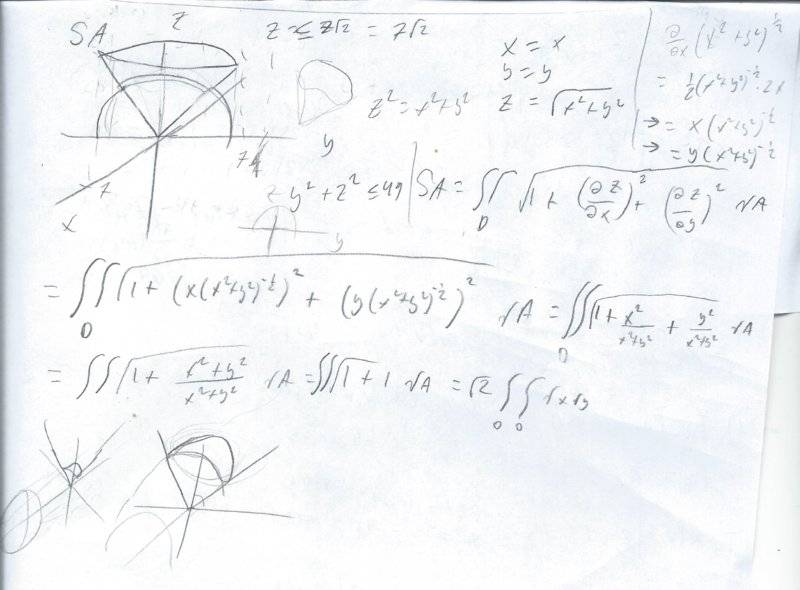
attempt.jpg

this is my attempt using the formula for SA, I could switch to parametric eqns, but even then I'd have hard time setting up limits of integration.
 

Attachments

  • attempt.jpg
    attempt.jpg
    44.8 KB · Views: 1,737
Physics news on Phys.org
I haven't worked it all out, but here's what I would try. The two surfaces intersect where their ##z## values are equal. So substituting ##z^2## on the cone for ##z^2## on the cylinder gives ##x^2+2y^2 = 49##, or$$
\frac{x^2}{49} + \frac{y^2}{\frac{49}{2}} = 1$$This tells you if you look straight down on the surfaces, their intersection curve looks like an ellipse and, in fact, the ##xy## domain is the interior of that ellipse. So you can set it all up in the ##x## and ##y## variables and integrate over the interior of that ellipse. If you are lucky it will come out real simple, otherwise, if you have to work the integral out, you might want to change coordinates to polar like coordinates ##x = 7\cos\theta,~ y = \frac 7 {\sqrt 2} \sin\theta##. Here's a sketch:
graphs.jpg
 

Attachments

  • graphs.jpg
    graphs.jpg
    12.6 KB · Views: 689
  • Like
Likes jonathanm111
I got it
solution.jpg


you were right, polar coordinates were the way to go. this was a strange problem, professor said it wouldn't be on any tests anyways.
Thank you.
 

Attachments

  • solution.jpg
    solution.jpg
    49.6 KB · Views: 657
Yes, it looks like you have it. But from your previous work you have ##dS=\sqrt 2~dydx## so your integral is##\iint_{ellipse}~\sqrt 2~dydx = \sqrt 2 \text{Area}## If you know the area of an ellipse with semi-axes ##a## and ##b## is ##\pi a b## you have from the equation of the ellipse ##\sqrt 2 \cdot 7 \cdot \frac 7 {\sqrt 2}=49\pi##, saving a bit of work.
 
Last edited:
  • Like
Likes jonathanm111
LCKurtz said:
Yes, it looks like you have it. But from your previous work you have ##dS=\sqrt 2~dydx## so your integral is##\iint_{ellipse}~\sqrt 2~dydx = \sqrt 2 \text{Area}## If you know the area of an ellipse with semi=axes ##a## and ##b## is ##\pi a b## you have from the equation of the ellipse ##\sqrt 2 \cdot 7 \cdot \frac 7 {\sqrt 2}=49\pi##, saving a bit of work.
I believe that's how they wanted us to solve it haha. nice find
 
Question: A clock's minute hand has length 4 and its hour hand has length 3. What is the distance between the tips at the moment when it is increasing most rapidly?(Putnam Exam Question) Answer: Making assumption that both the hands moves at constant angular velocities, the answer is ## \sqrt{7} .## But don't you think this assumption is somewhat doubtful and wrong?

Similar threads

Replies
2
Views
2K
  • · Replies 7 ·
Replies
7
Views
2K
Replies
1
Views
1K
  • · Replies 1 ·
Replies
1
Views
2K
Replies
11
Views
3K
  • · Replies 7 ·
Replies
7
Views
2K
  • · Replies 3 ·
Replies
3
Views
1K
  • · Replies 4 ·
Replies
4
Views
2K
  • · Replies 3 ·
Replies
3
Views
2K
Replies
4
Views
2K