Vector Field associated with Stereographic Projection

Click For Summary
SUMMARY

The discussion focuses on the calculation of the vector field associated with the stereographic projection, specifically using the Jacobian matrix $$J_{(\Phi_{SN})}$$. The participant identified the relationship between the partial derivatives and expressed concern over the accuracy of their calculations, particularly regarding the expected contour-like behavior of the vector field. Despite attempts to plot the results, the output was deemed nonsensical, prompting questions about the correctness of their methodology.

PREREQUISITES
  • Understanding of stereographic projection and its mathematical implications.
  • Familiarity with Jacobian matrices and their applications in vector calculus.
  • Knowledge of partial derivatives and their notation.
  • Experience with plotting vector fields in a mathematical software environment.
NEXT STEPS
  • Study the properties of Jacobian matrices in relation to transformations in vector calculus.
  • Learn about the geometric interpretation of stereographic projection and its applications.
  • Explore techniques for visualizing vector fields using software like MATLAB or Python's Matplotlib.
  • Investigate common pitfalls in calculating vector fields and how to troubleshoot them effectively.
USEFUL FOR

Mathematicians, physicists, and students studying vector calculus or differential geometry, particularly those interested in stereographic projections and vector field analysis.

RFeynman
Messages
7
Reaction score
0
Homework Statement
Calculate the field $$(\Phi_{SN})_{*} \frac{\partial}{\partial u}$$
Relevant Equations
$$(s,t) = (\Phi_{SN})(u,v) = \frac{1}{u^2 + v^2}(u,v)$$

$$\frac{\partial}{\partial u} = \frac{\partial s}{\partial u}\frac{\partial}{\partial s} + \frac{\partial t}{\partial u} \frac{\partial}{\partial t} $$
I identified $$(\Phi_{SN})_{*})$$ as $$J_{(\Phi_{SN})}$$ where J is the Jacobian matrix in order to $$(\Phi_{SN})$$, also noticing that $$\frac{\partial}{\partial u} = \frac{\partial s}{\partial u}\frac{\partial}{\partial s} + \frac{\partial t}{\partial u} \frac{\partial}{\partial t} $$, I wrote the first equation as:

(Its also worth pointing out that $$\frac{\partial}{\partial u} = [1,0]^T$$)

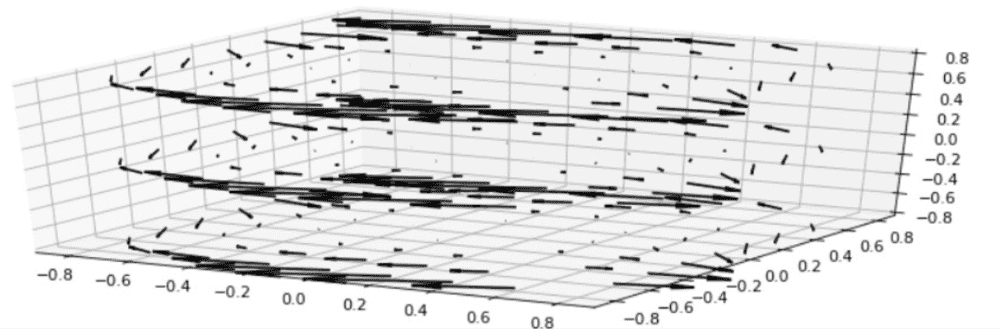
$$(\Phi_{SN})_{*} \frac{\partial}{\partial u} = J_{(\Phi_{SN})} [1,0]^T$$ and after some calculations I got some gibberish, I plotted it and got this:
1617548503270.png

I think this is incorrect, in my idea the vector field should be like the contour of a circumference. Am I doing some wrong when calculating the vector field or my procedure is correct?

Thank you very much for helping!
 
Physics news on Phys.org
Hey @Delta2 (as you're very skilled with vectors)I think you'd be able to answer this one; I cannot.
 
  • Like
Likes   Reactions: Delta2
I am afraid I can't help with this either.
 
  • Like
Likes   Reactions: benorin

Similar threads

  • · Replies 7 ·
Replies
7
Views
2K
Replies
10
Views
3K
Replies
33
Views
4K
  • · Replies 3 ·
Replies
3
Views
2K
  • · Replies 2 ·
Replies
2
Views
2K
Replies
12
Views
2K
  • · Replies 3 ·
Replies
3
Views
2K
  • · Replies 5 ·
Replies
5
Views
3K
  • · Replies 2 ·
Replies
2
Views
2K
  • · Replies 9 ·
Replies
9
Views
1K