Undergrad Vector Laplacian: Scalar or Vector?

  • Thread starter Thread starter olgerm
  • Start date Start date
  • Tags Tags
    Laplacian Vector
Click For Summary
The discussion centers on the nature of the Vector Laplacian, with conflicting interpretations from two Wikipedia pages regarding whether it is a scalar or vector. The d'Alembertian operator can be applied to both scalars and vectors, producing different results depending on the context. Clarification is sought on the expression for the Laplacian of a vector field, specifically in Cartesian coordinates. It is confirmed that in this context, the Laplacian of a vector field results in a vector, with the components defined as the second derivatives of the vector components. The conversation concludes with an agreement on the correct formulation of the Vector Laplacian in Cartesian coordinates.
olgerm
Gold Member
Messages
532
Reaction score
35
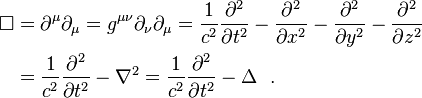
according to this page https://en.wikipedia.org/wiki/Vector_Laplacian value of Vector_Laplacian is vector, but according to this page https://en.wikipedia.org/wiki/D'Alembertian value of Vector_Laplacian is scalar
8a806b56e1a8af77aca1897fcd8ebf9c.png

Is on of these pages wrong or I misunderstand it?

I am asking because I want to know what does Δ2 equal to in this

1ad8dd4174eba9373c9235546a3264b8.png
and this
5020dc7c1608d709fcad4d7db1f19b50.png
equation on this https://en.wikipedia.org/wiki/Mathematical_descriptions_of_the_electromagnetic_field#Coulomb_gauge page.
 
Physics news on Phys.org
The d'Alembertian is a differential operator. You can apply it to a scalar and get a scalar, or you can apply it to a vector and get a vector.
 
So since magnetic potential A in this equation
1ad8dd4174eba9373c9235546a3264b8.png
is vector ##\nabla^2=(\sum_{i=1}^3(\frac{\partial^2 A}{\partial x_i*\partial x_1});\sum_{i=1}^3(\frac{\partial^2 A}{\partial x_i*\partial x_2});\sum_{i=1}^3(\frac{\partial^2 A}{\partial x_i*\partial x_3}))## not ##\nabla^2=\sum_{i=1}^3(\frac{\partial^2 A}{\partial x_i^2})##?
These are Cartesian coordinates.
 
It is unclear what you intend to write with these expressions. In particular, it is unclear what you intend for ##A## to be (the vector, the vector components, etc). I strongly suggest that you do not write vectors on component form (x;y;z), but instead use basis vectors. This will make it much clearer what is intended.

The Laplace operator applied to a vector in Cartesian coordinates is such that the ##x## component of ##\nabla^2 \vec A## is equal to ##\nabla^2 A_x##, where ##A_x## is the ##x## component of ##\vec A##.
 
  • Like
Likes olgerm
olgerm said:
A is vector-field. I am trying to find out what does ##\nabla^2 A##, on this Wikipedia page
https://en.wikipedia.org/wiki/Mathematical_descriptions_of_the_electromagnetic_field#Gauge_freedom , equal to.
Is it that ##(\nabla^2 A)_i=\frac{\partial^2 A_i}{\partial x_i^2}## or ##(\nabla^2 A)_j=\sum_{i=1}^3(\frac{\partial^2 A_i}{\partial x_i \cdot \partial x_j})## or ##\nabla^2 A=\sum_{i=1}^3(\frac{\partial^2 A_i}{\partial x_i^2})##?
Where ##A_i## is the ##i## component of ##\vec A##.
Neither, see my previous post.

Your first option is just one term in the sum, your second is grad(div(A)) and not the Laplacian of A, your third is a scalar.
 
Orodruin said:
Yes. Although this is only valid in Cartesian coordinates.
Ok, thanks.
 

Similar threads

  • · Replies 6 ·
Replies
6
Views
3K
  • · Replies 2 ·
Replies
2
Views
4K
  • · Replies 1 ·
Replies
1
Views
2K
  • · Replies 5 ·
Replies
5
Views
13K
  • · Replies 4 ·
Replies
4
Views
2K
  • · Replies 24 ·
Replies
24
Views
2K
  • · Replies 2 ·
Replies
2
Views
2K
Replies
92
Views
8K
  • · Replies 5 ·
Replies
5
Views
2K
  • · Replies 3 ·
Replies
3
Views
6K
