Vector potential of a plate with a uniform, time-harmonic current density

Click For Summary
SUMMARY

The discussion centers on deriving the vector potential A2 for a plate with a uniform, time-harmonic current density, following the successful calculation of A1. Participants emphasize the importance of applying the same approximations used for A1 to derive A2. Additionally, they highlight the practical utility of these approximations in engineering, particularly in the analysis of antenna systems.

PREREQUISITES
  • Understanding of vector potential in electromagnetism
  • Familiarity with time-harmonic current density concepts
  • Knowledge of approximation techniques in physics
  • Basic principles of antenna theory
NEXT STEPS
  • Study the derivation of vector potentials in electromagnetism
  • Research approximation methods used in electromagnetic analysis
  • Explore practical applications of vector potentials in antenna design
  • Learn about the conditions for valid approximations in electromagnetic fields
USEFUL FOR

Students and professionals in electrical engineering, particularly those focused on electromagnetism and antenna design, will benefit from this discussion.

Veronika
Messages
1
Reaction score
0
Hi all,

i tried to do this question but got stuck on the last point . Can anyone help me please?
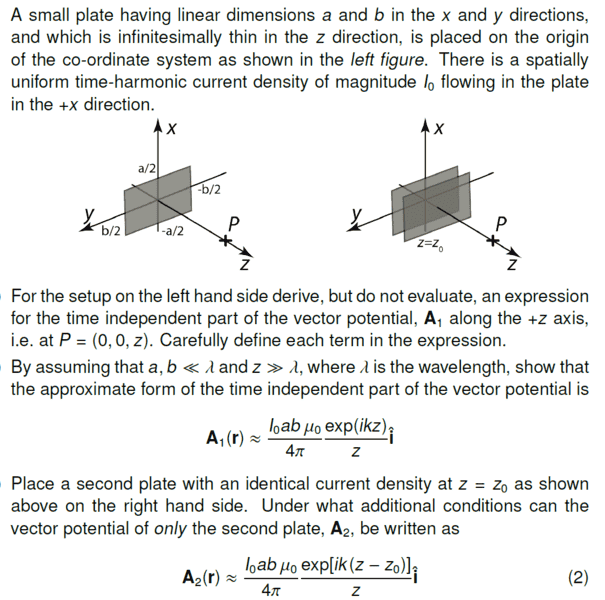
upload_2018-4-9_12-44-13.png

The general form of vector potential:
upload_2018-4-9_12-42-29.png


I got the answer for A1 vector potential but don't know what assumptions i need to get the expression for the A2. Does anyone know how one can derive it?

Thank you , Veronika
 

Attachments

  • upload_2018-4-9_12-42-29.png
    upload_2018-4-9_12-42-29.png
    5.3 KB · Views: 944
  • upload_2018-4-9_12-43-17.png
    upload_2018-4-9_12-43-17.png
    40 KB · Views: 695
  • upload_2018-4-9_12-44-13.png
    upload_2018-4-9_12-44-13.png
    47 KB · Views: 1,648
Physics news on Phys.org
I believe what they are asking you to do is first find an expression for A2 using the same approximations as you used for A1, then determine under what conditions your expression is well approximated by their expression.

By the way, these kinds of approximations are incredibly useful and engineers use them all of the time when analyzing practical antenna systems.
 

Similar threads

  • · Replies 5 ·
Replies
5
Views
2K
  • · Replies 6 ·
Replies
6
Views
2K
Replies
11
Views
3K
  • · Replies 5 ·
Replies
5
Views
3K
  • · Replies 1 ·
Replies
1
Views
3K
Replies
1
Views
2K
  • · Replies 6 ·
Replies
6
Views
4K
  • · Replies 13 ·
Replies
13
Views
3K
  • · Replies 3 ·
Replies
3
Views
3K
  • · Replies 7 ·
Replies
7
Views
2K