Vectors Directions: Where is this Resultant Vector Pointing?

Click For Summary
SUMMARY

The discussion focuses on determining the angle of a resultant vector when adding two force vectors, specifically using the law of cosines and the law of sines. The calculations provided yield a resultant vector magnitude of 47 lbs, with angles of 28 degrees and 12 degrees relative to the x-axis, depending on which vector is chosen as the reference. The participants emphasize the importance of precision in calculations and the correct application of vector addition methods, including the component method for clarity.

PREREQUISITES
  • Understanding of vector addition and resultant vectors
  • Familiarity with trigonometric functions, specifically sine and cosine
  • Knowledge of the law of cosines and law of sines
  • Ability to perform calculations involving angles and magnitudes of vectors
NEXT STEPS
  • Study the component method of vector addition in detail
  • Learn about the law of cosines and its applications in physics
  • Explore the concept of angle of elevation and its relevance in vector problems
  • Investigate the impact of rounding errors in vector calculations and how to minimize them
USEFUL FOR

Physics students, engineers, and anyone involved in mechanics or vector analysis will benefit from this discussion, particularly those looking to enhance their understanding of vector addition and resultant calculations.

Remle
Messages
12
Reaction score
8
Homework Statement
Two forces with magnitude of 15 pounds and 35 pounds and an angle of between them are applied to an object. Find magnitude of the resultant vector.
Relevant Equations
Law of cosine and law sine
Ok. My problem is what angle to choose when adding vector. Statement does not tell me which one is the "first" force vector. So, when using the law of sine formula I get two results.

First, using cosine to get the magnitude:
$$\vec c = \sqrt{a^2 + b^2 +2ab\cos\theta},$$
$$\vec c = \sqrt{15^2 + 35^2 +2(15(35) \cdot \cos(40)},$$
$$\vec c = 47~\text{lbs}$$

NOW; how and what angle do I choose for the resultant? (I know the problem is not asking for it but I want to practice). Picture of it attached.
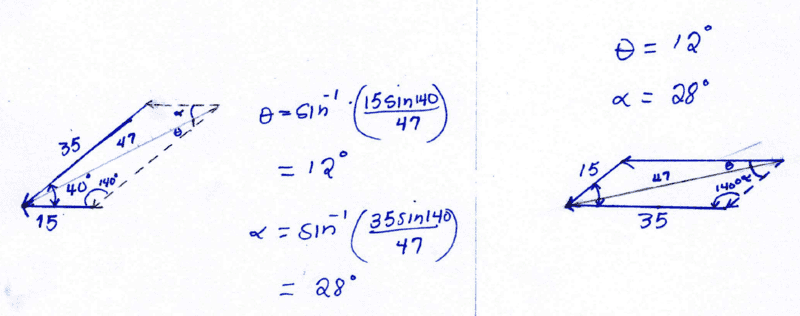
Screenshot 2024-03-01 084549.png
 
Last edited by a moderator:
Physics news on Phys.org
An angle depends on a reference direction. Like 15 degrees above the horizontal. You need to choose a suitable reference in your case.
 
  • Like
Likes   Reactions: Remle
PeroK said:
An angle depends on a reference direction. Like 15 degrees above the horizontal. You need to choose a suitable reference in your case.
So, for this problem is difficult to say? Does it need to specify which force is the first one? I, most of the time, choose the ##x\text{-axis}## as a reference but that too gave me 12 degrees and 28 degrees.
 
Remle said:
So, for this problem is difficult to say? Does it need to specify which force is the first one? I, most of the time, choose the ##x\text{-axis}## as a reference but that too gave me 12 degrees and 28 degrees.
It can't be both. The order you add vectors doesn't matter.
 
The question only asks for the magnitude of the resultant vector. What angle are you calculating?
 
PeroK said:
The question only asks for the magnitude of the resultant vector. What angle are you calculating?
I know is asking only for the magnitude of the vector. I believe the question is, which vector connects head-to-tail to whom to get the angle from the ##x\text{-axis}##?
 
The angle between two vectors is always the smaller angle that you get when you draw the arrows representing them with their tails together (see diagram drawn to scale.) It is less than or equal to 180°.

Tw_vectors.png
 
  • Like
Likes   Reactions: Remle
kuruman said:
The angle between two vectors is always the smaller angle that you get when you draw the arrows representing them with their tails together (see diagram drawn to scale.) It is less than or equal to 180°.

View attachment 341067
Using your diagram and ##x\text{-axis}## for the reference angle I get 28 degrees. Am I right?
 
Last edited:
Remle said:
Using your diagram and ##x\text{-axis}## for the reference angle I get 28 degrees. Am I right?
If you have two vectors, then you can calculate the resultant angle relative to either. I suspect that's what you've done in this case.
 
  • #10
For example, if you put the longer vector along the x-axis, then the resulting angle satisfies:
$$\tan \theta =\frac{15\sin(40)}{35+15\cos(40)}$$And, if you put the shorter vector along the x-axis, then you can swap the 15 and 35 in that calculation.
 
  • #11
Remle said:
Using your diagram and ##x\text{-axis}## for the reference angle I get 28 degrees. Am I right?
You don't show your work, so I cannot tell if you are right. I prefer to add the vectors by the component method.
##\mathbf{A}=(15,0)##
##\mathbf{B}=[35\cos(40^{\circ}),35\sin(40^{\circ})]##
##\mathbf{A}+\mathbf{B}=[15+35\cos(40^{\circ}),0+35\sin(40^{\circ})].##
Then the magnitude of the resultant is
##\vert \mathbf{A}+\mathbf{B}\vert =\sqrt{\left[15+35\cos(40^{\circ})\right]^2+\left[35\sin(40^{\circ})\right]^2}##
and the tangent of the angle between the resultant and the x-axis is the ratio of the resultant's y-component to the x-component
##\tan\theta=\dfrac{35\sin(40^{\circ})}{15+35\cos(40^{\circ})}## which is, of course, what @PeroK said you would get "if you put the shorter vector along the x-axis."

(Edited to insert missing parentheses.)
 
Last edited:
  • Like
Likes   Reactions: PeroK
  • #12
@kuruman @PeroK
Yeah, sorry for not showing work. Here it is:
If ##\text{vector-15}## is along the ##x\text{-axis}##, then:
$$\theta = \sin^{-1} {(\frac {15 \sin{140}} {47})}$$
$$\theta = \text{28°}$$

If ##\text{vector-35}## is along the ##x\text{-axis}##, then:
$$\theta = \sin^{-1} {(\frac {35 \sin{140}} {47})}$$
$$\theta = \text{12°}$$
 
  • Like
Likes   Reactions: kuruman and PeroK
  • #13
And 28 + 12 = 40, which is the angle between the original vectors. So, the resultant vector is 12 degrees from the longer vector and 28 degrees from the shorter vector.

Note that ##\frac{28}{12} = \frac{35}{15}##.
 
  • #14
PeroK said:
Note that ##\frac{28}{12} = \frac{35}{15}##.
Just in case the OP mistakenly thinks the above is a general rule, it’s worth adding this.

If we limit rounding errors in intermediate steps (e.g. use the more precise value that resultant = 47.48 lbf, not 47 lbf) then the 2 angles turn out to be about 28.3º and 11.7º.

##\frac{28.3}{11.7} \ne \frac{35}{15}##.

(Rounding the angles to 28º and 12º when giving ‘final answers’ is OK of course.)

However, the inequality is an approximate equality here. That's a result of the small angle approximation '##\sin \theta \approx \theta##' being valid within 10% even for angles up 0.75rad (43º).

A general message to the OP is to work to sufficient precision in intermediate steps. E.g. stating that the resultant is 47 lbf is OK; but in actual calculations 47.48 lbf should be used.

Edit - minor rewording.
 
  • Like
Likes   Reactions: PeroK
  • #15
Yes, it was something of a coincidence! In general, it's the ratio of sines that equals the ratio of the sides. In this case:
$$\frac{\alpha}{\beta} \approx \frac{\sin \alpha}{\sin \beta} = \frac A B $$
 
Last edited:
  • Like
Likes   Reactions: Steve4Physics

Similar threads

Replies
1
Views
1K
  • · Replies 18 ·
Replies
18
Views
1K
Replies
12
Views
3K
  • · Replies 2 ·
Replies
2
Views
8K
  • · Replies 9 ·
Replies
9
Views
2K
  • · Replies 11 ·
Replies
11
Views
2K
Replies
25
Views
2K
  • · Replies 4 ·
Replies
4
Views
1K
Replies
5
Views
811
Replies
3
Views
1K