Vectors Q: Solving OR & OP | Homework Forum

  • Thread starter Thread starter Eysz
  • Start date Start date
  • Tags Tags
    Vectors
Click For Summary

Homework Help Overview

The discussion revolves around a problem involving vector relationships, specifically focusing on the vectors OR, OP, and PR. Participants are exploring how to express OR in terms of other vectors and a scalar parameter t.

Discussion Character

  • Exploratory, Assumption checking

Approaches and Questions Raised

  • Participants discuss the relationship between the vectors OR and b, with one suggesting substitution of a specific value for t to simplify the expression. Others question the reasoning behind needing the answer in terms of b and explore the implications of vector directions.

Discussion Status

The conversation is active, with participants offering insights and clarifications about the relationships between the vectors. There is a recognition of the need for the final expression to align directionally with vector b, indicating a productive exploration of the problem.

Contextual Notes

There is a note that the thread was moved to the Homework forums, which may imply specific guidelines or constraints on how assistance is provided. The original poster has expressed uncertainty about progressing from their current understanding.

Eysz
Messages
3
Reaction score
0
NOTE: Thread was moved to Homework forums and thus has no homework template...
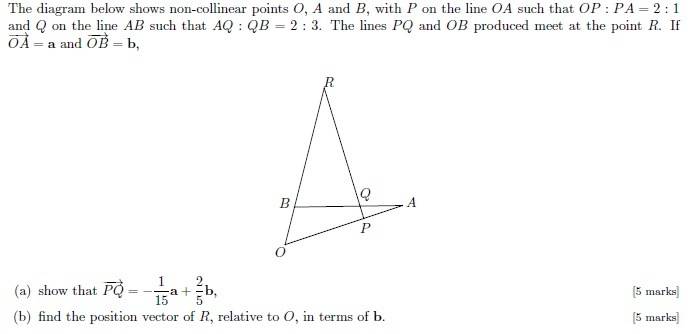
7MHpMAN.jpg


I managed to find (a) but i couldn't figure out (b).

I think OR = OP + PR = (2/3)a + t( (-1/15)a + (2/5)b) but i don't know how to go further please guide or help me with this please. Thanks
 
Physics news on Phys.org
There's a useful, directly observable, relationship between ##\vec{OR}## and b.
 
haruspex said:
There's a useful, directly observable, relationship between ##\vec{OR}## and b.

Then i should just substitute t=10 into the OR= (2/3)a + t( (-1/15)a + (2/5)b) since the answer must be in terms of b. That would make it 4b.

Is it correct?
 
Eysz said:
Then i should just substitute t=10 into the OR= (2/3)a + t( (-1/15)a + (2/5)b) since the answer must be in terms of b. That would make it 4b.

Is it correct?
Yes, but not because you are told the answer must be in terms of b. You know from the diagram that it must be in the direction of b. Unless a and b are in the same direction, how else will you get (2/3)a + t( (-1/15)a + (2/5)b) to be a scalar multiple of b?
 
  • Like
Likes   Reactions: Eysz
haruspex said:
Yes, but not because you are told the answer must be in terms of b. You know from the diagram that it must be in the direction of b. Unless a and b are in the same direction, how else will you get (2/3)a + t( (-1/15)a + (2/5)b) to be a scalar multiple of b?

I completely understand now! Thanks!
 

Similar threads

  • · Replies 13 ·
Replies
13
Views
2K
  • · Replies 6 ·
Replies
6
Views
2K
  • · Replies 14 ·
Replies
14
Views
3K
Replies
8
Views
2K
  • · Replies 10 ·
Replies
10
Views
2K
  • · Replies 4 ·
Replies
4
Views
3K
Replies
17
Views
3K
Replies
18
Views
2K
Replies
17
Views
4K
  • · Replies 14 ·
Replies
14
Views
4K