Velocity of a moving conducting bar in a magnetic field

Click For Summary
SUMMARY

The discussion focuses on the motion of a conducting bar in a magnetic field, specifically analyzing the conditions under which the bar experiences a force to the right. The force acting on the bar is given by the equation F = Il x B, where I is the current and B is the magnetic field strength. By applying the right-hand rule, it is determined that the current must flow "into the page" to achieve the desired force direction. The final velocity of the bar as it exits the rails is derived using kinematic equations, considering the initial velocity, acceleration, and displacement.

PREREQUISITES
  • Understanding of electromagnetic principles, specifically Lorentz force
  • Familiarity with kinematic equations in physics
  • Knowledge of vector cross products and the right-hand rule
  • Basic concepts of electric current and magnetic fields
NEXT STEPS
  • Study the derivation of the Lorentz force law in detail
  • Explore advanced kinematic equations for varying acceleration scenarios
  • Learn about the applications of electromagnetic induction in practical scenarios
  • Investigate the effects of varying magnetic field strengths on conducting materials
USEFUL FOR

Physics students, electrical engineers, and anyone interested in the principles of electromagnetism and motion in magnetic fields.

Linus Pauling
Messages
187
Reaction score
0
1. A conducting bar of length l and mass m rests at the left end of the two frictionless rails of length d in the figure. A uniform magnetic field of strength B points upward. In which direction, into or out of the page, will a current through the conducting bar cause the bar to experience a force to the right? Find an expression for the bar's speed as it leaves the rails at the right end. Express your answer in terms of the variables l, I, B, m, and d.
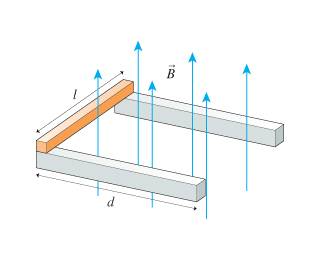
33.P68.jpg


2. F = Il x B


3. By the right hand rule, the current must be flowing "into the page." However, it isn't clear to me how to get the velocity expression. My instinct would be that v is directly proportional to I, B, and d and inversely proportional to l and m.
 
Physics news on Phys.org
By using the relevant equation you have found the force F. Mass of the bar is given. Find the acceleration.
Initial velocity of the bar is zero. You want to find the final velocity when the bar leaves the rails by displacing through a distance d.
Using kinematic equation find vf.
 

Similar threads

Replies
1
Views
2K
Replies
12
Views
2K
Replies
11
Views
3K
Replies
1
Views
2K
Replies
3
Views
2K
  • · Replies 4 ·
Replies
4
Views
3K
  • · Replies 3 ·
Replies
3
Views
2K
Replies
44
Views
4K
Replies
4
Views
1K
  • · Replies 2 ·
Replies
2
Views
2K