Verification for Net Force and Vectors?

Join the discussion
Ask a follow-up here, or get your own question answered by working scientists, mathematicians and engineers — people, not an autocomplete.
Real named experts · corrections over time · the nuance an AI answer skips
9 replies · 2K views
Meeeessttteeehh
Messages
19
Reaction score
4
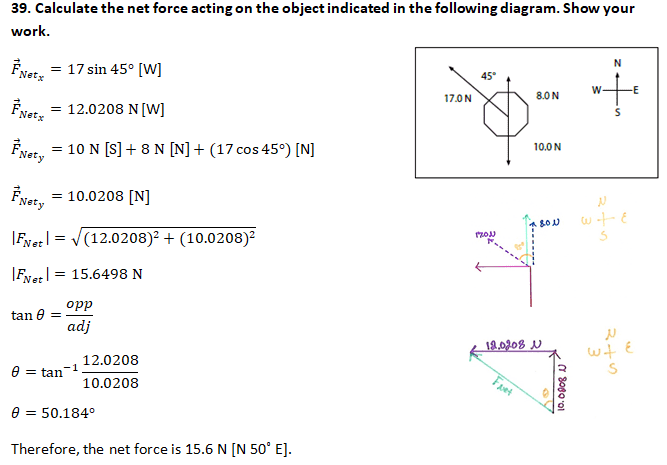
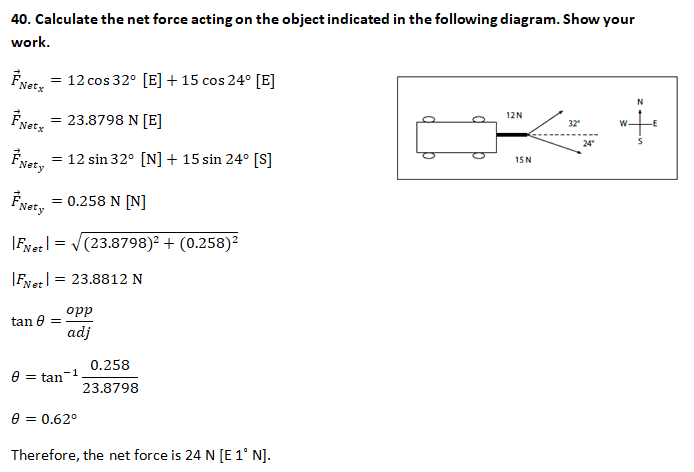
Hello everyone! I was given the following three questions in my homework, and I had a lot of trouble with them, so I was hoping someone could look them over! If you could just check out my pictures and say "yeah its awesome!" or "nope... [insert helpful answer here]" that would be GREAT. Thanks so much!
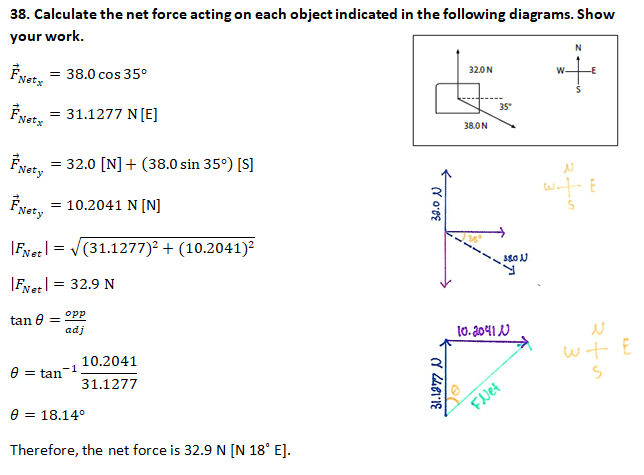
38.png
39.png
40.png
 

Attachments

  • 39.png
    39.png
    15.9 KB · Views: 506
  • 40.png
    40.png
    8.7 KB · Views: 432
  • 38.png
    38.png
    18.4 KB · Views: 635
Physics news on Phys.org
In 38, I do not understand the second hand-drawn force diagram. You have drawn the E force as N and the N force as E, leading to the wrong angle.

In 39, you end with "N 50 E", but no applied forces have a component to the E.

I haven't checked the numerics in detail, but they all look about right.
 
  • Like
Likes   Reactions: Meeeessttteeehh
haruspex said:
In 38, I do not understand the second hand-drawn force diagram. You have drawn the E force as N and the N force as E, leading to the wrong angle.

In 39, you end with "N 50 E", but no applied forces have a component to the E.

I haven't checked the numerics in detail, but they all look about right.

Thank you! I have adjusted the trig in question 38 and now have a final answer of 32.9 N [N 3 degrees E]. I will redraw the diagram. As for 39, that was a good catch. I guess you could probably tell I did this when I was tired... Thanks again!
 
haruspex said:
I was expecting you would just get the complement, making it N 72°E.

could you define complement? I'm not sure I understand.
 
Meeeessttteeehh said:
could you define complement? I'm not sure I understand.
In your original solution you got the N and E net forces swapped around, producing a resultant 18 degrees E of N. Correcting them should give you the complementary angle (90-θ), i.e 18 degrees N of E, or 72 degrees E of N.
 
haruspex said:
In your original solution you got the N and E net forces swapped around, producing a resultant 18 degrees E of N. Correcting them should give you the complementary angle (90-θ), i.e 18 degrees N of E, or 72 degrees E of N.

Sorry, but I still don't understand. I've been taught that when using the decomposition method I use trig to find theta. I swapped my values so they might be correct, and used tan to determine 3.0505 as theta, and I am not sure where I have gone wrong... Here is my updated picture
.
38b.png
 

Attachments

  • 38b.png
    38b.png
    3.6 KB · Views: 816
Meeeessttteeehh said:
Sorry, but I still don't understand. I've been taught that when using the decomposition method I use trig to find theta. I swapped my values so they might be correct, and used tan to determine 3.0505 as theta, and I am not sure where I have gone wrong... Here is my updated picture
. View attachment 219236
Isn't 3.0505 just the ratio of the sides? You need to apply tan-1 to that.
 
  • Like
Likes   Reactions: Meeeessttteeehh
haruspex said:
Isn't 3.0505 just the ratio of the sides? You need to apply tan-1 to that.

OH MY GOODESS. I just got the E 18 degrees N after drawing a million more triangles (more like 8 but still), but I can't believe I forgot the tan inverse. THANK YOU SO MUCH!