Verification for Net Force and Vectors?

Click For Summary

Homework Help Overview

The discussion revolves around understanding net forces and vector components in physics, specifically focusing on force diagrams and trigonometric calculations related to angles in force representation.

Discussion Character

  • Exploratory, Conceptual clarification, Mathematical reasoning, Problem interpretation

Approaches and Questions Raised

  • Participants discuss the accuracy of force diagrams and the implications of mislabeling forces. There are inquiries about the use of trigonometric functions to determine angles and the concept of complementary angles in vector addition.

Discussion Status

Some participants have provided feedback on the original poster's diagrams and calculations, suggesting corrections and clarifications. There is an ongoing exploration of the correct application of trigonometric functions, with some participants expressing confusion about the methods used.

Contextual Notes

Participants mention the importance of adhering to guidelines and templates in homework submissions. There is also a reference to the challenges of working on problems when fatigued, which may affect accuracy.

Meeeessttteeehh
Messages
19
Reaction score
4
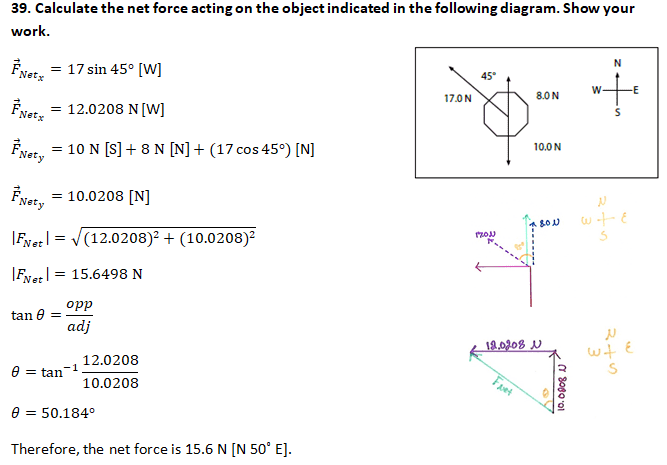
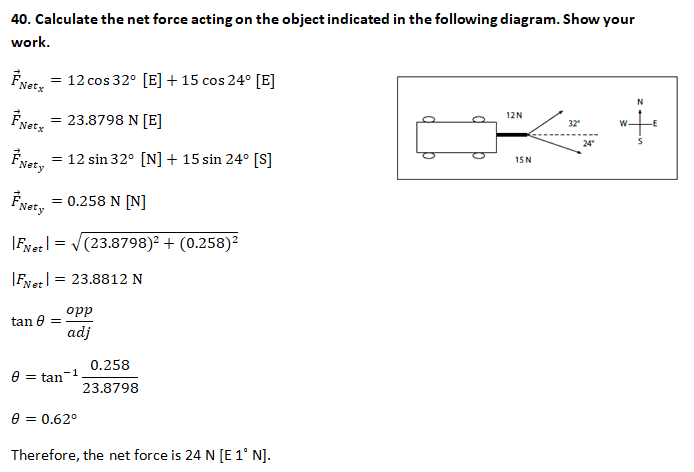
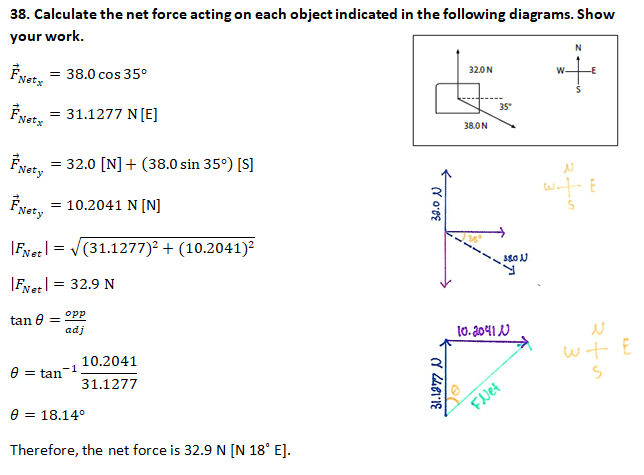
Hello everyone! I was given the following three questions in my homework, and I had a lot of trouble with them, so I was hoping someone could look them over! If you could just check out my pictures and say "yeah its awesome!" or "nope... [insert helpful answer here]" that would be GREAT. Thanks so much!
38.png
39.png
40.png
 

Attachments

  • 39.png
    39.png
    15.9 KB · Views: 485
  • 40.png
    40.png
    8.7 KB · Views: 413
  • 38.png
    38.png
    18.4 KB · Views: 619
Physics news on Phys.org
In 38, I do not understand the second hand-drawn force diagram. You have drawn the E force as N and the N force as E, leading to the wrong angle.

In 39, you end with "N 50 E", but no applied forces have a component to the E.

I haven't checked the numerics in detail, but they all look about right.
 
  • Like
Likes   Reactions: Meeeessttteeehh
Hello meester, :welcome:

Check your ##\sin 35^\circ##
[edit] no need. But still:

Read the guidelines and don't erase the template.
 
haruspex said:
In 38, I do not understand the second hand-drawn force diagram. You have drawn the E force as N and the N force as E, leading to the wrong angle.

In 39, you end with "N 50 E", but no applied forces have a component to the E.

I haven't checked the numerics in detail, but they all look about right.

Thank you! I have adjusted the trig in question 38 and now have a final answer of 32.9 N [N 3 degrees E]. I will redraw the diagram. As for 39, that was a good catch. I guess you could probably tell I did this when I was tired... Thanks again!
 
Meeeessttteeehh said:
N 3 degrees E
I was expecting you would just get the complement, making it N 72°E.
 
haruspex said:
I was expecting you would just get the complement, making it N 72°E.

could you define complement? I'm not sure I understand.
 
Meeeessttteeehh said:
could you define complement? I'm not sure I understand.
In your original solution you got the N and E net forces swapped around, producing a resultant 18 degrees E of N. Correcting them should give you the complementary angle (90-θ), i.e 18 degrees N of E, or 72 degrees E of N.
 
haruspex said:
In your original solution you got the N and E net forces swapped around, producing a resultant 18 degrees E of N. Correcting them should give you the complementary angle (90-θ), i.e 18 degrees N of E, or 72 degrees E of N.

Sorry, but I still don't understand. I've been taught that when using the decomposition method I use trig to find theta. I swapped my values so they might be correct, and used tan to determine 3.0505 as theta, and I am not sure where I have gone wrong... Here is my updated picture
.
38b.png
 

Attachments

  • 38b.png
    38b.png
    3.6 KB · Views: 793
Meeeessttteeehh said:
Sorry, but I still don't understand. I've been taught that when using the decomposition method I use trig to find theta. I swapped my values so they might be correct, and used tan to determine 3.0505 as theta, and I am not sure where I have gone wrong... Here is my updated picture
. View attachment 219236
Isn't 3.0505 just the ratio of the sides? You need to apply tan-1 to that.
 
  • Like
Likes   Reactions: Meeeessttteeehh
  • #10
haruspex said:
Isn't 3.0505 just the ratio of the sides? You need to apply tan-1 to that.

OH MY GOODESS. I just got the E 18 degrees N after drawing a million more triangles (more like 8 but still), but I can't believe I forgot the tan inverse. THANK YOU SO MUCH!
 

Similar threads

  • · Replies 4 ·
Replies
4
Views
2K
  • · Replies 2 ·
Replies
2
Views
2K
Replies
4
Views
2K
  • · Replies 6 ·
Replies
6
Views
2K
Replies
6
Views
2K
  • · Replies 5 ·
Replies
5
Views
3K
Replies
9
Views
3K
  • · Replies 3 ·
Replies
3
Views
3K
Replies
8
Views
7K
  • · Replies 11 ·
Replies
11
Views
1K