Vertical spring & maximum length

Click For Summary
SUMMARY

The discussion centers on the dynamics of a vertical spring system involving a mass and its maximum extension. Participants analyze the energy conservation equation, represented as ΔEk + ΔEg + ΔEs = 0, and derive expressions for kinetic energy (KE), gravitational potential energy (PE), and spring potential energy. Key points include the importance of correctly accounting for initial spring extension and clarifying ambiguous problem statements regarding mass displacement and velocity direction. The final expressions derived involve quadratic equations, emphasizing the complexity of the system.

PREREQUISITES
  • Understanding of energy conservation principles in physics
  • Familiarity with Hooke's Law and spring mechanics
  • Knowledge of quadratic equations and their applications
  • Basic concepts of gravitational force and mass dynamics
NEXT STEPS
  • Study energy conservation in mechanical systems with a focus on springs
  • Learn about Hooke's Law and its implications for spring extension
  • Explore the derivation and application of quadratic equations in physics problems
  • Investigate common ambiguities in physics problem statements and how to clarify them
USEFUL FOR

Physics students, educators, and anyone involved in mechanical engineering or dynamics who seeks to deepen their understanding of spring systems and energy conservation principles.

stunner5000pt
Messages
1,447
Reaction score
5
Homework Statement
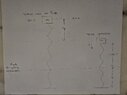
A spring with spring constant k has an unstretched length of L. A mass m is hung vertically from the spring. The mass is pulled down a distance x and given an initial velocity upward of v.
Determine the maximum length that the spring reaches in terms of the above variables.
Assume the spring has mass zero.
Relevant Equations
Conservation of energy
[tex] \Delta E_{k} + \Delta E_{g} + \Delta E_{s} = 0 [/tex]
Included a diagram as well... forgive me... I cannot seem to 'uninvert' the attached picture

final velocity is zero
if we set the lowest point that the mass reaches as zero, then the final height is zero
let H be the 'extra' length that the spring reaches over and above the initial stretch

\Delta E_{k} + \Delta E_{g} + \Delta E_{s} = 0
\frac{1}{2} m (v_{2}^2 - v_{1}^2 ) + mg (h_{2} - h_{1}) + \frac{1}{2} k ( (x + h_{f} )^2 - x^2) = 0
using the things that are zero above

-\frac{1}{2} v^2 - mg h_{f} + \frac{1}{2} k ( (x + h_{f} )^2 - x^2) = 0

-\frac{1}{2} v^2 - mg h_{f} + \frac{1}{2} k ( 2x h_{f} + h_{f}^2 ) = 0

\frac{k}{2} h_{f}^2 + h_{x} ( -mg + kx) - \frac{1}{2} v^2 = 0

ok at this point it's getting a bit messy as this requires to go into a quadratic formula but, is this correct so far?

Thank you for help in advance!
20241122_105119.jpg
 
  • Like
Likes   Reactions: PeroK
Physics news on Phys.org
That looks good. I agree that the final expression will be messy.

Don't forget that the spring extends when first loaded with the mass.
 
stunner5000pt said:
\frac{k}{2} h_{f}^2 + h_{x} ( -mg + kx) - \frac{1}{2} v^2 = 0
You seem to have lost an ##m## from your KE term!
 
PeroK said:
That looks good. I agree that the final expression will be messy.

Don't forget that the spring extends when first loaded with the mass.
PeroK said:
You seem to have lost an ##m## from your KE term!

Whoops! thanks for catching this! Something seemed off initially when i wrote it down too
Just want to clarify.. did I not include the spring extending the mass when it first loaded?
 
stunner5000pt said:
Whoops! thanks for catching this! Something seemed off initially when i wrote it down too
Just want to clarify.. did I not include the spring extending the mass when it first loaded?
The question is slightly ambiguous. The spring has natural length ##L##. If we hang the mass from the spring, then it will stretch to ##L + x_0##, where ##kx_0 = mg##, and that will be the equilibrium point.

When it says the mass is "pulled down a distance ##x##", I would interpret that as a further extension to ##L + x_0 + x##. But, it could mean that ##x## is intended to be what I've called ##x_0##. Or, it could be that the extension is now simply ##L + x##, where ##x > x_0##.

In any case, I don't like calling an initial extension something like ##x##, as we'd want to use ##x## as the variable in our equations. This seems to be something some problems setters do. It annoys me because it forces us to use a new variable.

Finally, it seems odd to pull something down and give it an upward velocity. Why not a downward velocity? That seems more natural.

It feels to me like one of these problems where someone who doesn't really understand physics just cobbles together some random ideas. Where did it come from?
 
PeroK said:
The question is slightly ambiguous.
I would agree if it said the spring is pulled down by x, but it says the mass is pulled down. To me, that means this is in addition to the extension caused by the weight of the mass.
 
  • Like
Likes   Reactions: erobz
PeroK said:
Don't forget that the spring extends when first loaded with the mass.
So it's not clear to me from the problem statement whether or not this extension is included when "the mass is pulled down a distance x".
 

Similar threads

  • · Replies 28 ·
Replies
28
Views
2K
  • · Replies 21 ·
Replies
21
Views
2K
  • · Replies 4 ·
Replies
4
Views
928
  • · Replies 22 ·
Replies
22
Views
2K
Replies
7
Views
1K
  • · Replies 3 ·
Replies
3
Views
686
Replies
27
Views
1K
  • · Replies 3 ·
Replies
3
Views
2K
  • · Replies 33 ·
2
Replies
33
Views
2K
  • · Replies 14 ·
Replies
14
Views
2K