Discussion Overview
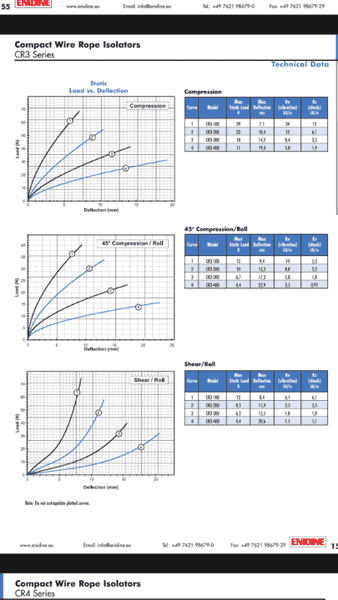
The discussion revolves around understanding the cutoff frequency of the CR3-100 damper, particularly in the context of vibration damping for a mass-spring system. Participants explore how to determine the appropriate frequency for effective isolation and attenuation of vibrations, referencing technical specifications and application guides.
Discussion Character
- Technical explanation
- Mathematical reasoning
- Debate/contested
Main Points Raised
- One participant inquires about the cutoff frequency of the CR3-100 damper and its relationship to the KN/m value provided in the technical sheet.
- Another participant suggests that the cutoff frequency is dependent on the modal frequency of interest, which is influenced by the mass on the spring, and notes that isolation typically begins at 1.4 times the natural frequency.
- A participant mentions that the catalogue indicates a natural frequency of one-third the excitation frequency is necessary for 80% attenuation.
- Several participants discuss the need to isolate a system from frequencies above 30 Hz and how to calculate the required natural frequency and stiffness to achieve this attenuation.
- There is a question regarding the cancellation of units in the Kv equation, with participants expressing confusion about the relationship between Newtons, hertz squared, and meters per second squared.
- One participant confirms the calculations for static load and stiffness, indicating that the fourth isolator option works for the desired attenuation.
Areas of Agreement / Disagreement
Participants generally agree on the need for calculations related to the damper's performance but express uncertainty regarding the specific cutoff frequency and the unit cancellation in the Kv equation. Multiple views on the interpretation of the technical specifications remain present.
Contextual Notes
Limitations include potential dependencies on specific definitions and assumptions regarding the mass-spring system and the parameters for vibration isolation. The discussion does not resolve the uncertainties surrounding the cutoff frequency and unit cancellation.