Visualizing the space and structure described by a metric

Click For Summary
The discussion focuses on visualizing geometric transformations in a 3D Euclidean space when changing coordinate systems. It clarifies that while the surfaces defined by fixed coordinates change from spheres to ellipsoids, the underlying space remains unchanged. The equations provided illustrate how the horizontal dimensions are affected by a parameter, while the vertical dimension remains constant, leading to a "squashed" appearance. The term "squashed" is defined as having reduced height rather than being flat, and the role of angular coordinates in defining radial changes is also explored. Overall, the conversation emphasizes the importance of understanding the relationship between the coordinate system and the geometric shapes involved.
Whitehole
Messages
128
Reaction score
4
I need help to visualize the geometry involved here,
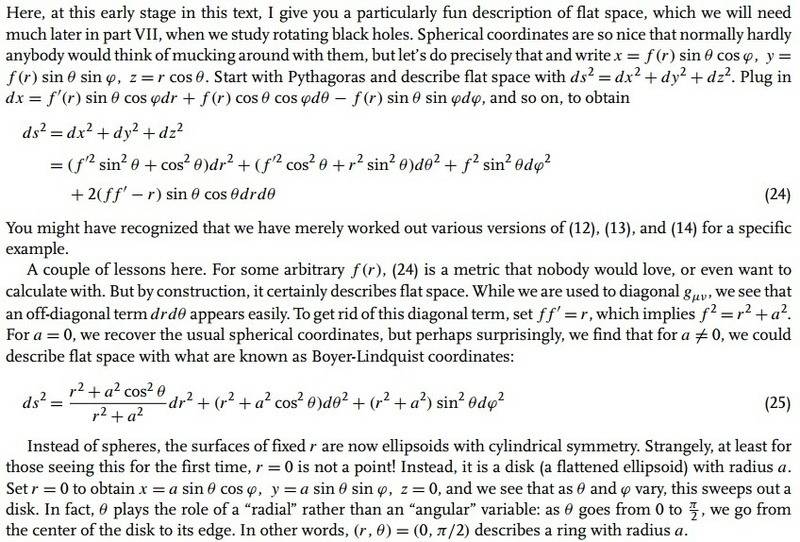
Image.jpg


How can I visualize the last paragraph? Why is the surface of fixed r now an ellipsoid? Also for r = 0, it is already a disk? I've tried searching for the geometry of these but I can't find any image of the geometry that I can just stare at and understand already what the paragraph meant. Anybody can give me insights?
 
Physics news on Phys.org
Bear in mind that these machinations do not change the space, which remains 3D Euclidean. All they change is the coordinate system, so that the surfaces defined by fixing a coordinate change.
In spherical coordinates in flat space the surfaces of fixed coordinates are:
- spheres centred on the origin for fixed ##r##
- cones around the z axis with tip at the origin, for fixed ##\theta##
- half planes emanating from the z axis, for fixed ##\phi##

The change above alters the first of these so that the spheres become ellipsoids. You can see that must be the case because of the equations:
$$x=f\sin\theta\cos\phi$$
$$y=f\sin\theta\sin\phi$$
$$z=r\sin\theta\cos\phi$$
If ##f=r## these are the equations of a sphere of radius ##r##. If ##a\neq 0## than ##f=\sqrt{a^2+r^2}>r## so the horizontal dimensions ##x,y## are expanded while keeping the vertical dimension ##z## constant. That squashes the sphere into an oblate spheroid.
 
andrewkirk said:
Bear in mind that these machinations do not change the space, which remains 3D Euclidean. All they change is the coordinate system, so that the surfaces defined by fixing a coordinate change.
In spherical coordinates in flat space the surfaces of fixed coordinates are:
- spheres centred on the origin for fixed ##r##
- cones around the z axis with tip at the origin, for fixed ##\theta##
- half planes emanating from the z axis, for fixed ##\phi##

The change above alters the first of these so that the spheres become ellipsoids. You can see that must be the case because of the equations:
$$x=f\sin\theta\cos\phi$$
$$y=f\sin\theta\sin\phi$$
$$z=r\sin\theta\cos\phi$$
If ##f=r## these are the equations of a sphere of radius ##r##. If ##a\neq 0## than ##f=\sqrt{a^2+r^2}>r## so the horizontal dimensions ##x,y## are expanded while keeping the vertical dimension ##z## constant. That squashes the sphere into an oblate spheroid.
How can ##a## only alter the horizontal dimensions, ##r## is a 3-d coordinate here so it should affect the z component if it were to change right? Also, is the term squashed sphere accurate? Because squashed means that the z coordinate is decreasing and eventually flat, correct me if I'm wrong.
 
Whitehole said:
How can a only alter the horizontal dimensions, r is a 3-d coordinate here so it should affect the z component if it were to change right?
No. I think you are confusing yourself by using the term '3D coordinate'. Look at the formulas for x, y and z. You can see that only the x and y formulas use f, which depends on a. z uses r instead of f, and hence has no dependence on a.
Whitehole said:
squashed means that the z coordinate is decreasing and eventually flat, correct me if I'm wrong.
No, squashed doesn't mean having zero height. It just means having less height than it had previously.
 
andrewkirk said:
No. I think you are confusing yourself by using the term '3D coordinate'. Look at the formulas for x, y and z. You can see that only the x and y formulas use f, which depends on a. z uses r instead of f, and hence has no dependence on a.

No, squashed doesn't mean having zero height. It just means having less height than it had previously.
Now I got it, I didn't carefully saw the "fixed r". Also, yes, specifically squashed means having less height than it had previously. For the last part, how can ##θ## play the role of the radial variable if it is already flat? ##φ## sweeps out the disk from 0 to 2π. But ##θ## . . .
 
Think about what it looks like when you view an ant crawling about on the Northern hemisphere of an origin-centred sphere from above it on the z axis, eg viewing the unit sphere from the point (0,0,10).
Changes in the ant's ##\theta##, keeping ##r## and ##\phi## constant, will look like increases or decreases in radius.
Squashing the sphere down to absolutely flat, which is what the set r=0 is, looks the same as viewing a 'fully inflated' sphere from above.
 
andrewkirk said:
Think about what it looks like when you view an ant crawling about on the Northern hemisphere of an origin-centred sphere from above it on the z axis, eg viewing the unit sphere from the point (0,0,10).
Changes in the ant's ##\theta##, keeping ##r## and ##\phi## constant, will look like increases or decreases in radius.
Squashing the sphere down to absolutely flat, which is what the set r=0 is, looks the same as viewing a 'fully inflated' sphere from above.
Very nice example. Thanks a lot for helping me visualize all this!
 

Similar threads

  • · Replies 37 ·
2
Replies
37
Views
7K
  • · Replies 6 ·
Replies
6
Views
3K
  • · Replies 12 ·
Replies
12
Views
3K
  • · Replies 7 ·
Replies
7
Views
2K
  • · Replies 6 ·
Replies
6
Views
2K
  • · Replies 1 ·
Replies
1
Views
2K
  • · Replies 1 ·
Replies
1
Views
740
  • · Replies 0 ·
Replies
0
Views
2K
  • · Replies 1 ·
Replies
1
Views
3K
  • · Replies 6 ·
Replies
6
Views
3K