Voltage across resistors - Series & Parallel

Click For Summary
SUMMARY

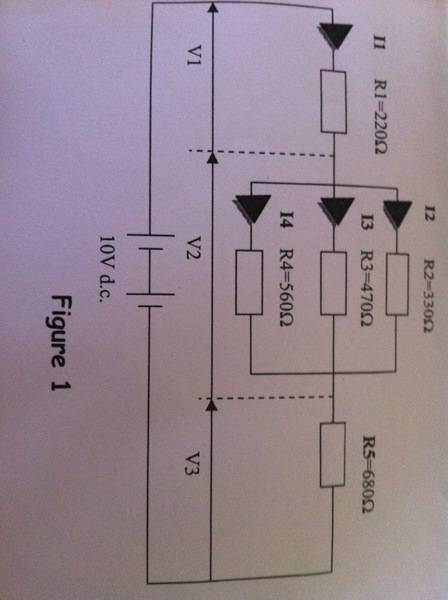
The discussion focuses on calculating voltage and current in a circuit with resistors in series and parallel configurations. The total resistance (Rt) was calculated as 1.044kΩ, using the formula for parallel resistors: Rt = 1/(1/330 + 1/470 + 1/650). The voltage across each resistor was derived using Ohm's Law (V = I * R), with specific values for currents through resistors R1 and R5 being 9.578mA. The participants confirmed that the voltage across parallel resistors remains constant, allowing for straightforward calculations of individual currents (I2, I3, I4) using the equivalent resistance of the parallel combination.

PREREQUISITES
  • Understanding of Ohm's Law (V = I * R)
  • Knowledge of series and parallel resistor configurations
  • Ability to calculate equivalent resistance for parallel resistors
  • Familiarity with circuit simulation tools like PCBWizard
NEXT STEPS
  • Learn how to calculate equivalent resistance for complex resistor networks
  • Study Kirchhoff's Voltage Law for loop analysis in circuits
  • Explore advanced circuit simulation techniques using PCBWizard
  • Investigate the impact of resistor tolerance on circuit performance
USEFUL FOR

Electrical engineering students, hobbyists working on circuit design, and anyone seeking to deepen their understanding of voltage and current calculations in series and parallel resistor configurations.

lloydowen
Messages
78
Reaction score
0
Hey, I have a circuit which you can see in the images attached.

I had 3 questions and I *THINK* I've answered one of them. But I can't seem to get to the next part. Here's the questions below

Questions:
a) The total Resistance (Rt) of the circuit.
b) The voltage across each resistor, V1, V2, V3
c) The currents I1, I2, I3, I4

Attempts:

a) What I have done so far is RT = 1/(1/330 + 1/470 + 1/650) = 144Ω
Series + Parallel = Rt = 220 + 680 = 900Ω (Series)​
900Ω + 144Ω = 1.044kΩ​

b) *Haven't really gotten that far* all that I've gathered is V= I * R I only have the variable R so I'm not sure what to do :(
Cloud2go%2030%20Nov%202011%2013:35.jpg

Homework Statement


Homework Equations


The Attempt at a Solution

 
Physics news on Phys.org
You have the total resistance and the battery voltage so you can calculate the current from the battery. V1 and V3 should then be straightforward...
 
technician said:
You have the total resistance and the battery voltage so you can calculate the current from the battery. V1 and V3 should then be straightforward...

Thank you! Can't believe I didn't think of that :( What about V3 ? Do I calculate each resistor & then add them together?
 
Alright I'll try that.. The current through R1 is 9.578mA and I suppose R5 should be the same ?
 
Can you now find V2? The resistors R2, R3 and R4 are in parallel
 
technician said:
Can you now find V2? The resistors R2, R3 and R4 are in parallel

Well because they're in parallel wouldn't the voltage remain the same throughout each resistor? so If I fidn the voltage for one would they all be the same? My teacher is really bad sorry if these seems stupid !
 
You are correct, the voltage across R2, R3 and R4 is the same (do you know what it is)
So now you can calculate the current through R2, R3 and R4...
 
Sorry but I can't think of a formula to calculate the voltages for the parallel circuit :(
 
lloydowen said:
Sorry but I can't think of a formula to calculate the voltages for the parallel circuit :(

What's the equivalent resistance of the parallel resistors?
 
  • #10
144Ω I believe...
 
  • #11
You should be able to calculate V1 and V3...which should then give you V2 !
 
  • #12
lloydowen said:
144Ω I believe...

If that's the case, what's the voltage drop across that resistance?
 
  • #13
I don't know how to work the v.d out :( I have it drawn on pcbwizard so I can check my answers but I need to be able to do manual way :/
 
  • #14
lloydowen said:
I don't know how to work the v.d out :( I have it drawn on pcbwizard so I can check my answers but I need to be able to do manual way :/

Ohm's law! You've already calculated the current, right?
 
  • #15
I have the current for R1 and R5, not the parallel circuit though ?
 
  • #16
lloydowen said:
I have the current for R1 and R5, not the parallel circuit though ?

Surely it's the same current? R1 and R5 are in series with the equivalent resistance of R2||R3||R4. Note: The individual currents through the parallel resistors must sum to that.
 
  • #17
Yes R1 and R5 are the same current, but I don't get the formula which links the equivalent current from the parallel to series ? If that makes sense.. :/
 
  • #18
lloydowen said:
Yes R1 and R5 are the same current, but I don't get the formula which links the equivalent current from the parallel to series ? If that makes sense.. :/

R1, R5, AND the equivalent resistance for the parallel resistors all share the same current.
 
  • #19
I realize that R1 and R5 have equal current. I also realize that if you add all of the parallel resistors up you receive the equivalent current of R1 and R5, but what I don't get is how you work the current out for the parallel circuit? I only realize that they are the same because I'm using a circuit simulator to try and help me...
 
  • #20
lloydowen said:
I realize that R1 and R5 have equal current. I also realize that if you add all of the parallel resistors up you receive the equivalent current of R1 and R5, but what I don't get is how you work the current out for the parallel circuit? I only realize that they are the same because I'm using a circuit simulator to try and help me...

Let's call the equivalent resistance of the three parallel resistors R234. Then R1 and R234 and R5 are in series. They all MUST have the same current because they are in series.
 
  • #21
Yes they do, but in the question I am asked to find each branch of the current I2, I3, I4, that's what I can't do, I have found the current of 9.578mA by using ohms law... I = 10/1.044kΩ
 
  • #22
lloydowen said:
Yes they do, but in the question I am asked to find each branch of the current I2, I3, I4, that's what I can't do, I have found the current of 9.578mA by using ohms law... I = 10/1.044kΩ

By Ohm's law you know the voltage across R234. That voltage is therefore across all three resistors (parallel components all share the same voltage difference).
 
  • #23
Alright I think I get what you're saying... So what I got is V2= I*R

V2= 9.578 x 1.044
V2= 9.999432V

And with that voltage I put it into Ohms law to find I2, I3 and I4 ?
 
  • #24
lloydowen said:
Alright I think I get what you're saying... So what I got is V2= I*R

V2= 9.578 x 1.044
V2= 9.999432V

And with that voltage I put it into Ohms law to find I2, I3 and I4 ?

That'll work! [EDIT: make sure that the resistance vale you use is the equivalent resistance of the parallel resistors! R234]

Also note that, as technician intimated previously, if you know all the other potential changes around a loop then you can find the "missing" one; the sum of all the changes must be zero. So knowing the battery voltage and V1 and V3, you can find V2 since Vbat - V1 - V2 - V3 = 0
 
Last edited:
  • #25
Sorry I'm lost again, so in PCBWizard I got I2=4.18mA but when I work out the following formula I get a completely different result...

I2= V/R
I2= 9.99432/330

*330 being the resistance of the resistor..*
 
  • #26
Also PCBWizard is saying V2= 1.379V where I got 9.999432V :(

We also done the practical of this circuit in class and V2= 1.39V (Multimeter In real Life)

So my workings out can't be correct :(
 
  • #27
lloydowen said:
Sorry I'm lost again, so in PCBWizard I got I2=4.18mA but when I work out the following formula I get a completely different result...

I2= V/R
I2= 9.99432/330

*330 being the resistance of the resistor..*

9.99432 is your current value for the series current through R1, R234, and R5. It's NOT the current through the individual resistors R2, R3, and R4 (those individual currents will add up to 9.99432 though).

The reason that you found the voltage across R234 was so that you could use it to determine the individual currents through R2, R3, R4 using Ohm's Law for each of them.
 
  • #28
I've even confused my self now I think. If I add up my PCBWizard Values which are
V1=2.107V
V2=1.379V
V3=6.513V

I get 9.999V So that's what I have worked out.

So I am back in the same place CONFUSED!
 
  • #29
lloydowen said:
I've even confused my self now I think. If I add up my PCBWizard Values which are
V1=2.107V
V2=1.379V
V3=6.513V

I get 9.999V So that's what I have worked out.

So I am back in the same place CONFUSED!

Allowing for rounding errors they sum to 10V, which is the battery voltage. What's wrong with that?
 
  • #30
No there's nothing wrong with that at all but I still don't understand how I find V1.

If the Battery Voltage is 10V and the Current Flowing in the circuit is 9.578mA and the circuit resistance 1.044KΩ, I don't understand what I have to do with these values to find V1, V2 & V3.
 

Similar threads

  • · Replies 3 ·
Replies
3
Views
2K
  • · Replies 12 ·
Replies
12
Views
2K
  • · Replies 1 ·
Replies
1
Views
2K
  • · Replies 3 ·
Replies
3
Views
2K
  • · Replies 17 ·
Replies
17
Views
12K
  • · Replies 3 ·
Replies
3
Views
2K
Replies
15
Views
2K
  • · Replies 8 ·
Replies
8
Views
2K
  • · Replies 4 ·
Replies
4
Views
2K
  • · Replies 18 ·
Replies
18
Views
3K