Voltage regulator, tweaking capacitor values

Click For Summary

Discussion Overview

The discussion revolves around the criticality of capacitor values in voltage regulator circuits, specifically focusing on the LM7805 fixed output regulator. Participants explore the implications of different capacitance values for input and output capacitors, their roles in stability and performance, and the reasoning behind the values suggested in datasheets.

Discussion Character

  • Technical explanation
  • Debate/contested
  • Exploratory

Main Points Raised

  • One participant questions the criticality of capacitance values for C1 and C0, suggesting that alternative values like 0.47 uF or 0.22 uF might suffice instead of the specified 0.33 uF.
  • Another participant asserts that for standard dropout regulators like the 7805, capacitance values are not critical, with C1 primarily serving to hold up voltage during dips and C0 aiding dynamic load regulation.
  • A participant references Note 2 from the datasheet, indicating that CI is necessary if the regulator is far from the power supply filter, and emphasizes the importance of maintaining the input voltage above the output voltage.
  • There is agreement that standard voltage dropout regulators require a significant input-to-output voltage margin.
  • One participant highlights the necessity of having a 0.1 uF capacitor on both input and output pins for stability, suggesting that placement is crucial for effectiveness.
  • A participant questions why a 0.33 uF capacitor was specifically chosen, noting variations in recommended values across different manufacturers' datasheets.
  • Another participant mentions that while the exact value may not be critical, a range of 0.1 to 0.47 uF is acceptable, potentially based on extensive testing and simulations to control oscillations.
  • There is a noted discrepancy in capacitor values between different versions of the LM7805 datasheet, indicating that practical testing and simulations are essential alongside theoretical considerations.

Areas of Agreement / Disagreement

Participants express differing views on the criticality of capacitor values, with some arguing that they are not critical for standard dropout regulators while others emphasize their importance for stability. The discussion remains unresolved regarding the optimal capacitor values and their implications.

Contextual Notes

Participants reference specific notes from the datasheet and variations in capacitor values across different manufacturers, indicating that practical testing and circuit simulations may influence the choice of capacitor values.

mishima
Messages
576
Reaction score
43
Hi, on page 23 of this datasheet (http://www.fairchildsemi.com/ds/LM/LM7805.pdf) the top figure 10 shows a setup for a fixed output regulator, for example suitable for logic chips which need a steady 5V. I was wondering how critical the values of capacitance were for C1 especially and also C0. I was also wondering how in theory these ideal values were calculated for this setup.

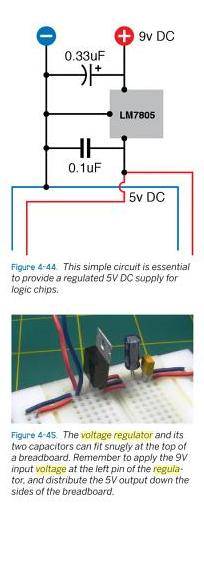
Here is another image from the book "Make: electronics" (taken from google) which shows the setup on top of a breadboard ready for logic chip experimentation. Not surprisingly the same capacitance values are suggested.
vretg.jpg


Based on the fine print on the datasheet I'm assuming the primary function of C1 is to filter noise from a nearby power supply. I don't own a .33 uF capacitor but could reach that value by combining other values, but I'm wondering if for example a .47 uF or .22 uF would perform just as well, rather than cluttering things up. Thanks.
 
Engineering news on Phys.org
For standard dropout regulators like the 7805, the capacitance values are not critical. The input capacitance is mostly for hold-up reasons (as any input power source falls off), and the output capacitance is to improve dynamic load regulation (decoupling).

For Low Dropout (LDO) voltage regulators, the capacitance values are much more important, because they are part of the stability design of the LDOs.
 
I think this is the reason for Note 2 on the datasheet. Correct me if I'm wrong Berkeman. Since the input voltage needs to remain 2 volts above the output voltage, CI would help maintain this for induced short negative spikes.
Notes:
1. To specify an output voltage, substitute voltage value for “XX.” A common ground is required between the input and the
output voltage. The input voltage must remain typically 2.0V above the output voltage even during the low point on the input
ripple voltage.
2. CI is required if regulator is located an appreciable distance from power supply filter.
3. CO improves stability and transient response.
 
Agreed. Standard voltage dropout regulators need to keep a pretty big input-to-output voltage margin.
 
The point that hasn't been made is that there should be ( by datasheet info) a 0.1 on the input AND output pins
These 2 caps are for the stability of the regulator and should be wired as close to the In, Out and GND pins as possible

so where the 0.1 uF position is shown on that breadboard construction is defeating the purpose of its inclusion

Any other electro's etc for smoothing are over and above the above requirementDave
 
So, why out of all the possible values did they choose to show a 0.33 uF capacitor?
 
interestingly the Fairchild 7805 does show the input cap at 0.33uF
the Texan Instruments one is 0.22uF
and as I commented earlier I have been more used to seeing data that used 0.1uF

mishima ... the value obviously doesn't need to be precise, but somewhere in the 0.1 to 0.47 would be acceptable.
Why something in that range of values ? ... probably after lots of testing/ circuit simulations, they found that its the best value for controlling oscillations.

cheers
Dave
 
Another thing is that the 7805 on page 3 has C1 as 0.1 uF, but the 7805A on page 12 has C1 as 0.33 uF. Anyways thanks, I need to remember theory is just one part of this stuff, and that testing/sims play a huge role.
 

Similar threads

  • · Replies 2 ·
Replies
2
Views
3K
  • · Replies 9 ·
Replies
9
Views
6K
Replies
4
Views
4K
  • · Replies 4 ·
Replies
4
Views
4K
  • · Replies 2 ·
Replies
2
Views
4K
  • · Replies 11 ·
Replies
11
Views
8K
  • · Replies 12 ·
Replies
12
Views
10K
Replies
29
Views
11K
  • · Replies 19 ·
Replies
19
Views
5K
  • · Replies 8 ·
Replies
8
Views
4K