How Do You Compare Resistance in a Carbon Resistor and an LED Using a V-I Graph?

Click For Summary
The discussion focuses on comparing the resistance of a carbon resistor and an LED using V-I graphs. The carbon resistor follows Ohm's law, exhibiting a linear relationship, while the LED demonstrates non-ohmic behavior with a curved line. The resistance of the carbon resistor is determined to be 10 ohms. To find the current at which the LED's resistance equals that of the carbon resistor, the instantaneous resistance of the LED can be calculated using R = V/I, noting that this method provides only the slope at a specific point on the curve. The conversation highlights the distinction between dynamic and static resistance, emphasizing that the LED typically has a higher resistance than the carbon resistor.
P1nkButt3rflys
Messages
16
Reaction score
0
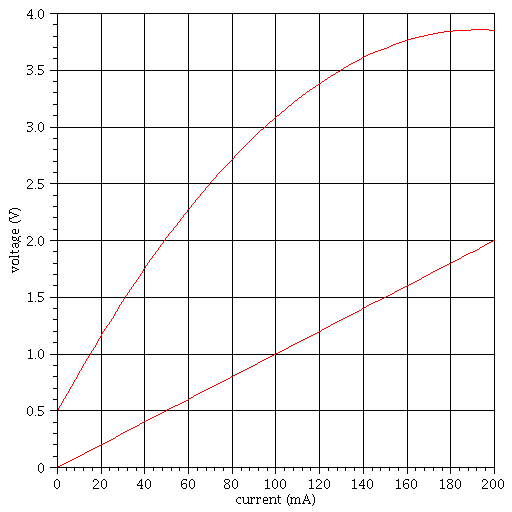
A) The graph shows V-I curves for two conductors. One is measured for a carbon resistor and obeys Ohm's law; the other is for a light-emitting diode (LED) and shows non-ohmic behaviour. What is the resistance of the carbon resistor?

B) For what value of current is the resistance of the LED the same as that of the carbon resistor? (Use a ruler and a triangle to draw on the diagram.)

I got the first portion. The carbon resistor is the linear line and the LED is the curved line. Using the graph I found R = 10 ohm for A. But cannot figure out how to solve B, any suggestions?
LED8.gif
 
Physics news on Phys.org
For the LED, you can find the resistance at a particular value of current and voltage with the equation ## R = \frac{V}{I} ## (note that this isn't the same as Ohm's Law -- it can only be used to find the the instantaneous resistance, and does not describe the resistance of the conductor at all values of the voltage).

Graphically, ## \frac{V}{I} ## is the slope of the graph, which you can find with tangent lines.
 
The slope of the curve defines its resistance at that region of operation. So draw tangents everywhere, to see how the slope changes.

For the carbon resistor, the tangents everywhere are the same, its resistance does not vary.
 
The prblem in (b) should have asked specifically for dynamic resistance. The LED "resistance" could equally well mean static resistance in which case the LED always has a larger resistance than the resistor. For example, an ohmmeter would measure static resistance = V/i at whatever the meter current i happens to be.
 
The book claims the answer is that all the magnitudes are the same because "the gravitational force on the penguin is the same". I'm having trouble understanding this. I thought the buoyant force was equal to the weight of the fluid displaced. Weight depends on mass which depends on density. Therefore, due to the differing densities the buoyant force will be different in each case? Is this incorrect?

Similar threads

Replies
3
Views
2K
  • · Replies 3 ·
Replies
3
Views
1K
  • · Replies 10 ·
Replies
10
Views
3K
  • · Replies 60 ·
3
Replies
60
Views
10K
  • · Replies 5 ·
Replies
5
Views
2K
  • · Replies 7 ·
Replies
7
Views
6K
  • · Replies 9 ·
Replies
9
Views
3K
  • · Replies 12 ·
Replies
12
Views
7K
Replies
1
Views
1K
Replies
4
Views
2K