Water pressure in different shaped tanks

Click For Summary
SUMMARY

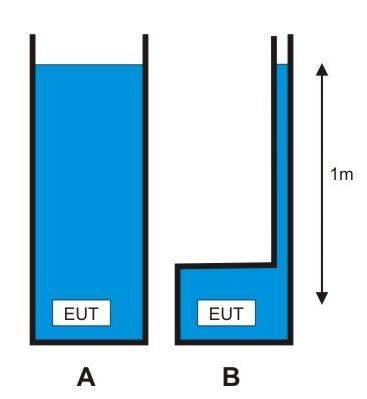
The discussion centers on the water pressure experienced by an Equipment Under Test (EUT) in two different tank setups for IP67 rating compliance. The first setup (Fig A) involves submerging the EUT at the bottom of a tank, while the second setup (Fig B) uses a thin pipe leading to a closed chamber, maintaining the same overall water depth. Despite the different configurations, the pressure on the EUT remains consistent due to Pascal's Law, which states that pressure in a fluid at rest is exerted equally in all directions. The pressure can be calculated using the formula P = ρgh, where P is pressure, ρ is the fluid density, g is the acceleration due to gravity, and h is the height of the fluid column.

PREREQUISITES
  • Understanding of IP67 rating and its testing requirements
  • Familiarity with Pascal's Law and fluid mechanics
  • Basic knowledge of pressure calculations in fluid columns
  • Experience with experimental setups for electrical enclosures
NEXT STEPS
  • Research the implications of IP67 rating on electrical enclosure design
  • Learn about fluid dynamics and pressure calculations in various configurations
  • Explore advanced testing methods for electrical enclosures
  • Study real-world applications of Pascal's Law in engineering
USEFUL FOR

Electrical engineers, product designers, and quality assurance professionals involved in testing and certifying electrical enclosures for environmental protection standards.

jlj
Messages
1
Reaction score
0
For an IP67 rating (http://en.wikipedia.org/wiki/IP_Code), an electrical enclosure must be submerged to 1m for 30 minutes with no water ingress.

A basic test setup is shown in Fig A with the EUT ( Equipment Under Test) placed at the bottom of a tank.
attachment.php?attachmentid=71439&stc=1&d=1405689996.jpg


An alternative test setup was proposed to me, as shown in Fig B.
This setup has a thin pipe into a closed chamber, with the same overall depth of water.

I want to say that the pressure on the EUT is the same with the two setups, but my intuition says otherwise.

So, does Fig B result in the same water pressure on the EUT as Fig A? Why?
 

Attachments

  • tanks.jpg
    tanks.jpg
    9.3 KB · Views: 612
Physics news on Phys.org

Similar threads

  • · Replies 6 ·
Replies
6
Views
2K
  • · Replies 13 ·
Replies
13
Views
2K
  • · Replies 32 ·
2
Replies
32
Views
10K
  • · Replies 9 ·
Replies
9
Views
2K
  • · Replies 12 ·
Replies
12
Views
3K
  • · Replies 6 ·
Replies
6
Views
2K
  • · Replies 4 ·
Replies
4
Views
2K
Replies
50
Views
7K
  • · Replies 9 ·
Replies
9
Views
4K
Replies
6
Views
6K