Join the discussion
Registration is free. Start your own thread to ask a follow-up.
92 replies · 12K views
Physics news on Phys.org
gracy
- 2,486
- 83
No.Sorry.Thankfully Typo.The formula is fo V.I forgot to press caps lock.ehild said:Is the formula in Post#3 really for v?
gracy
- 2,486
- 83
This question has one more part.
If the block comes down(i.e block is now no longer on wedge)what is the velocity of wedge?
If the block comes down(i.e block is now no longer on wedge)what is the velocity of wedge?
gracy
- 2,486
- 83
gracy
- 2,486
- 83
My doubt is that now block is not on wedge,so force which was responsible for motion of block is no longer there.So block should have constant velocity that is same as it's velocity when the block was at bottom most part because after that force was removed (as block came off from wedge)
AlephNumbers
- 293
- 33
What forces act on the wedge after the block is no longer on it?
AlephNumbers
- 293
- 33
Yes, you are correct. The velocity should not only be constant, but it should be the same velocity that you solved for.
gracy
- 2,486
- 83
But as per my teacher I am not right.
AlephNumbers
- 293
- 33
Perhaps I am mistaken then. The surface that the wedge is on is frictionless, yes?
gracy
- 2,486
- 83
Yes.AlephNumbers said:The surface that the wedge is on is frictionless, yes
AlephNumbers
- 293
- 33
Oh, right. The linear momentum has to be equal to zero, right? The block will have a velocity, but it will be directed at an angle of 0 degrees.
Last edited:
gracy
- 2,486
- 83
Along which axis?AlephNumbers said:The linear momentum has to be equal to zero, right?
AlephNumbers
- 293
- 33
The x-axis is what we are worried about here. You do not know the exact details of the separation of the block and wedge, so consider what would happen if the block simply collided with a frictionless surface at an angle, with a velocity.
gracy
- 2,486
- 83
MY teacher gave me these two equations
- MV+mv=0
mgh=1/2 MV^2 +1/2 mv^2
Solving for these two I got an answer
- MV+mv=0
mgh=1/2 MV^2 +1/2 mv^2
Solving for these two I got an answer
gracy
- 2,486
- 83
gracy said:Solving for these two I got an answer
gracy
- 2,486
- 83
I didn't understand.AlephNumbers said:collided with a frictionless surface
AlephNumbers
- 293
- 33
The motion of the block is directed down the incline before it reaches the bottom of the wedge. Then the block hits the frictionless surface at an angle θ, with a velocity v. What happens then?
AlephNumbers
- 293
- 33
You have the right equations, but solving the second part of this problem requires a conceptual understanding of frictionless surfaces.
gracy
- 2,486
- 83
And what about answer.Is it right or wrong?AlephNumbers said:You have the right equations
Science Advisor
Homework Helper
- 15,536
- 1,917
You can assume that the transition from the slope to the horizontal track is smooth, that is, the block will not bounce. This means that the angle theta gradually decreases to zero. That also means that the velocity of the wedge will change.
Conservation of momentum and energy applies, they are the same, as they were while the block moved on the wedge. If V is the backward speed of the wedge and v is the forward speed of the block after separation, the total momentum is still zero and the total energy is mgh, as it was at the instant when the motion started.
The equations in Post #44 are correct.
Conservation of momentum and energy applies, they are the same, as they were while the block moved on the wedge. If V is the backward speed of the wedge and v is the forward speed of the block after separation, the total momentum is still zero and the total energy is mgh, as it was at the instant when the motion started.
The equations in Post #44 are correct.
gracy
- 2,486
- 83
please can you answer post 35.
Science Advisor
Homework Helper
- 15,536
- 1,917
gracy said:My doubt is that now block is not on wedge,so force which was responsible for motion of block is no longer there.So block should have constant velocity that is same as it's velocity when the block was at bottom most part because after that force was removed (as block came off from wedge)
There is no force when the box has left the wedge, but there is interaction between the block and wedge during the transition , and that force is not the same as it was along the wedge.
gracy
- 2,486
- 83
And one more question.
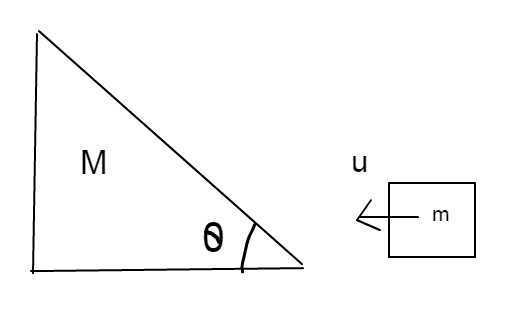
What is the maximum height reached by small "m"(after climbing that much height it stops)
Block stops with respect to wedge but in the ground frame both blocks and wedge are moving with same velocity let's say V
So mu=(m+M)V
And conservation of energy
1/2 mv^2=mgh(maximum height)+1/2mV^2+1/2MV^2
What is the maximum height reached by small "m"(after climbing that much height it stops)
Block stops with respect to wedge but in the ground frame both blocks and wedge are moving with same velocity let's say V
So mu=(m+M)V
And conservation of energy
1/2 mv^2=mgh(maximum height)+1/2mV^2+1/2MV^2
Last edited:
gracy
- 2,486
- 83
Is conservation of momentum applied in non inertial frame?As conservation of momentum is derived from Newton's second law and Newton's second law is only applicable in inertial frames ,conservation of momentum should only be applied in inertial frames,right?
Yoonique
- 105
- 0
Yes you are right. But is you want the conservation of momentum to be applied in non inertial frame, you need to add in fictitious forces into your free body diagram.gracy said:Is conservation of momentum applied in non inertial frame?As conservation of momentum is derived from Newton's second law and Newton's second law is only applicable in inertial frames ,conservation of momentum should only be applied in inertial frames,right?
gracy
- 2,486
- 83
Hmmm...correction needed.gracy said:And conservation of energy
1/2 mv^2=mgh(maximum height)+1/2mV^2+1/2MV^2
1/2 mu^2=mgh(maximum height)+1/2mV^2+1/2MV^2
Yoonique
- 105
- 0
I think this is wrong. The use of conservation of momentum should be in the same direction. So it should be mucosθ=(M+m)Vgracy said:So mu=(m+M)V
gracy
- 2,486
- 83
gracy said:mu=(m+M)V
From these equations I solved for h(maximum height upto which block rises on wedge .gracy said:1/2 mu^2=mgh(maximum height)+1/2mV^2+1/2MV^2
h=1/2 MV^2(M+m)/m^g
I want to know whether this h=Height of wedge(H)
Or h<H
gracy
- 2,486
- 83
No.It is correct.Yoonique said:I think this is wrong. The use of conservation of momentum should be in the same direction. So it should be mucosθ=(M+m)V
Similar threads
- palaphys
- · Replies 25 ·
- Introductory Physics Homework Help
- Replies
- 25
- dl447342
- · Replies 2 ·
- Introductory Physics Homework Help
- Replies
- 2
- tryingtolearn1
- · Replies 5 ·
- Introductory Physics Homework Help
- Replies
- 5
- Titan97
- · Replies 13 ·
- Introductory Physics Homework Help
- Replies
- 13
- ahmadphy
- · Replies 9 ·
- Mechanics
- Replies
- 9
- PAstudent
- · Replies 1 ·
- Introductory Physics Homework Help
- Replies
- 1
- rdemyan
- · Replies 3 ·
- Mechanics
- Replies
- 3
- Glenboro
- · Replies 7 ·
- Introductory Physics Homework Help
- Replies
- 7
- Leo Liu
- · Replies 4 ·
- Introductory Physics Homework Help
- Replies
- 4
- Krushnaraj Pandya
- · Replies 4 ·
- Introductory Physics Homework Help
- Replies
- 4