Discussion Overview
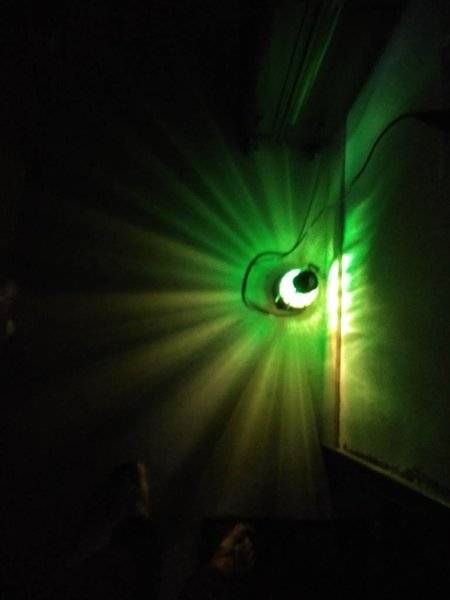
The discussion revolves around the phenomenon of fringes observed on the floor from a night lamp, with participants exploring potential explanations for this effect. The conversation includes considerations of light interference, the lamp's design, and the optical properties of the lamp's materials.
Discussion Character
- Exploratory
- Technical explanation
- Debate/contested
Main Points Raised
- One participant suggests that the fringes may result from interference between light waves from the lamp and reflections from the wall, though they express uncertainty about the wall's reflective properties.
- Another participant proposes that the patterns could simply be due to the lamp's clear plastic components, requesting more detailed images of the lamp.
- Some participants question the likelihood of interference, sharing experiences with different lamp designs that produce similar but less pronounced effects.
- There is a suggestion that the fringes may originate from the lamp's green glass part, which is described as having a 16-sided polygon shape, potentially affecting light emission.
- One participant explains that the curved surfaces of the glass act like lenses, focusing light into vertical stripes, but raises a question about the uniformity of curvature and the resulting fringe pattern.
- A comparison is made to lighthouse Fresnel lenses, noting how they produce distinct light patterns through their design.
- Participants discuss the possibility of treating the 16 curves as plano-concave lenses and suggest conducting experiments to isolate the effects of the green glass on the observed pattern.
- Observations are made regarding the alignment of dark areas with thicker portions of the green glass, indicating potential absorption rather than lensing effects.
Areas of Agreement / Disagreement
Participants express a range of views on the cause of the fringes, with no consensus reached. Some propose optical explanations involving lens effects, while others suggest simpler explanations related to the lamp's materials. The discussion remains unresolved regarding the exact mechanism behind the observed phenomenon.
Contextual Notes
Participants note the complexity of the lamp's design and the potential influence of various factors, such as the curvature of the glass and the arrangement of the light sources, on the resulting fringe patterns. There are also mentions of the need for further experimentation to clarify the observations.