Weird results when measuring water evaporation

Join the discussion
Ask a follow-up here, or get your own question answered by working scientists, mathematicians and engineers — people, not an autocomplete.
Real named experts · corrections over time · the nuance an AI answer skips
2 replies · 2K views
john321654
Messages
1
Reaction score
0
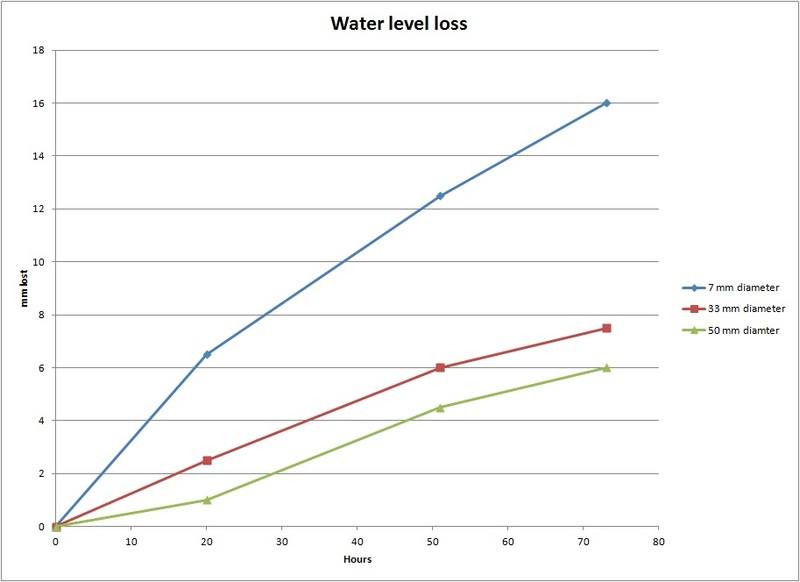
I am doing a senior design project regarding water hydration and did some tests to get a general evaporation rate. I assumed that evaporation is proportional to the surface area of the water to air boundary so I thought that the water level of water in any constant cross section container should fall at the same rate. However, upon testing different sized plastic containers all next to each other, I found that the water level fell much faster in my 7 mm diameter plastic tube than in the 33 mm or 50 mm diameter tubes over several days. All the containers started filled to the brim and had a box covering them to stop light and any air currents.

My question is that why would the water level drop much faster in the smaller diameter tube?

Could it have something to do with the volume of water, the surface area of the container to the volume of water, the meniscus, or capillary action?

Here's a graph of the data.
wwfsg.jpg
 
Physics news on Phys.org
I can think of two possibilities.

1. As you say, the meniscus would make the surface area of the water in the narrow tube larger than merely the cross sectional area. That increase the ratio of surface area to water volume.

You could maybe test this by standing narrow tubes inside a wider one.

2. The narrow tube also has a larger surface area (around) in proportion to its volume. That makes for more heat flowing in through the sides of the tube per unit of water surface area.
 
The evaporated water has to diffuse away from the surface, or it will hinder further evaportation. This will go much easier from a smaller surface. Stopping air currents will make this much harder.
with a large container of water, you might fill the entire box with saturated water vapour, and evaporation will only depend on how fast the water vapour can diffuse out of the box through leaks/pores (or you opening it for measurements)
The vapour pressure of water is 2.3 kPa at 20C, so only 0.023 * 18/22.4 = 1.8 g/liter of water will make it 100% saturated, and the air might very well have been 50% saturated before you started, so you don't need all that much water to fill the entire box with saturated water vapour.