Weld Strength: 6061-T6 Aluminum Forklift Pocket Weld

  • Thread starter Thread starter laforzadiment
  • Start date Start date
  • Tags Tags
    Strength Welding
Click For Summary

Discussion Overview

The discussion revolves around determining the failure load for a 6061-T6 aluminum forklift pocket weld using 4043 filler material. Participants explore the appropriate methods for calculating weld strength, safety factors, and the implications of weld quality and failure mechanisms. The context includes technical aspects of welding and material properties, as well as considerations for real-world applications.

Discussion Character

  • Technical explanation
  • Debate/contested
  • Experimental/applied

Main Points Raised

  • One participant suggests multiplying the cumulative throat area by the ultimate yield strength of the filler to find the failure load, expressing uncertainty about formal education on welds.
  • Another participant advises using an allowable stress, which is less than the ultimate yield strength, and mentions that the safety factor depends on various factors.
  • A participant questions the application of a safety factor of 1 for a failed weld, expressing skepticism about the calculated failure load being excessively high compared to the forklift's weight.
  • Concerns are raised about the potential for fatigue failure and the importance of considering multiple factors that affect weld strength, including the quality of the weld and the presence of defects.
  • A later reply emphasizes the complexity of failure mechanisms, suggesting a thorough examination of the failure site to identify signs of fatigue, corrosion, and other issues that could contribute to weld failure.

Areas of Agreement / Disagreement

Participants express differing views on the appropriate safety factor to use and the methods for calculating failure loads. There is no consensus on the best approach to determine the failure load or the implications of weld quality on strength.

Contextual Notes

Participants highlight the limitations of relying solely on theoretical calculations without considering real-world factors such as weld quality, fatigue, and potential defects. The discussion reflects uncertainty regarding the application of safety factors and the complexity of failure mechanisms in welded structures.

laforzadiment
Messages
12
Reaction score
0
Hello again PF

I am trying to find the failure load for a 6061-T6 Aluminum forklift pocket weld with 4043 filler. Can I simply multiply the cumulative throat area by the ultimate yield strength of the filler for this value? I never had any formal education on welds, wasn't sure if I'm missing something here.

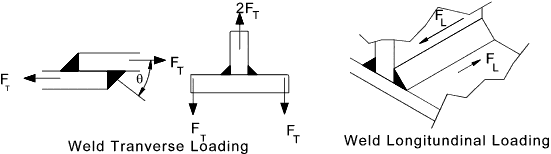
This is a dual fillet weld failing in the transverse direction similar to the middle picture shown below. This data is pretty available for steel but I can't find any charts on aluminum.
weld_dir.gif


Thanks!
 
Engineering news on Phys.org
You would multiple the throat area by an allowable stress which will be less than the ultimate yield strength: allowable stress = yield stress / safety factor.

The safety factor is greater than 1 and depends on many factors.

See "Design of Welded Structures" or similar reference for AISC allowable stresses for weld metals.
 
Since the item has been manufactured and exists + it has failed, my safety factor would just be 1 to find the value of the load, correct?

If i have a 6 inch weld (along the length of the pocket, connecting the bottom to the right side) with a throat of 0.25, I have a throat area of 1.5 in^2. This means using the above method, if the yield strength of 4043 is 20 ksi or whatever that I'm looking at 30,000 lbs to fail a single weld? That can't be right. The forklift doesn't even weigh over 10,000 and isn't going fast enough to impart a force that high.

Help :-X
 
that is the very reason why safety factors are used. Nothing made by a human being is perfect. Are you sure you Diego't get fatigue failure?
I ask because fatigue can result in sudden failure.
I would also use a safety factor of one for your situation but that would only give the ideal load at which it would fail if everything was perfect.
A number of aspects affect the true strengt of the weld so you can never bed too sure. From my experience with tig welding aluminium, it's not the easiest material to weld.
 
First off, I'm far from being an expert in either welding or failure mechanics/analysis, but failures are rarely as simple a mechanism as a lab test. First off give the failure site a very good examination. Look for signs of fatigue failure, crack growth, weld tearing, failure through the weld's throat or at the bonding surface, corrosion, lack of weld penetration, inclusions, failure initiation sites, etc. It is not unusual to find more than 1 suspect condition around the failure area.

Was the weld closed or finished off across the ends of the piece, or was it left as simply 2 filet welds ending along the length of piece. Not completing the weld around the ends provides a site for many bad things to happen, corrosion, stress risers.

If you can determine the failure mechanics, then you may be better able to estimate the forces involved, or figure out the appropriate corrective actions.
 

Similar threads

  • · Replies 16 ·
Replies
16
Views
3K
  • · Replies 3 ·
Replies
3
Views
4K
Replies
1
Views
2K
  • · Replies 4 ·
Replies
4
Views
4K
  • · Replies 4 ·
Replies
4
Views
34K
  • · Replies 1 ·
Replies
1
Views
2K
  • · Replies 1 ·
Replies
1
Views
6K
  • · Replies 3 ·
Replies
3
Views
15K
Replies
3
Views
2K
  • · Replies 9 ·
Replies
9
Views
34K