What Am I Doing Wrong in Calculating Potential on a Grid?

Click For Summary

Homework Help Overview

The discussion revolves around calculating electric potential at a specific point in a system of point charges, particularly at the origin of a grid. Participants are exploring the relationship between potential energy and electric potential, as well as the implications of charge symmetry in the context of the problem.

Discussion Character

  • Conceptual clarification, Assumption checking, Mathematical reasoning

Approaches and Questions Raised

  • Participants are attempting to clarify the distinction between potential energy and electric potential, questioning the setup of the problem and the relevant equations. There is discussion about the contributions of different charges to the potential at the origin and the implications of symmetry in the charge arrangement.

Discussion Status

The discussion is active, with participants providing insights and questioning each other's reasoning. Some have identified misunderstandings regarding the nature of potential versus potential energy, while others are exploring the contributions of individual charges to the overall potential. Guidance has been offered regarding the simplification of potential calculations.

Contextual Notes

Participants are navigating the complexities of charge interactions and the definitions of potential and potential energy. There is an emphasis on ensuring clarity in the problem's requirements, particularly regarding the distinction between the work done in bringing a charge from infinity and the potential energy of the system.

ab200
Messages
13
Reaction score
3
Homework Statement
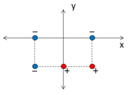
Five charges are arranged as shown below. Each charge is either +1.5 nC (red) or -1.5 nC (blue). They are spaced by 1 cm intervals (each dotted line is 1 cm long). What is the potential, in V, at the origin?

How much work do you have to do, in electron volts (eV), to move an electron from infinitely far away to the origin?
Relevant Equations
V = kq/r
U = qV
Looking at the image, I see that due to symmetry, the bottom-left negative charge and the bottom-right positive charge cancel out, leaving me with a triangle around the center. I'm not entirely sure how to solve for potential at the origin specifically, but I believe that the potential energy of a system is equal to the external work needed to assemble it.

Thus, U = k [(q1q2 / r12) + (q2q3 / r23) + (q1q3 / r13)]. But I got a very, very small number that doesn't seem right, plus U is in joules, not volts. If I divide by 1.6e-19 to convert to volts, I get an enormous number that doesn't seem right either.

What am I doing wrong in terms of problems setup?
 

Attachments

  • potentials.PNG
    potentials.PNG
    3.9 KB · Views: 120
Physics news on Phys.org
There is a problem with your strategy. The problem is asking you to find the work that you (an external agent) have to do to bring an electron from infinity to the origin. What procedure are you going to follow to find this work? Work is denoted by ##W## but see no relevant equation that involves it. How do you propose to include that? Also, in your equation for U you have q1, q2 and q3. Which one of these is the electron charge?
 
  • Like
Likes   Reactions: MatinSAR
ab200 said:
I believe that the potential energy of a system is equal to the external work needed to assemble it.
You are not asked for the potential energy of the system. You are asked for the potential energy of a test charge in the field of the system. I see that same question asked twice. Once as a request for potential and once as a request for work along a trajectory.

If it were me, I'd work on some additional cancellation.
 
  • Like
Likes   Reactions: MatinSAR
jbriggs444 said:
You are asked for the potential energy of a test charge in the field of the system.
Actually it's an electron.
 
kuruman said:
Actually it's an electron.
The same question is asked twice. Once asking for Volts and once asking for electron volts per electron.
 
kuruman said:
There is a problem with your strategy. The problem is asking you to find the work that you (an external agent) have to do to bring an electron from infinity to the origin. What procedure are you going to follow to find this work? Work is denoted by ##W## but see no relevant equation that involves it. How do you propose to include that? Also, in your equation for U you have q1, q2 and q3. Which one of these is the electron charge?
Yes, in this case work is equal to the change in potential energy. The electron charge for part 2 of the question would be q4, with the relevant U values being U14, U24, and U34.
 
jbriggs444 said:
You are not asked for the potential energy of the system. You are asked for the potential energy of a test charge in the field of the system. I see that same question asked twice. Once as a request for potential and once as a request for work along a trajectory.

If it were me, I'd work on some additional cancellation.
Yes, I figured this out. I was missing that the first part of the question actually asks for electric potential V rather than potential energy U. The equation for the electric potential of the system (multiple) of point charges is V = V1 + V2 + V3.

You’re right about the second part as well. I, not being the brightest, ended up solving for the potential energy of the system U = U14 + U24 + U34 (where q4 is the new electron charge). Given that U14 = V1 x q4, U24 = V2 x q4, etc. when I converted the final answer for U from joules in the electron volts, I ended up dividing by the value of q4 anyway.
 
ab200 said:
The equation for the electric potential of the system (multiple) of point charges is V = V1 + V2 + V3.
It’s easier than that!

The total potential at the origin can be thought of as the sum of 3 contributions:

1) from the bottom left and the bottom right charges;
2) from the top left and the bottom middle charges;
3) from the top right charge.

What can you say about 1) and 2)?
 
  • Like
Likes   Reactions: MatinSAR
Steve4Physics said:
It’s easier than that!

The total potential at the origin can be thought of as the sum of 3 contributions:

1) from the bottom left and the bottom right charges;
2) from the top left and the bottom middle charges;
3) from the top right charge.

What can you say about 1) and 2)?
I see that in 1), the two charges are symmetric about the y axis. However, in case 2) I’m a little bit confused why they cancel each other out. Yes, they are equal distances from the origin, but does that necessarily mean they cancel out? If the bottom middle and top right charges were switched, I would be totally on board, but maybe I’m still missing something.
 
  • #10
ab200 said:
Yes, they are equal distances from the origin, but does that necessarily mean they cancel out?
Yes.
 
  • #11
ab200 said:
However, in case 2) I’m a little bit confused why they cancel each other out. Yes, they are equal distances from the origin, but does that necessarily mean they cancel out?
Don't get potentials (scalars) mixed up with electric fields (vectors).

If you were adding fields at a point, the direction (as well as the magnitude) of each individual field would be very important. You would have an exercise in vector addition.

But adding potentials at a point is much simpler – elementary addition. That's one reason why physicists often prefer to use potentials when dealing with fields - it makes the maths much simpler.
 
  • Like
Likes   Reactions: ab200, jbriggs444, MatinSAR and 1 other person

Similar threads

Replies
6
Views
5K
  • · Replies 1 ·
Replies
1
Views
4K
  • · Replies 3 ·
Replies
3
Views
10K
  • · Replies 5 ·
Replies
5
Views
2K
  • · Replies 23 ·
Replies
23
Views
2K
  • · Replies 4 ·
Replies
4
Views
4K
  • · Replies 7 ·
Replies
7
Views
2K
  • · Replies 8 ·
Replies
8
Views
6K
  • · Replies 3 ·
Replies
3
Views
1K
  • · Replies 3 ·
Replies
3
Views
15K