What Are the Allowed Values of Ω in an Infinite Square Well Potential?

Click For Summary

Homework Help Overview

The discussion revolves around a quantum mechanics problem involving a particle in an infinite square well potential. The original poster presents a scenario where the expectation value of the particle's position is given as a function of time, leading to questions about the allowed values of frequency Ω and the corresponding wave function.

Discussion Character

  • Exploratory, Conceptual clarification, Problem interpretation

Approaches and Questions Raised

  • Participants discuss the implications of the expectation value provided and question the allowed values of Ω. Some suggest writing down the Schrödinger equation as a starting point, while others explore the need for a statistical operator approach. There is also mention of the necessity for a superposition of states to achieve the given expectation value.

Discussion Status

The discussion is ongoing, with participants offering hints and exploring various interpretations of the problem. Some have provided insights into the nature of the wave function and the relationship between energy levels and frequency, while others express frustration over the lack of initial attempts from the original poster.

Contextual Notes

There is a noted absence of initial attempts from the original poster, which has led to some frustration among participants. The problem's context suggests a need for a deeper understanding of quantum mechanics principles, particularly regarding non-stationary states and superpositions.

flydream19
Messages
3
Reaction score
0
1. All given variables and known data
Consider a particle of mass m subject to the infinite square well potential function (with L>0)
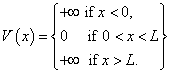
jCTbQHm.gif


Suppose that you do not know the state function describing the system, but that you are told the expectation value of the position of the particle is given by

[tex]\left\langle x \right\rangle \left( t \right) = \frac{L}{2} + \alpha L\sin \left( {\Omega t} \right)[/tex]

where α is some unknown constant less than 1/2, and Ω is some frequency greater than zero.

Homework Equations


Equations used in Quantum Mechanics​

Questions:
a. There are many possible values of Ω - what are the allowed values of Ω? (That is, provide an equation for ℏΩ (h-bar*Ω) ). Explain your answer.

b. Write down the most general wave function consistent with this expectation value. Explain your answer.​
 
Physics news on Phys.org
So... where is your "attempt at a solution"??

OK, I'll give you a hint: write down the Schrödinger equation applicable to this situation.
Then solve it.
 
Where is this question from? I find it quite strange, to say it friendly.

If you look for the state of a system with restricted information like in this example, the best you can do is to look for a statistical operator with maximum (von Neumann) entropy consistent with the given information. This is at least the way to look at this problem from the point of view of Shannon-Jaynes information theory.
 
This a great question! I've just spent a lovely hour in the sunshine having a go at it. As it is not a stationary state you need at least two terms in the general solution. As you need to arrive at at an expectation value of x that has a sinΩt dependency it looks like you need just two terms. I got that hΩ will represent the difference between the two energy levels of the two terms.
 
vanhees71 said:
Where is this question from? I find it quite strange, to say it friendly.

If you look for the state of a system with restricted information like in this example, the best you can do is to look for a statistical operator with maximum (von Neumann) entropy consistent with the given information. This is at least the way to look at this problem from the point of view of Shannon-Jaynes information theory.

:confused:

Surely it's just a question about pure states.

Jilang said:
This a great question! I've just spent a lovely hour in the sunshine having a go at it. As it is not a stationary state you need at least two terms in the general solution. As you need to arrive at at an expectation value of x that has a sinΩt dependency it looks like you need just two terms. I got that hΩ will represent the difference between the two energy levels of the two terms.

I agree! Perhaps we should add that when you have a superposition of two energy eigenstates, the system will "ring" at the characteristic frequency [itex]\Omega[/itex], as a result of "quantum mechanical cross terms". When you couple the system to an electromagnetic field, it might throw out a photon of that frequency.
 
Meanwhile, the OP has still made zero attempt at a solution...
 
strangerep said:
Meanwhile, the OP has still made zero attempt at a solution...

What's frustrating is that others who put in decent effort get no replies at all...
 

Similar threads

  • · Replies 9 ·
Replies
9
Views
2K
  • · Replies 14 ·
Replies
14
Views
3K
Replies
2
Views
2K
Replies
3
Views
2K
Replies
2
Views
2K
Replies
16
Views
3K
  • · Replies 3 ·
Replies
3
Views
3K
  • · Replies 7 ·
Replies
7
Views
3K
Replies
7
Views
3K
  • · Replies 3 ·
Replies
3
Views
2K