RedBarchetta
- 49
- 1
Once again, thanks to the physics forum, my previously answered questions helped me get an A on my homework. Thanks! Once again, any help or direction is appreciated. 
1. Find the critical numbers of the function. (Enter your answers as fractions.) (3 answers)
F(x) = (x^(4/5))*(x - 8)^2
So I tried to take the derivative but came out with a sloppy mess.
First I expanded the last term.
F'(x)=(x^4/5)*(x^2-16x+64)
Applied the product rule.
F'(x)=(4/5)x^(9/5))-(64/5)x^(4/5)+2x^(9/5)-16x^(4/5)
Simplified.
F'(x)=(256/5)x^(-1/5)+(14/5)x^(9/5)-(16/5)x^(4/5)
That's where I get stuck.
_______________________________________________________________________
2.Consider the following figure.
Use the graph of f to estimate the values of c to the nearest 0.1 that satisfy the conclusion of the Mean Value Theorem for the interval [1,7]. (4 answers "c=___")
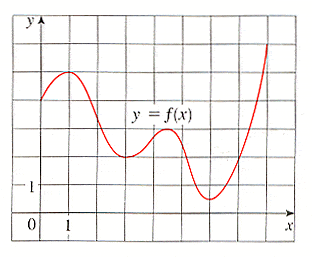
I'm lost on this one.
_______________________________________________________________________
3. Find the number c that satisfies the conclusion of the Mean Value Theorem on interval [1, 8].
http://www.webassign.net/www25/symImages/8/4/1dfa59f85aa090c063e8caadcd2d2c.gif
With this one I started by taking the derivative of the function and ended up with 4x/16.
I set this equal to zero and had x=0. I tried this but it was wrong.
_______________________________________________________________________
4. If f(4) = 15 and f '(x) ≥ 2 for 4 ≤ x ≤ 8, how small can f(8) possibly be?
No clue on the theory on this one.
_______________________________________________________________________
5. Suppose the derivative of a function f is given below. On what interval is f increasing? (Enter the interval that contains smaller numbers first. If you need to use - or , enter -INFINITY or INFINITY.)
f '(x) = (x + 1)^2(x - 5)^3(x - 6)^4
I typed it into the calculator, I saw the it was going to infinity, I need to take the derivative to find the critical point?
_______________________________________________________________________
6. Consider the equation below. (Give your answers correct to two decimal places.)
f(x) = 7sin(x) + 7cos(x)
0 ≤ x ≤ 2(pie)
How do you take the derivative of that? Also, how do you work with pie? It's so painstakingly time-taking for me. I've had to convert everything. This is how far I got:
f'(x)=7(sin(x)+cos(x))
f'(x)=7(cos(x)-sin(x))
f'(x)=0 when 7(cos(x)-sin(x))=0
(cos(x)-sin(x))=0
cos(x)=sin(x)
then...?
(b) Find the local minimum and maximum values of f.
I'm typing in 1.41 and -1.41 but it says its wrong. Also, when your loo
_______________________________________________________________________
7. Find the number c that satisfies the conclusion of Rolle's Theorem.
f(x) = x^3- x^2-2x+6 [0, 2]
I got 1.21 but it says its wrong. Argh.
_______________________________________________________________________
8. Find the number c that satisfies the conclusion of Rolle's Theorem.
f(x) = cos(2x) on interval [pie/8,7*pie/8]
So, derivative? Chain rule.
f'(x)=-2sin(2x)
f'(x)=0 when f'(x)=-2sin(2x)=0
-2sin(2x)=0
sin(2x)=0
Then...?
Thanks!
1. Find the critical numbers of the function. (Enter your answers as fractions.) (3 answers)
F(x) = (x^(4/5))*(x - 8)^2
So I tried to take the derivative but came out with a sloppy mess.
First I expanded the last term.
F'(x)=(x^4/5)*(x^2-16x+64)
Applied the product rule.
F'(x)=(4/5)x^(9/5))-(64/5)x^(4/5)+2x^(9/5)-16x^(4/5)
Simplified.
F'(x)=(256/5)x^(-1/5)+(14/5)x^(9/5)-(16/5)x^(4/5)
That's where I get stuck.
_______________________________________________________________________
2.Consider the following figure.
Use the graph of f to estimate the values of c to the nearest 0.1 that satisfy the conclusion of the Mean Value Theorem for the interval [1,7]. (4 answers "c=___")
I'm lost on this one.
_______________________________________________________________________
3. Find the number c that satisfies the conclusion of the Mean Value Theorem on interval [1, 8].
http://www.webassign.net/www25/symImages/8/4/1dfa59f85aa090c063e8caadcd2d2c.gif
With this one I started by taking the derivative of the function and ended up with 4x/16.
I set this equal to zero and had x=0. I tried this but it was wrong.
_______________________________________________________________________
4. If f(4) = 15 and f '(x) ≥ 2 for 4 ≤ x ≤ 8, how small can f(8) possibly be?
No clue on the theory on this one.
_______________________________________________________________________
5. Suppose the derivative of a function f is given below. On what interval is f increasing? (Enter the interval that contains smaller numbers first. If you need to use - or , enter -INFINITY or INFINITY.)
f '(x) = (x + 1)^2(x - 5)^3(x - 6)^4
I typed it into the calculator, I saw the it was going to infinity, I need to take the derivative to find the critical point?
_______________________________________________________________________
6. Consider the equation below. (Give your answers correct to two decimal places.)
f(x) = 7sin(x) + 7cos(x)
0 ≤ x ≤ 2(pie)
How do you take the derivative of that? Also, how do you work with pie? It's so painstakingly time-taking for me. I've had to convert everything. This is how far I got:
f'(x)=7(sin(x)+cos(x))
f'(x)=7(cos(x)-sin(x))
f'(x)=0 when 7(cos(x)-sin(x))=0
(cos(x)-sin(x))=0
cos(x)=sin(x)
then...?
(b) Find the local minimum and maximum values of f.
I'm typing in 1.41 and -1.41 but it says its wrong. Also, when your loo
_______________________________________________________________________
7. Find the number c that satisfies the conclusion of Rolle's Theorem.
f(x) = x^3- x^2-2x+6 [0, 2]
I got 1.21 but it says its wrong. Argh.
_______________________________________________________________________
8. Find the number c that satisfies the conclusion of Rolle's Theorem.
f(x) = cos(2x) on interval [pie/8,7*pie/8]
So, derivative? Chain rule.
f'(x)=-2sin(2x)
f'(x)=0 when f'(x)=-2sin(2x)=0
-2sin(2x)=0
sin(2x)=0
Then...?
Thanks!
Last edited by a moderator: