What are the key characteristics of polar curves like petals and limacons?

  • Context: MHB 
  • Thread starter Thread starter Eissa12
  • Start date Start date
  • Tags Tags
    Curves Polar
Click For Summary
SUMMARY

This discussion focuses on the characteristics of polar curves, specifically rose curves and limacons. The rose curve is defined by the equation r = a sin(bθ), where the number of petals is determined by the value of b; if b is odd, the curve has b petals, while if b is even, it has 2b petals. The limacon, represented by r = d + a sin(θ), exhibits variations such as cardioids and inner loops, which occur based on the relationship between d and a. Key values for petal tips and the conditions for r = 0 are also explored, providing a comprehensive understanding of these polar curves.

PREREQUISITES
  • Understanding of polar coordinates and polar equations
  • Familiarity with trigonometric functions and their graphs
  • Knowledge of the properties of rose curves and limacons
  • Ability to sketch polar graphs and interpret their features
NEXT STEPS
  • Study the derivation and properties of rose curves using r = a sin(bθ)
  • Explore the variations of limacons, focusing on the conditions for inner loops and cardioids
  • Practice sketching polar graphs for different values of a and b in rose curves
  • Investigate the impact of phase shifts in polar equations on graph characteristics
USEFUL FOR

Mathematicians, educators, and students interested in advanced geometry, particularly those studying polar coordinates and their applications in graphing and analysis.

Eissa12
Messages
1
Reaction score
0
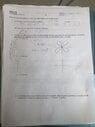
View attachment 8979A) Find all values on [0,2pie) such that (thita0) produces the tip of a petal (maximum magnitude of r) all values for which r=0, and sketch a graph?

a) r = 5 sin 2 (thita0)

a) r = 5 sin 3 (thita0)

a) r = 5 sin 4 (thita0)

B) considering what you can observe in the previous graphs, what are general guidelines for number, length and position of petals for a general rose curve: r = a sin b (thita0).

c) A polar curve in the frome r = d + a sin (thita0) is called a limacon and has several distinct variations, including a cardioid and a limacon with an inner loop. Create general guidelines for when these variations occur and explain what causes them to occur?
 

Attachments
  • thumbnail_image1.jpg
    thumbnail_image1.jpg
    69.1 KB · Views: 172
Last edited:
Physics news on Phys.org
tip of the petal $\implies$ $\cos(2\theta) = \pm 1$ ...

$0 \le \theta < 2\pi \implies 0 \le 2\pi < 4\pi$$r = 5\cos(2\theta) \implies \cos(2\theta) = \pm 1 \implies 2\theta \in \left\{ 0, \pi, 2\pi, 3\pi \right\} \implies \theta \in \left\{0, \dfrac{\pi}{2}, \pi, \dfrac{3\pi}{2} \right\}$

[DESMOS]advanced: {"version":7,"graph":{"polarMode":true,"viewport":{"xmin":-10.57,"ymin":-7,"xmax":10.57,"ymax":7.000000000000002}},"expressions":{"list":[{"type":"expression","id":"graph1","color":"#2d70b3","latex":"r\\left(\\theta\\right)=5\\cos\\left(2\\theta\\right)\\ ","polarDomain":{"min":"0","max":"2\\pi"}},{"type":"expression","id":"6","color":"#2d70b3"},{"type":"expression","id":"4","color":"#000000"},{"type":"expression","id":"3","color":"#6042a6"},{"type":"expression","id":"2","color":"#388c46"}]}}[/DESMOS]
 
Last edited by a moderator:

Similar threads

  • · Replies 3 ·
Replies
3
Views
3K
  • · Replies 4 ·
Replies
4
Views
11K
  • · Replies 3 ·
Replies
3
Views
7K
  • · Replies 5 ·
Replies
5
Views
5K
  • · Replies 4 ·
Replies
4
Views
4K
  • · Replies 1 ·
Replies
1
Views
10K
Replies
1
Views
2K
  • · Replies 8 ·
Replies
8
Views
3K
  • · Replies 7 ·
Replies
7
Views
5K
  • · Replies 18 ·
Replies
18
Views
15K