What Are the Key Concepts and Misconceptions About Resonance?

  • Context: Undergrad 
  • Thread starter Thread starter blooperkin
  • Start date Start date
  • Tags Tags
    Confused Resonance
Click For Summary

Discussion Overview

The discussion revolves around the concept of resonance, exploring its definitions, implications, and common misconceptions. Participants inquire about the nature of driven oscillations, the relationship between driving and natural frequencies, and the effects of damping on amplitude. The scope includes theoretical explanations and practical examples across mechanical and electrical systems.

Discussion Character

  • Exploratory
  • Technical explanation
  • Conceptual clarification
  • Debate/contested

Main Points Raised

  • Some participants question the meaning of "amplitude of driver of oscillation" and why the amplitude of the driven object matches the driver's amplitude when the driver frequency is zero.
  • There is uncertainty regarding whether the driven system is initially oscillating or at rest.
  • Participants discuss the behavior of amplitude in relation to the 'light damping' curve, noting that amplitude increases up to the natural frequency (f₀) and decreases thereafter.
  • Some argue that a system's natural frequency is fixed, using examples like a swing and a brass instrument to illustrate this point, while others suggest that the driven frequency can influence oscillation amplitude.
  • A participant mentions that in an electrical LCR resonant circuit driven by a sine wave, only the driving frequency is present, regardless of the circuit's resonant frequency.
  • Another participant agrees that this holds true for any system after transients are damped.

Areas of Agreement / Disagreement

Participants express multiple competing views regarding the nature of resonance, the relationship between driving and natural frequencies, and the behavior of oscillations under different conditions. The discussion remains unresolved with no consensus reached on several points.

Contextual Notes

Limitations include assumptions about the initial state of the driven system, the definitions of amplitude and frequency, and the effects of damping on oscillation behavior. The discussion does not resolve these complexities.

blooperkin
Messages
8
Reaction score
0
Hi!

I have a few questions about resonance:
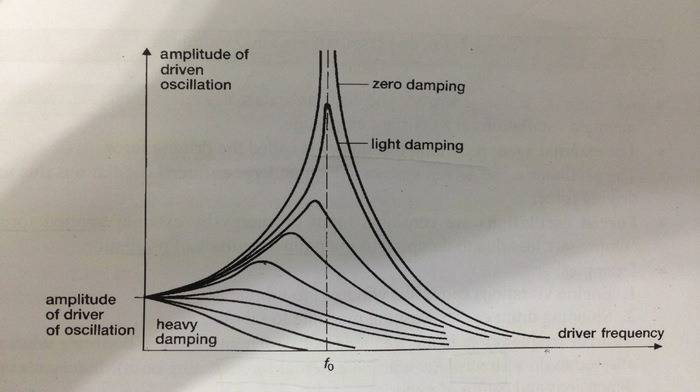
4jweb8.jpg


1) What exactly is the "amplitude of driver of oscillation"? And why is the amplitude of the driven object equal to the amplitude of the driver right from the start when the driver frequency is 0?

2) Is the driven system originally oscillating?

3) In reference to the 'light damping' curve, why does the amplitude of driven oscillation increase between 0 and f₀, but decrease after f₀?

4) Also, is a system's natural frequency fixed? eg. No matter how hard I push someone who is sitting on a swing, the amplitude will increase but the frequency will remain constant? How about a brass instrument?

Just started learning this topic so I may have many misconceptions - hopefully a simple basic explanation about the concept of resonance would be good.

- a very confused student
 
Last edited:
Physics news on Phys.org
blooperkin said:
Hi!

I have a few questions about resonance:
4jweb8.jpg


1) What exactly is the "amplitude of driver of oscillation"? And why is the amplitude of the driven object equal to the amplitude of the driver right from the start when the driver frequency is 0?

2) Is the driven system originally oscillating?

3) In reference to the 'light damping' curve, why does the amplitude of driven oscillation increase between 0 and f₀, but decrease after f₀?

4) Also, is a system's natural frequency fixed? eg. No matter how hard I push someone who is sitting on a swing, the amplitude will increase but the frequency will remain constant? How about a brass instrument?

Just started learning this topic so I may have many misconceptions - hopefully a simple basic explanation about the concept of resonance would be good.

- a very confused student
This plot is in respect with a forced (or driven) oscillator.
A periodic force is applied to the oscillator. The force has an amplitude and a frequency (fd).
The oscillator itself has its natural frequency, fo. This one is fixed for a given system and is the frequency at which it will oscillate if there is no driving force.
If it is driven though, it will oscillate with the frequency of the driving force (fd). The amplitude of this oscillation will depend on how far is fd from fo.
 
Lets start this discussion with the following. Resonance is a phenomena associated with oscillatory changes in some physical quantity. that could be vibrations in mechanical devices with elastic or movable components, in electrical devices excited by alternating voltage, cavities with flowing gases, atoms and molecules that have certain symmetries.

It would be useful to know in what context you are interested in so as to pick reverent examples to work with.

Mechanical resonance can easily be appreciated. Most real rigid bodies are elastic to some extent. And as such can be set into a vibration or oscillation by striking it or interacting with it with some other type of force. The vibration frequency is characteristic of the shape and material of the object. When you apply a force to an object and you distort it even ever so slightly, you do work and transfer energy to the body. The body being elastic will rebound and vibrate some more but real bodies have a characteristics like an internal friction which causes the vibration to dissipate with time usually quickly. If you apply the force before the vibration dissipates the vibration can be sustained. If the force applied is in tune i.e. the same frequency as the characteristic frequency of the bodies vibration the vibration will increase in intensity and the body will accumulate more energy before it can be dissipated. The build up in energy can continue until the vibration distorts the object even to the extent that it exceeds the elastic limit of the material of the object. An example is a singer holding a tone equal to the characteristic frequency of a wine glass to cause it to eventually break. The "singing" of stretched cable in a high wind is another example of resonance. The body of a guitar or other string instrument. An annoying rattle in a car at a certain speed. This is resonance
blooperkin said:
1) What exactly is the "amplitude of driver of oscillation"? And why is the amplitude of the driven object equal to the amplitude of the driver right from the start when the driver frequency is 0?

The amplitude of the driver is the maximum displacement of the force of the driving mechanism i.e the external force the pushing or pulling that is being applied to force the system into an oscillation. The driven system is initially at rest so when the driver force is applied it responds to it in kind.

blooperkin said:
) Is the driven system originally oscillating?
The driven system can be oscillating or not.

blooperkin said:
3) In reference to the 'light damping' curve, why does the amplitude of driven oscillation increase between 0 and f₀, but decrease after f₀?
The graph shows you the response of the system to different driving frequencies, Resonance is a phenomena in which some energy provide to a system by the driver is stored in that system as measured by amplitude of its oscillations or vibrations. The closer the driver frequency is to the resonance frequency the more energy is stored in the driven system as seen by the increase in the amplitude i.e. the size of the vibrations.

blooperkin said:
4) Also, is a system's natural frequency fixed? eg. No matter how hard I push someone who is sitting on a swing, the amplitude will increase but the frequency will remain constant? How about a brass instrument?

The natural resonant frequency is fixed. With regard to the swing the natural frequency is determined by the length of the ropes as a swing it is a simple pendulum. Changing the driver frequency so that it is "off resonance" will result in a smaller amplitude. The swing might oscillate at the driver frequency if it is strong enough.

To see a vivid example of resonance and it importance in engineering Google the" Tacoma Narrows Bridge" for a famous example
 
On a small point regarding (4), if we take the example of an electrical LCR resonant circuit driven with a sine wave, I think that the only frequency present would be the driving frequency, irrespective of the resonant frequency of the circuit.
 
This is true for any system, after the transients are damped.
 

Similar threads

Replies
17
Views
3K
  • · Replies 17 ·
Replies
17
Views
3K
  • · Replies 4 ·
Replies
4
Views
2K
  • · Replies 92 ·
4
Replies
92
Views
7K
  • · Replies 5 ·
Replies
5
Views
3K
  • · Replies 7 ·
Replies
7
Views
2K
  • · Replies 10 ·
Replies
10
Views
3K
  • · Replies 11 ·
Replies
11
Views
2K
  • · Replies 3 ·
Replies
3
Views
2K
  • · Replies 9 ·
Replies
9
Views
7K