What Are the Mass and Friction Coefficient for the Blocks?

  • Thread starter Thread starter EPFLstudent
  • Start date Start date
Click For Summary

Homework Help Overview

The discussion revolves around a problem involving two blocks with different masses, where the dynamics of their motion are influenced by friction. The original poster presents specific values for the smaller block's mass and the resulting accelerations of the larger block, seeking to derive relationships and determine the mass of the larger block and the friction coefficient.

Discussion Character

  • Exploratory, Conceptual clarification, Problem interpretation

Approaches and Questions Raised

  • Participants explore the relationship between the movements of the two blocks, with one noting that the smaller block moves twice as much as the larger block. There are inquiries about the forces acting on the smaller block and suggestions to utilize free body diagrams for clarity.

Discussion Status

The discussion is active, with participants engaging in exploratory dialogue about the relationships between the blocks' movements and the forces involved. Guidance has been offered regarding the use of free body diagrams to analyze the problem further.

Contextual Notes

Participants are working under the constraints of the problem's parameters, including specific masses and accelerations, while also considering the absence of friction on certain surfaces. The original poster's questions indicate a need for clarification on the dynamics involved.

EPFLstudent
Messages
2
Reaction score
0
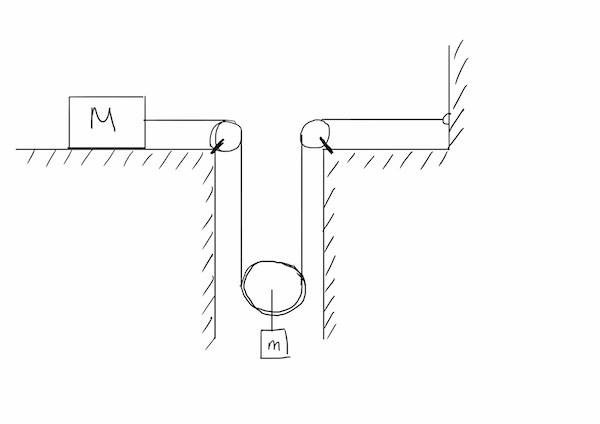
Figure attached below. You have a big block of mass M and a small block of mass m. When m=3kg, the acceleration of the large block is 0.6ms-2. When m=4kg, the acceleration of the large block is 1.6ms-2. The dynamic friction coefficient between the large block and the surface it slides on is μ. There is no friction between any other surface. Questions:

a) Express the relationship between the movement of block m and block M
b) Derive expressions for the motion of block m and block M.
c) Determine the mass of block M and the dynamic friction coefficient, μ, between it and the surface it slides on.
FDmZ7.jpg
 
Last edited:
Physics news on Phys.org
Nice problem. So what have you got so far? How does the motion of mass m relate to the motion of mass M?
 
I know that [itex]x_m = 2 x_M[/itex], so that the small block moves two times as much as the big block. My problem is decomposing the forces.
 
Draw free body diagrams. Start with the mass m. What forces are acting on m?
 

Similar threads

  • · Replies 4 ·
Replies
4
Views
3K
Replies
13
Views
4K
  • · Replies 6 ·
Replies
6
Views
2K
Replies
6
Views
1K
  • · Replies 9 ·
Replies
9
Views
2K
  • · Replies 5 ·
Replies
5
Views
1K
  • · Replies 33 ·
2
Replies
33
Views
4K
Replies
6
Views
2K
Replies
15
Views
3K
Replies
1
Views
3K