What Are the Periodic Patterns of Sine Functions in Trigonometry?

  • Context: Undergrad 
  • Thread starter Thread starter greggory
  • Start date Start date
  • Tags Tags
    Expression Sine Waves
Click For Summary

Discussion Overview

The discussion revolves around the periodic patterns of sine functions in trigonometry, exploring specific expressions and their graphical representations. Participants examine the behavior of sine functions and their relationships with other trigonometric functions, focusing on both theoretical and practical implications.

Discussion Character

  • Exploratory
  • Technical explanation
  • Conceptual clarification
  • Debate/contested

Main Points Raised

  • One participant presents an expression involving sine functions and asks for an explanation of its graphical behavior.
  • Another participant suggests that the expression can be simplified depending on the placement of parentheses, leading to different interpretations of the equation.
  • A participant acknowledges the explanation and introduces a new expression involving sine and tangent functions, seeking further clarification on its periodic nature.
  • Another participant explains that the sine of 2π equals zero and provides a simplification of the introduced expression, leading to a cosine function.
  • It is noted that all trigonometric functions are periodic, implying that combinations of these functions will also exhibit periodic behavior.

Areas of Agreement / Disagreement

Participants express varying interpretations of the initial sine expression, leading to different simplifications and understandings. While there is agreement on the periodic nature of trigonometric functions, the discussion includes multiple perspectives and interpretations without a clear consensus on the initial expressions.

Contextual Notes

Participants rely on specific definitions and interpretations of trigonometric functions, which may lead to different conclusions based on the context of the expressions used. The discussion does not resolve the ambiguities related to the initial expression's formulation.

Who May Find This Useful

This discussion may be of interest to students and educators in mathematics, particularly those exploring trigonometric functions and their properties, as well as individuals seeking to understand the graphical representations of these functions.

greggory
Messages
14
Reaction score
0
"Waves" of sine expression

So, I have been working with a lot of Math today(sorry if I am asking so many questions), and I found and expression. All sine functions use radians.

sin(y) + sin(y) / sin(y)

Now, assuming you start with 1, if you were to plot y on a graph with variable x increasing each time calculated, you would get something like this:
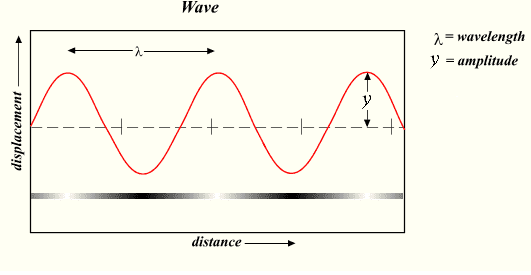
wave_amplitude_line.png


This image isn't mine, so this is just something identicle.

Can this be explained?
 
Mathematics news on Phys.org


Two things.

First of all, the equation can be simplified. Depending on the use of parentheses, if you mean \ sin(y)+\frac{ sin(y)}{ sin(y)}, this simplifies to \ sin(y)+1

If you meant \frac{ sin(y)+ sin(y)}{ sin(y)}, this simplifies to the number 2.

In the latter case, it is a null statement, but assuming you meant the first equation, the sine function is defined in a couple of cool ways (the easiest being the ratio of the opposite and hypotenuse of a right triangle), and it turns out when you define a function that way it repeats itself like a wave.


Thank you for the explanation. I was wondering why it did that(it was obvious, but any who).

But the expression sin(y) + sin(2*pi) / tan(y) does the same thing. Can that be explained?
 
Last edited:


Because sin(2\pi)= 0! And tan(y)= sin(y)/cos(y) so that
\frac{sin(y)+ sin(2\pi)}{tan(y)}= \frac{sin(y)}{\frac{sin(y)}{cos(y)}}= sin(y)\frac{cos(y)}{sin(y)}= cos(y)


And in a more general way, all of the trigonometric functions are periodic, so any combination of trig functions with also be periodic.
 

Similar threads

  • · Replies 8 ·
Replies
8
Views
2K
  • · Replies 139 ·
5
Replies
139
Views
11K
  • · Replies 3 ·
Replies
3
Views
2K
  • · Replies 7 ·
Replies
7
Views
3K
  • · Replies 78 ·
3
Replies
78
Views
7K
  • · Replies 3 ·
Replies
3
Views
2K
  • · Replies 1 ·
Replies
1
Views
2K
  • · Replies 15 ·
Replies
15
Views
3K
  • · Replies 1 ·
Replies
1
Views
2K
  • · Replies 1 ·
Replies
1
Views
2K