rumborak
- 706
- 154
The "wireless power" thread made me think of this, but I have pondered it before when it comes to microphone arrays etc
You can easily find documentation on the interference patterns N in-line sources of waves generate. E.g.
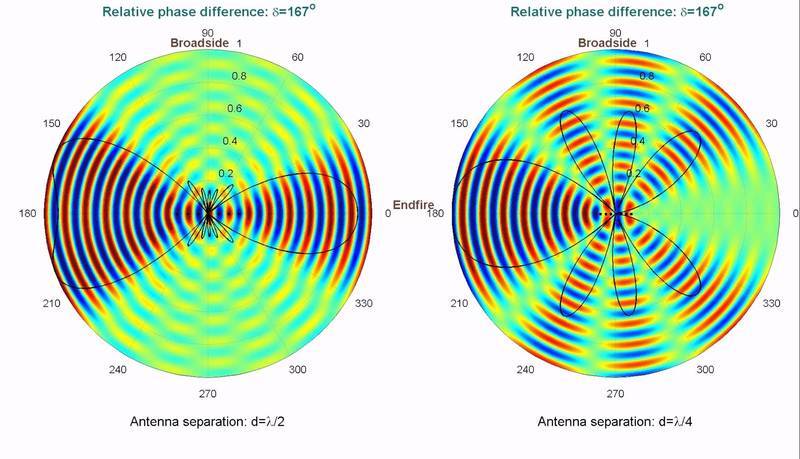
The annoying thing here is that you have infinitely extending lobes, which would be undesirable for something that tries to pinpoint delivery of (acoustic/EM) energy.
It would seem to me that for example a source arrangement in a triangle would allow some spatially constrained Maxima inside it; but are there simple rules of thumb for this type of thing that constrain the patterns? I can imagine that with a complete ring of sources you could probably reverse engineer any pattern with a Fourier analysis, but that's also overkill on the other end.
You can easily find documentation on the interference patterns N in-line sources of waves generate. E.g.
The annoying thing here is that you have infinitely extending lobes, which would be undesirable for something that tries to pinpoint delivery of (acoustic/EM) energy.
It would seem to me that for example a source arrangement in a triangle would allow some spatially constrained Maxima inside it; but are there simple rules of thumb for this type of thing that constrain the patterns? I can imagine that with a complete ring of sources you could probably reverse engineer any pattern with a Fourier analysis, but that's also overkill on the other end.