What are the practical limits of constructive interference?

Click For Summary
SUMMARY

The discussion centers on the practical limits of constructive interference in the context of directed energy weapons and microphone arrays. It highlights the challenges posed by infinitely extending lobes in interference patterns, which complicate the pinpoint delivery of acoustic and electromagnetic energy. The conversation references the necessity of an extended source to achieve a narrow beam width, governed by the diffraction limit, and introduces the concept of Supergain Arrays as a technique to improve performance, albeit with limited effectiveness. Key resources include the Wikipedia article on directed-energy weapons and the Long Range Acoustic Device (LRAD).

PREREQUISITES
  • Understanding of constructive interference and diffraction principles
  • Familiarity with directed energy weapons and their applications
  • Knowledge of microphone array configurations and their interference patterns
  • Basic principles of Fourier analysis in wave patterns
NEXT STEPS
  • Research the principles of diffraction and its impact on beam width
  • Explore the design and functionality of Supergain Arrays
  • Investigate the applications and limitations of Long Range Acoustic Devices (LRAD)
  • Study the mathematical foundations of Fourier analysis in wave interference
USEFUL FOR

Engineers, physicists, and researchers involved in the development of directed energy systems, as well as audio engineers working with microphone arrays and interference patterns.

rumborak
Messages
706
Reaction score
154
The "wireless power" thread made me think of this, but I have pondered it before when it comes to microphone arrays etc
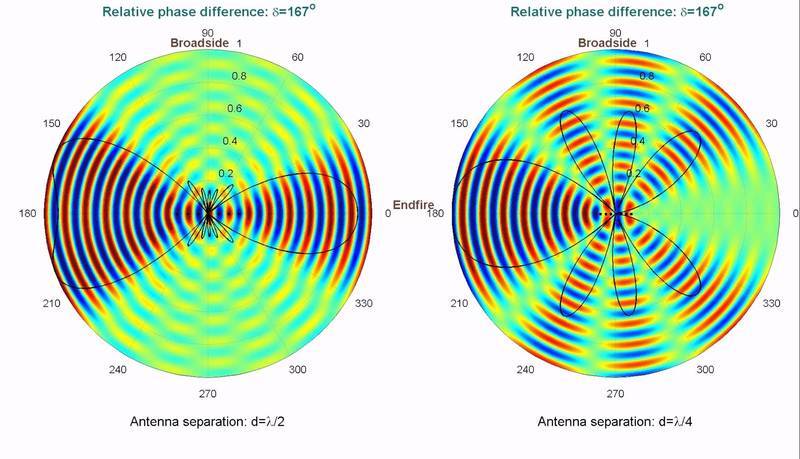
You can easily find documentation on the interference patterns N in-line sources of waves generate. E.g.
maxresdefault.jpg


The annoying thing here is that you have infinitely extending lobes, which would be undesirable for something that tries to pinpoint delivery of (acoustic/EM) energy.
It would seem to me that for example a source arrangement in a triangle would allow some spatially constrained Maxima inside it; but are there simple rules of thumb for this type of thing that constrain the patterns? I can imagine that with a complete ring of sources you could probably reverse engineer any pattern with a Fourier analysis, but that's also overkill on the other end.
 
Science news on Phys.org
rumborak said:
The annoying thing here is that you have infinitely extending lobes, which would be undesirable for something that tries to pinpoint delivery of (acoustic/EM) energy.
This is a consequence of Diffraction. To direct energy in a specified direction with a certain required beam width you need an extended source. The narrower the required beam θ, the wider the necessary Aperture, d. (roughly θ = λ/2d) There are techniques for doing a bit better than the diffraction limit with 'Supergain Arrays' but there is not a lot of juice in that lemon. This is one of the reasons why Radiotelescopes are so enormous.
 

Similar threads

  • · Replies 23 ·
Replies
23
Views
7K
  • · Replies 9 ·
Replies
9
Views
9K
  • · Replies 26 ·
Replies
26
Views
4K
  • · Replies 2 ·
Replies
2
Views
2K
  • · Replies 13 ·
Replies
13
Views
4K