What Can You Learn About the Moon?

  • Context: Insights 
  • Thread starter Thread starter Greg Bernhardt
  • Start date Start date
  • Tags Tags
    lunar moon quiz
Click For Summary

Discussion Overview

The discussion revolves around a quiz about the Moon, exploring various aspects of lunar knowledge, including its atmosphere, density, and related phenomena such as lunar eclipses. Participants share their quiz scores and engage in discussions about the Moon's characteristics and related astronomical concepts.

Discussion Character

  • Exploratory
  • Debate/contested
  • Conceptual clarification

Main Points Raised

  • Some participants express confusion about the Moon's atmosphere, with one noting that it has an "exceedingly low density exoatmosphere."
  • There is a discussion about the Moon being the second densest body in the solar system, with some suggesting it should be referred to as the second densest satellite.
  • Participants debate the definition of a "Blood Moon" and the conditions under which total lunar eclipses occur, with references to the term "Tetrad."
  • Several participants share their quiz scores, indicating varying levels of knowledge about lunar facts.
  • One participant humorously notes the Moon's lack of atmosphere in a joke format.
  • There are corrections and clarifications regarding the Moon's magnetic field and the interpretation of quiz questions.

Areas of Agreement / Disagreement

Participants generally express differing views on the Moon's atmosphere and magnetic field, with no consensus reached on these topics. The discussion remains unresolved regarding the definitions and characteristics of lunar phenomena.

Contextual Notes

Some statements about the Moon's atmosphere and magnetic field are contingent on definitions and measurement limitations, which are not fully resolved in the discussion.

Messages
19,881
Reaction score
10,890
Greg Bernhardt submitted a new PF Insights post

The Moon Quiz
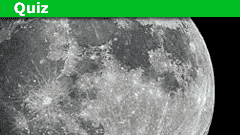
themoon.png


Continue reading the Original PF Insights Post.
 
  • Like
Likes   Reactions: QuantumQuest
Physics news on Phys.org
I got 4 correct out of 12. In question 3, I thought the moon has no atmosphere. A very interesting quiz, but not an easy one. Thank you Greg.
 
2/12, I hate the moon, now :oldgrumpy:
 
  • Like
Likes   Reactions: Charles Link
I gave up in the middle.
 
  • Like
Likes   Reactions: Charles Link
I managed 6 / 12 ... you asked some very good questions!
 
That's a tough quiz. I got 3 and 5.
 
Knowing about the moon is good to us because many things are related with the moon like existence of tides etc.
 
Last edited by a moderator:
12 out of 12. I really like Astronomy!
 
  • Like
Likes   Reactions: davenn and Greg Bernhardt
  • #10
7 out of 12. Went for the missing atmosphere (nice one, Greg) but recovered a bit on the space mission questions.
 
  • Like
Likes   Reactions: Greg Bernhardt
  • #11
8/12
 
  • #12
8, with some lucky guesses.
 
  • Like
Likes   Reactions: Greg Bernhardt
  • #13
astronomy teaches the correct use of the sun and the planets
 
  • #14
6, with two pure luck hits.
 
  • #15
@Greg Bernhardt:
The moon is the second-densest body in the solar system, beaten by Jupiter’s moon ____
Mercury, Venus, Earth and Mars are denser. Vesta is a bit denser. Io is denser. Various small particles should have a higher density.

4 total lunar eclipses that happen in a row is called
4 total lunar eclipses in a row are impossible. "Blood moon" is just a simple lunar eclipse, or four full moons in a season. Either or, not both.
 
  • Like
Likes   Reactions: PeterDonis
  • #16
10 out of 12, made a wrong guess on how many moons fit inside the Earth (should have calculated it in my head), and I had no idea what a Blood Moon was but I don't consider that a matter of physics anyway. :wink:
 
  • Like
Likes   Reactions: davenn
  • #17
mfb said:
Mercury, Venus, Earth and Mars are denser. Vesta is a bit denser.

I think a better wording for question 10 would be that the moon is the second densest satellite in the solar system.
 
  • #18
The second densest moon?

Oh, and various artificial satellites are denser than the Moon.

Got China, the night launch and the sun/eclipsing moon wrong. And the two questions that didn't have a right answer.
 
  • #20
Greg Bernhardt said:
No, it is wrong in the source.

Edit: Wait, they use 6 months as spacing between the full eclipses. That is weird. I would certainly not call that "in a row".
 
  • Like
Likes   Reactions: Greg Bernhardt
  • #21
9 out of 12

PeterDonis said:
10 out of 12, made a wrong guess on how many moons fit inside the Earth (should have calculated it in my head), and I had no idea what a Blood Moon was but I don't consider that a matter of physics anyway. :wink:
yeah me too,

I chose 42 instead of 49 ... reading/watching too much Hitchhikers guide to the Galaxy hahaha

Greg Bernhardt said:

we have just been through a 4 eclipse blood mood set. This set of 4 is called a Tetrad
two total eclipses in a year, two years in a row

The first happened on April 15, 2014 and the second on October 8, 2014.
The third blood moon on Saturday April 4, 2015. The last on September 28, 2015
The eclipses in a tetrad occur 6 months apart with at least 6 full Moons between them.Dave
 
  • #22
I got 8 correct. Having a father who worked on building the lunar module helped a lot, although I screwed up the first test of of the LM. I am surprised by the 49 moons fitting in Earth.
 
  • #23
I got 12 on my second try. Does that count? :p
 
  • Like
Likes   Reactions: Pepper Mint, mfb and Greg Bernhardt
  • #24
My score was 4. no cheating by googling before doing it
At least I was pretty much certain on the ones I got right.
 
Last edited:
  • #25
4. Meh..
 
  • #26
mfb said:
Edit: Wait, they use 6 months as spacing between the full eclipses. That is weird. I would certainly not call that "in a row".
Whet they mean is that there are no intervening partial or penumbral lunar eclipses. Greg has this one right.

I do have to quibble about question #3. When people say that the Moon does have an atmosphere, what they mean is that the Moon has an exceeding low density exoatmosphere, with a surface atmospheric density on the Moon about 10-13 times that of the density of the Earth's atmosphere at the surface. When people say the Moon does not have a global magnetic field, what they mean the the Moon's dipole moment is less than 10-5 times that of the Earth's. There is no way to say that the Moon has no global magnetic field. The best we can say is that the Moon's global magnetic field, if it exists, is less than measurement noise. Measurement noise for magnetic field strength relative to that of the Earth is many orders of magnitude larger than is the measurement noise for particles of gas relative to that of the Earth standard atmosphere.
 
Last edited:
  • Like
Likes   Reactions: Greg Bernhardt
  • #27
Did you hear about the restaurant on Moon? Great food, but no atmosphere.
 
  • #28
"Congratulations – you have completed The Moon Quiz. You scored 4 points out of 12 points total."
 
  • #29
8/12; learn something new every day!
 

Similar threads

  • · Replies 40 ·
2
Replies
40
Views
5K
  • Sticky
  • · Replies 9 ·
Replies
9
Views
7K
  • · Replies 7 ·
Replies
7
Views
2K
  • · Replies 2 ·
Replies
2
Views
2K
  • · Replies 5 ·
Replies
5
Views
3K
  • · Replies 6 ·
Replies
6
Views
2K
  • · Replies 7 ·
Replies
7
Views
3K
  • · Replies 26 ·
Replies
26
Views
4K
  • · Replies 6 ·
Replies
6
Views
2K
  • · Replies 4 ·
Replies
4
Views
2K