What causes the dimming effect in an LED with solar panel and mirror setup?

Click For Summary

Discussion Overview

The discussion revolves around the dimming effect observed in an LED setup that includes a solar panel and an optic fiber acting as a mirror. Participants explore the mechanisms behind the dimming, including energy transfer, efficiency, and the behavior of the LED under these conditions.

Discussion Character

  • Exploratory
  • Technical explanation
  • Debate/contested

Main Points Raised

  • One participant describes a setup where an LED, solar panel, and battery interact, questioning whether the LED dims continuously or blinks rapidly.
  • Another participant suggests that if the LED is the only power source after sunset, it would gradually lose energy and eventually go out, but could last a long time if partially replenished by the solar panel.
  • Some participants mention the potential utility of a transparent solar panel to improve efficiency in this setup.
  • Concerns are raised about the inefficiency of solar panels, with one participant estimating their efficiency at around 10-20% and questioning where energy loss occurs.
  • A participant calculates the maximum power transfer from the LED to the solar panel under ideal conditions, suggesting that the actual power output would be very low.
  • Another participant posits that the dimming effect may be due to the LED being partially shut down by a circuit that senses illumination from the solar panel, potentially leading to cyclic switching behavior.
  • It is noted that the modest efficiencies of both the solar cell and the LED likely result in minimal battery charge regeneration.

Areas of Agreement / Disagreement

Participants express multiple competing views on the mechanisms behind the dimming effect, the efficiency of energy transfer, and the potential for battery charge regeneration. The discussion remains unresolved with no consensus reached.

Contextual Notes

Participants highlight limitations related to assumptions about efficiency, power transfer, and the behavior of the LED and solar panel under varying conditions. The discussion reflects uncertainty regarding the exact dynamics at play.

Artlav
Messages
161
Reaction score
1
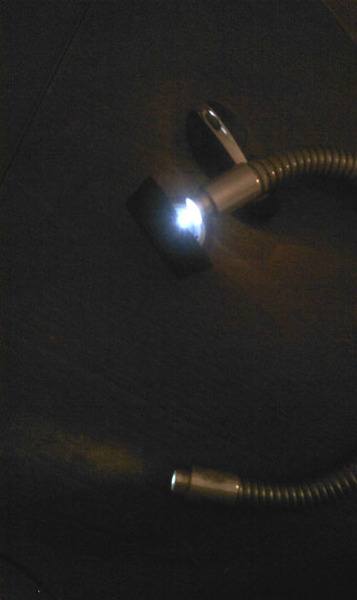
The ideas setup is this:
image_157.jpg


There is a LED with solar panel and a battery, from one of the sun-charged nightlights, and an optic fiber (the "mirror") that routes the light from the LED onto it's own solar panel.

The effect is that the light dims about half way down.

Question: What exactly happens in there?
Specifically,
-Does the LED gets continuously dimmer (and why)?
-Or, does it start to blink on and off very fast thus appearing dimmed (and why, what kind of wave would it be)?
 
Engineering news on Phys.org
Assuming the sun had gone down and the device's only source of power was the LED, I would think that it would gradually lose energy. Some of the radiant energy would become thermal(however small an amount) and it would eventually go out. Now, running on a full charge from the sun and then partially replenishing itself at the same time, it would probably last a very long time, certainly long enough to last until the sun came back(I would think, since the nightlight alone can do that), but it wouldn't last forever.

Could be worth giving it a try though, that would be an extremely useful emergency flashlight if you also rigged up a bright LED that wasn't feeding into the solar panel. It would drain faster, sure, but in an emergency I don't think you'd really care.
 
KevinMcGovern said:
Assuming the sun had gone down and the device's only source of power was the LED, I would think that it would gradually lose energy. Some of the radiant energy would become thermal(however small an amount) and it would eventually go out. Now, running on a full charge from the sun and then partially replenishing itself at the same time, it would probably last a very long time, certainly long enough to last until the sun came back(I would think, since the nightlight alone can do that), but it wouldn't last forever.

Could be worth giving it a try though, that would be an extremely useful emergency flashlight if you also rigged up a bright LED that wasn't feeding into the solar panel. It would drain faster, sure, but in an emergency I don't think you'd really care.
Sounds about right. I bet it would work better if you had a transparent solar panel. That could be quite useful.
 
I know there are windows which act as solar panels, but they're made in a different way than traditional silicon-cell solar panels, and they're much less efficient.
 
KevinMcGovern said:
I know there are windows which act as solar panels, but they're made in a different way than traditional silicon-cell solar panels, and they're much less efficient.
I guess that would be the trade off. It could be used to illuminate a room, if you had the panel directly opposite the light, and had the rest open.
 
my understanding is that solar panels are extremely inefficient... something on the order of 10 or 20%. Likely where most of the energy loss is occurring. It's been a while since I seriously looked into the technology, though, so I could be wrong.
 
Well, the biggest problem I see is the power transfer from the LED to the solar panel. ASSUMING the LED is low wattage (50mW) AND has a high efficiency light to power ratio (90%), AND that the light frequency output from the LED is a perfect match for the Solar Panel, AND that the solar panel is super efficient (30%), the MAXIMUM power from LED to solar panel output would be:
50mW * 0.90 * 0.30 = .0135mW. Adding the battery would actually make things worse. Without going into the vagaries of device latencies, I would guess the "lifetime" of this cycle would be in the nanosecond time domain, perhaps less.

Fish
 
The most important effect is likely to be partial shutting down of the LED by a circuit which senses when the solar cell is being illuminated. If this uses snap action (hysteresis) switching, one would expect to see cyclic switching on and off, at a rate depending on the response time of the circuit used.

There is probably very little regeneration of the battery charge going on here, because of the modest efficiencies of the solar cell and the LED. That said, since the LED is probably not running at full power all the time, the average current consumption may well be reduced.
 
Last edited:

Similar threads

Replies
6
Views
4K
  • · Replies 31 ·
2
Replies
31
Views
5K
  • · Replies 3 ·
Replies
3
Views
2K
Replies
18
Views
3K
  • · Replies 27 ·
Replies
27
Views
6K
  • · Replies 13 ·
Replies
13
Views
7K
  • · Replies 9 ·
Replies
9
Views
4K
  • · Replies 18 ·
Replies
18
Views
16K
  • · Replies 1 ·
Replies
1
Views
2K
  • · Replies 3 ·
Replies
3
Views
5K