What could be the ratings of inductor used?

  • Thread starter Thread starter Nikhil N
  • Start date Start date
  • Tags Tags
    Emi Inductor
Click For Summary

Discussion Overview

The discussion revolves around the power ratings and performance of inductors in a circuit that produces bursts of 500V. Participants explore issues related to component ratings, circuit behavior, and potential causes of component failure, particularly focusing on inductors and resistors. The scope includes technical explanations and troubleshooting of circuit design and component selection.

Discussion Character

  • Technical explanation
  • Debate/contested
  • Experimental/applied

Main Points Raised

  • One participant questions the need to consider the power rating of the inductor, noting that it burns during operation.
  • Another participant suggests that the burning of the inductor may be due to excessive conductive or magnetic losses, recommending the use of a core with an airgap to mitigate these losses.
  • Concerns are raised about the behavior of a voltage source (V4) in the circuit, questioning why it does not reflect expected voltage levels.
  • Participants discuss the importance of component ratings, particularly for the first MOSFET in the circuit, and the need to calculate the current from the source.
  • There are suggestions to use an air core coil or to wind a custom inductor to handle higher currents without saturating.
  • One participant emphasizes the importance of proper circuit construction, criticizing the use of a breadboard for high-voltage applications.
  • Another participant mentions that certain components in the circuit may be removing significant energy, affecting overall performance.

Areas of Agreement / Disagreement

Participants express various viewpoints on the causes of component failures and the appropriate ratings for inductors and other components. There is no consensus on the exact issues or solutions, indicating that multiple competing views remain.

Contextual Notes

Participants mention specific component ratings and configurations, but there are unresolved questions about the actual voltages in the circuit and the impact of circuit layout on performance. The discussion highlights the complexity of circuit design and the need for careful consideration of component specifications.

Nikhil N
Messages
80
Reaction score
2
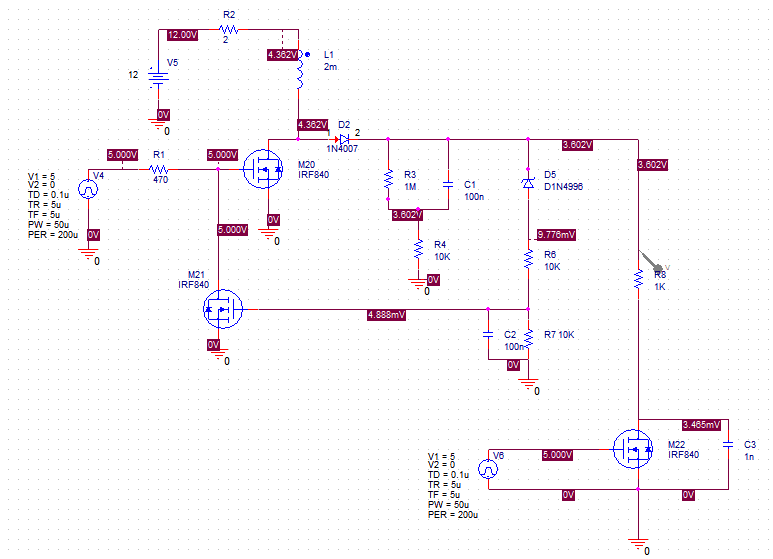
I have a circuit which can produce bursts of 500V. When I did this circuit, The 2.2 mH is burning. I want to know whether do we need to take care the power rating of inductor?
After the test I tried the experiment without inductor too. I have used 2.2ohm, 1W resistor. That too started to burn. Can anyone help to rectify the problem?
burst_gen.PNG
 
Engineering news on Phys.org
The burning of L1 may be due to:

1) Too big conductive losses in the coil.
2) Too big magnetic ( hysteresis ) losses in the core.

In case of 2), use another core with an airgap, thereby reducing the magnetic losses.
Most of the variation of magnetic energy in the core will take place in the airgap.
Recalculate the core used, the number of windings, etc.

Something like this:
www.mhw-intl.com/assets/EPCOS/RM/B65813%20RM-10.pdf
( B65813-+400-A48. Number of windings = 74 @2.2 mH )

I assume that you could have used something like a toroidal core without an airgap.

Short circuiting L1 will prevent the circuit to oscillate properly, thus burning R2.
 
Last edited:
Can anyone tell the power ratings of the components that can I use in the above circuit? I couldn't rectify the problem that present with the first stage(First MOSFET) of the circuit. The second and third stages (Second and third MOSFETs) are working fine, as I expected. I need to know how can we calculate the current needed from the source.
 
upload_2017-5-23_20-24-25.png


Seems to me your trouble is not component ratings , your trouble is V4 not behaving .
If V4 is a 0 to 5 volt rectangular waveform with 25% duty cycle(high for only 50 usec out of every 200),
why does it show 5.000 volts instead of 1.25 volts ?
How then does M20 ever turn off ?
 
Last edited:
  • Like
Likes   Reactions: Asymptotic and dlgoff
Hesch said:
The burning of L1 may be due to:

1) Too big conductive losses in the coil.
2) Too big magnetic ( hysteresis ) losses in the core.

In case of 2), use another core with an airgap, thereby reducing the magnetic losses.
Most of the variation of magnetic energy in the core will take place in the airgap.
Recalculate the core used, the number of windings, etc.

Something like this:
www.mhw-intl.com/assets/EPCOS/RM/B65813%20RM-10.pdf
( B65813-+400-A48. Number of windings = 74 @2.2 mH )

I assume that you could have used something like a toroidal core without an airgap.

Short circuiting L1 will prevent the circuit to oscillate properly, thus burning R2.
Can this type works?
https://in.element14.com/webapp/wcs/stores/servlet/ProductDisplay?catalogId=15001&langId=91&storeId=10186&krypto=7sfjjeMFALCbXTesrbvVOvyn9Aeqp17bFZ9kr5saiD3X4Ax5ZVFxcUFSLNmNpRlYTaaxZjQOoj9NUuxMc7jq%2B%2BB9fvmInkRu0l2TnFazfzm7Vel9OqzAqrsoPylh3nUrgJmFUB7vbKFeM3UdMFwKTA%3D%3D&ddkey=http%3Aen-IN%2FElement14_India%2Fbourns%2F2324-v-rc%2Finductor-toroid-v-1000uh-10-2%2Fdp%2F1929754
 
Nikhil N said:
Can this type works?

I recommend a core with an actual airgap.

The inductance depends on the amount of magnetic energy in the core, created at some current. This energy is proportional to H*B. If you sketch a B(H) hysterisis curve as for the magnetic material, the magnetic losses in the core will be proportional to the area of the hysterisis loop. These losses will be converted to thermal energy ( heat ).

With an actual airgap, most of the magnetic energy will be concentrated in the airgap ( where the H-field is very large ), but there is no hysterisis at all in air/vacuum, thus no losses in the airgap. That's why many inductor cores are provided by an airgap.

Introducing an actual airgap, you will make the core inhomogenous, dividing the magnetic energies into two parts, the smaller part with losses, the larger part with no losses.

BHCurve.gif
 
Last edited:
  • Like
Likes   Reactions: jim hardy
This,

upload_2017-6-2_10-21-58.png

7.632 volts across R2,
suggests >3.8 amps through L1

Hesch's most excellent advice will keep it out of saturation.
 
jim hardy said:
View attachment 204150

Seems to me your trouble is not component ratings , your trouble is V4 not behaving .
If V4 is a 0 to 5 volt rectangular waveform with 25% duty cycle(high for only 50 usec out of every 200),
why does it show 5.000 volts instead of 1.25 volts ?
How then does M20 ever turn off ?
the voltage displayed in the circuit are bias voltages
 
Nikhil N said:
the voltage displayed in the circuit are bias voltages
What then are the actual voltages ?
 
  • #10
jim hardy said:
What then are the actual voltages ?
actual_voltage.PNG

Red one across 2 Ohm and green at Gate of first MOSFET
 
  • #11
Nikhil N said:
Red one across 2 Ohm and green at Gate of first MOSFET
okay, thanks

i drew them in so they're visible.

nkhil1.jpg


It's so difficult to communicate with precision using just words. That's why a picture like this is so helpful.

""""Red one across 2 Ohm..."""
Surely you mean "Red one is voltage BETWEEN NODE R2-L1 AND CIRCUIT COMMON",
which is voltage(to common) at right end of the two ohm not across the two ohm.
because
IF Red is the voltage across the 2 ohm,
THEN six amps are flowing through it when mosfet is gated OFF.

IF I'm right as to what your picture shows
THEN it looks to me like that part of the circuit is working fine.
A burnt up L2 means it needs more current capability. You need one that'll handle two amps of DC without saturating. Do you have room for an air core coil?
Audio enthusiasts use them for speaker crossover filters.
This is just one of many sites that cater to that market.
https://www.parts-express.com/Search.aspx?keyword=2.0mh indictor&sitesearch=true

You could wind your own coil on a piece of plastic pipe and use the inductance formula for a solenoid..
 
  • #12
jim hardy said:
okay, thanks

i drew them in so they're visible.

View attachment 205034

It's so difficult to communicate with precision using just words. That's why a picture like this is so helpful.

""""Red one across 2 Ohm..."""
Surely you mean "Red one is voltage BETWEEN NODE R2-L1 AND CIRCUIT COMMON",
which is voltage(to common) at right end of the two ohm not across the two ohm.
yah that's right.
 
  • #13
I am checking the first part of the circuit. I have a toroidal Inductor which can pass upto 3.4Amps. Now the inductor working fine, but nothing seeing at output. Is that because, the resistors and capacitors used are of higher power ratings?

IMG_20170608_090935.jpg
 
  • #14
Nikhil N said:
I am checking the first part of the circuit. I have a toroidal Inductor which can pass upto 3.4Amps. Now the inductor working fine, but nothing seeing at output. Is that because, the resistors and capacitors used are of higher power ratings?

Hi Nikhil

building a circuit like that on a breadboard is about the worse thing you could do !
No wonder you have been having problems. They are not designed for higher currents and voltages

you really need to be soldering all the connections together in a more normal circuit construction ( WITHOUT a breadboard)
so that it eliminates the possibility of burnt out connector strips in the breadboard due to the currents
that could be passing through poor joints

EDIT ... just to clarify ... I'm making these comments because of your references to
500V pulses and inductors passing more than 1 ADave
 
Last edited:
  • #15
davenn said:
Hi Nikhil

building a circuit like that on a breadboard is about the worse thing you could do !
No wonder you have been having problems. They are not designed for higher currents and voltages

you really need to be soldering all the connections together in a more normal circuit construction ( WITHOUT a breadboard)
so that it eliminates the possibility of burnt out connector strips in the breadboard due to the currents
that could be passing through poor joints

EDIT ... just to clarify ... I'm making these comments because of your references to
500V pulses and inductors passing more than 1 ADave
Now I have done the same circuit in copper pcb, with soldering. But I am using signal generator to give the switching pulses to the MOSFET and I am using DC power supply for giving 12V Vcc. So will there be issue with ground? Does the circuit needs pull-down resistors ?
 
  • #16
R8 & M22 remove a LOT of energy from your circuit.

If you lift R8 your regulator should reach around through M21 and hold output about 400 volts.
That'd check your flyback high voltage source part of the circuit.

Observe 400 volts across 1 k ohmR8 is 160 watts. With 25% duty cycle on V6-M22 that's 40 watts.
I don't think you can squeeze 40 watts through your 2 ohm R2 with only 12 volts . Try the maximum power transfer theorem, I get 18 watts.

One step at a time - get your step-up flyback stage working , then load it up.

I want to praise you for building this circuit out of real parts. One learns SOOOO much more that way.
Bravo, Nikhil !

keep us posted ?

old jim
 
Last edited:
  • Like
Likes   Reactions: CWatters
  • #17
I see a few issues with the circuit.

The following assumes, but is not limited to, the no load condition, i.e. R8, M22, C3 removed.

The R2 - L1 time constant is 1mS, however the pulse width is only 50uS (1/20 time constant). Consequently the inductor current and output power will be very low.

The R7 - C2 time constant is 1mS, much longer that pulse repitition rate. Expect some output overshoot; perhaps enough to damage M20 due to overvoltage.

Zener diode D5, 1N4996, is rated 390V. Taking account of 5% tolerance of D5 and M21 threshold voltage yields an output voltage between 375V and 418V.

Voltage drive to M20 Gate is marginal, I suggest a few more volts to ensure reliable switching.
 
  • Like
Likes   Reactions: jim hardy
  • #18
Can Anybody tell why the current from the source(12V Voltage source)
Current_source.PNG
goes negative side?
 
  • #19
Nikhil N said:
Can Anybody tell why the current from the source(12V Voltage source) goes negative side?

Not without knowing how you measured it.
Where are your oscilloscope leads connected ?

More confusing is why does it start at 4 amps not zero ?

upload_2017-6-13_21-27-27.png


I don't believe your trace is current,
i think it's voltage between node R2-L1 and circuit common.
Which when subtracted from Vsupply(12) and divided by two gives the current
done graphically here

nikhil1.jpg


Current WILL flow in accordance with laws of Ohm and Kirchoff.
When you measure something that disagrees with those laws, it's a mistake .
If you believe current is flowing the wrong way,
and expect us to be able to help,
you'll have to explain why you think it's flowing backward.
Could be as simple as a pass-through current robe on the wrong way. The arrow on current probes indicates direction of conventional current ..
 

Similar threads

  • · Replies 4 ·
Replies
4
Views
2K
  • · Replies 4 ·
Replies
4
Views
3K
  • · Replies 1 ·
Replies
1
Views
2K
  • · Replies 37 ·
2
Replies
37
Views
5K
  • · Replies 5 ·
Replies
5
Views
4K
  • · Replies 6 ·
Replies
6
Views
4K
  • · Replies 7 ·
Replies
7
Views
2K
  • · Replies 19 ·
Replies
19
Views
2K
  • · Replies 3 ·
Replies
3
Views
4K
  • · Replies 1 ·
Replies
1
Views
7K