What Determines the Resolution Limit of a Microscope?

  • Context: Graduate 
  • Thread starter Thread starter eoghan
  • Start date Start date
  • Tags Tags
    Disc Microscope
Click For Summary

Discussion Overview

The discussion centers on the factors that determine the resolution limit of a microscope, particularly focusing on the derivation of the resolution formula involving the angular aperture and the Airy disk. Participants explore geometric relationships and mathematical derivations related to resolving two point sources.

Discussion Character

  • Technical explanation
  • Mathematical reasoning
  • Debate/contested

Main Points Raised

  • One participant questions the derivation of the resolution limit, referencing the angular aperture of the lens and the relationship between two point sources.
  • Another participant suggests deriving the size of the Airy disk in the focal plane as a necessary step for understanding resolution.
  • A different participant presents a mathematical approach to relate the distances between images and the resolution limit, expressing uncertainty about the simplicity of their derivation compared to the textbook method.
  • One participant notes the connection between angular resolution and linear resolution, indicating that they are related through the focal length and numerical aperture of the lens.

Areas of Agreement / Disagreement

Participants express differing views on the derivation process and the relationships involved in determining resolution limits. No consensus is reached on the correctness of the various approaches or the derivations presented.

Contextual Notes

Some assumptions regarding the geometry and definitions of terms like numerical aperture and focal length are not fully explored. The discussion also reflects varying levels of confidence in the mathematical derivations provided.

eoghan
Messages
201
Reaction score
7
Hi there!
I wonder where the resolution limit for a microscope comes out. I know that the lens can act as a circular aperture of diameter D and so a point source is diffracted in a disk of angular aperture 1.22\lambda/D
Two sources are resolved if their distance is greater than (without Abbe correction) 1.22\lambda/NA
How can I obtain this result?
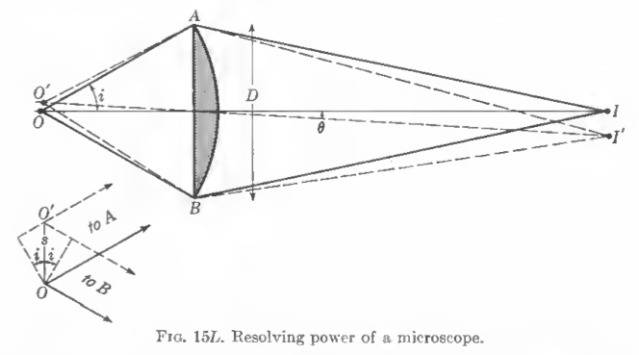
I'm reading Jenkins and White and they start supposing two point sources, O on the axis of the lens and O' slightly above which form images I and I'. Each image consists of a disk and the angular separation of the disks when they are on the limit of resolution is 1.22\lambda/D
When this condition holds, the wave from O' diffracted to I has zero intensity and the extreme rays O'BI and O'AI differ in path by 1.22lambda. (B is the top point of the lens, and A is the lower point; I is the position of the image of O and lies on the lens axis) Why do they differ in path by 1.22lambda?

I also attach the image, taken from the book, of the geometry
14iq0lw.jpg
 
Last edited:
Science news on Phys.org
I suppose you have to derive first the size of the Airy disk in the focal plane. The rest is geometry.
 
I tried, but I'm not sure. The distance II' is
II'=f\sin(\theta)
where f is the distance of I from the center of the lens.
The images are resolved if
II'\geq f\frac{1.22\lambda}{D}
If we call f' the distance between O and the center of the lens, we have
\frac{OO'}{f'}=\frac{II'}{f}
therefore at the limit of the resolution
\frac{OO'}{f'}=\frac{f\frac{1.22\lambda}{D}}{f}
But from the geometry we know that
f'=\frac{\frac{D}{2}}{\tan(i)}\simeq\frac{D}{2sin(i)}
Thus, in the end
OO'=\frac{1.22\lambda}{2\sin(i)}

Is this all right? My doubt is that this derivation is much simpler than that given in textbook...
 
It may help to realize that angular resolution and linear resolution are related through the focal length of the lens 'f' and NA = D/2f (approximately).
 

Similar threads

  • · Replies 3 ·
Replies
3
Views
1K
  • · Replies 7 ·
Replies
7
Views
3K
  • · Replies 4 ·
Replies
4
Views
5K
  • · Replies 5 ·
Replies
5
Views
2K
  • · Replies 3 ·
Replies
3
Views
2K
  • · Replies 3 ·
Replies
3
Views
3K
  • · Replies 1 ·
Replies
1
Views
4K
  • · Replies 6 ·
Replies
6
Views
2K
  • · Replies 4 ·
Replies
4
Views
2K
Replies
1
Views
2K