What Does a Non-Uniformly Accelerated Motion Graph Look Like?

  • Thread starter Thread starter Saitama
  • Start date Start date
  • Tags Tags
    Motion Type
Click For Summary
SUMMARY

The discussion focuses on the characteristics of a non-uniformly accelerated motion graph, specifically analyzing the motion between time intervals t2 to t3. The user initially misidentified the motion as uniformly retarded but later recognized that the velocity cannot decrease from rest. The graph's slope changes, indicating non-uniform acceleration, and the motion resembles an arc rather than a straight line. The conclusion emphasizes that the graph does not fit the standard forms of uniform motion or uniformly accelerated motion.

PREREQUISITES
  • Understanding of motion graphs, including displacement-time and velocity-time graphs.
  • Familiarity with concepts of uniform motion, uniformly accelerated motion, and uniformly retarded motion.
  • Knowledge of basic calculus, specifically derivatives related to motion.
  • Ability to analyze the shape and slope of graphs to determine motion characteristics.
NEXT STEPS
  • Study the principles of non-uniform acceleration in physics.
  • Learn how to derive equations of motion from displacement-time graphs.
  • Explore the relationship between acceleration and the shape of motion graphs.
  • Investigate real-world examples of non-uniformly accelerated motion.
USEFUL FOR

Students studying physics, particularly those focusing on kinematics and motion analysis, as well as educators looking for insights into teaching graph interpretation in motion.

Saitama
Messages
4,244
Reaction score
93
Hello Everyone!
Just got a homework about graphs of motion. I have solved all the problems but got stuck in one of them. Here's the problem:-
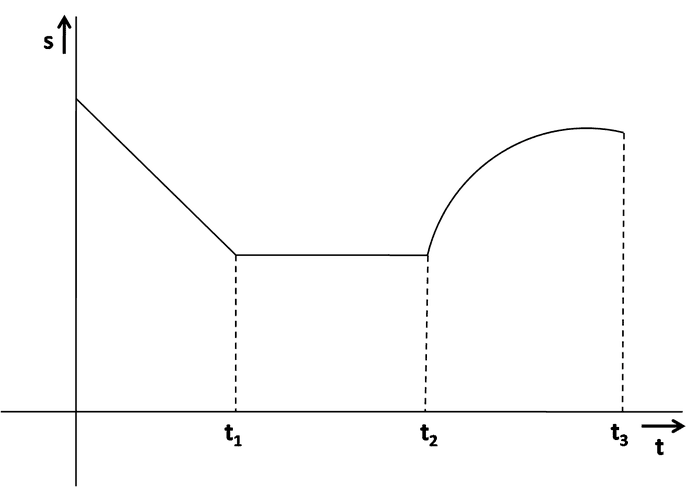
23k6pgo.png


I solved it like this:-
0 to t1 - Uniform Motion with negative velocity
t1 to t2 - Rest
t2 to t3 - Uniformly retarded

I asked my teacher and he told me that the last step is wrong i.e. t2 to t3 is wrong.
Would someone please tell me where i am wrong?
Thanks...
 
Physics news on Phys.org
Pranav-Arora said:
I asked my teacher and he told me that the last step is wrong i.e. t2 to t3 is wrong.
Would someone please tell me where i am wrong?
What information does the slope of the graph give you? Since the slope from t2-t3 is changing (decreasing) what kind of motion is this? Is slope changing at a uniform rate? How can you tell?

AM
 
Thanks Andrew for your Reply.
I just wanted to know that if it is uniformly accelerated or uniformly retarded. It should be uniformly retarded because Displacement-time graph for uniformly retarded is same as it is given in t2-t3. But here its starting from velocity 0(zero) and a body cannot retard because velocity is 0. If the body will try to move too, its velocity will increase only. In no sense it can decrease. But also it cannot be uniformly accelerated motion because if we draw tangents at different points of the slope between t2 to t3, we will notice that the velocity is decreasing so it cannot be uniformly accelerated.
 
The displacement at t = t3 would appear to be less than the maximum displacement achieved in the period t2 <= t <= t3. If that is so, more than simple friction (retardation?) is at work.

The object "takes off" from its rest position at t = t2 at some velocity (as evidenced by the sudden change in slope of the curve at that time), after which the rate of change in displacement slows and eventually reverses direction. What kind of motion does this remind you of?
 
Pranav-Arora said:
Thanks Andrew for your Reply.
I just wanted to know that if it is uniformly accelerated or uniformly retarded. It should be uniformly retarded because Displacement-time graph for uniformly retarded is same as it is given in t2-t3. But here its starting from velocity 0(zero) and a body cannot retard because velocity is 0. If the body will try to move too, its velocity will increase only. In no sense it can decrease. But also it cannot be uniformly accelerated motion because if we draw tangents at different points of the slope between t2 to t3, we will notice that the velocity is decreasing so it cannot be uniformly accelerated.
Why do you think it is uniform? What is the shape of the graph? Following up on Gneill's post, what does that tell you about how S changes with t?

AM
 
One thing more i can add, the time between t1 and t2 is equal to t2 and t3.
Now any answers?
 
Pranav-Arora said:
One thing more i can add, the time between t1 and t2 is equal to t2 and t3.
Now any answers?
It looks to me that the graph from t2-t3 is an arc of a circle. That does not mean that the path is circular - we are only dealing with motion in one dimension. What you have to do is determine the acceleration that would be required to make that graph. hint: if it was a parabolic graph, what would be the second derivative of displacement with respect to time (ie. the acceleration). Since it is not a parabola, can the acceleration be the same as with a parabola?

AM
 
Thanks Andrew for your reply.
I got my homework on the basis of those graphs only which I have studied.
Till now I have studied Uniform Motion graphs, Uniformly accelerated graphs, Uniformly Reatarded and Non-Uniformly Accelerated graphs. Is the graph in the question one of these?
 
So what does the graph of non-uniformly accelerated motion look like?

AM
 

Similar threads

Replies
40
Views
2K
  • · Replies 5 ·
Replies
5
Views
2K
Replies
55
Views
3K
  • · Replies 2 ·
Replies
2
Views
1K
  • · Replies 14 ·
Replies
14
Views
3K
Replies
2
Views
2K
  • · Replies 10 ·
Replies
10
Views
3K
  • · Replies 6 ·
Replies
6
Views
1K
Replies
11
Views
3K
Replies
4
Views
2K