What does the Navier-Stokes equation look like after time discretization?

Click For Summary
SUMMARY

The discussion centers on the time discretization of the Navier-Stokes equation as presented in the "Gerris flow solver" paper by Prof. S. Popinet. The equation involves multiple time steps: n-1 (previous), n+0.5 (mid), and n+1 (next), leading to confusion regarding the use of different terms for density and velocity. The method employed is the time step projection method, which computes an intermediate velocity before updating it to ensure divergence-free conditions by solving the Laplace pressure term. The notation used for density at n+0.5 raises questions about its relationship with density at n and the absence of an advection equation.

PREREQUISITES
  • Understanding of the Navier-Stokes equations
  • Familiarity with time discretization techniques
  • Knowledge of finite difference schemes
  • Experience with computational fluid dynamics (CFD) tools, specifically Gerris
NEXT STEPS
  • Study the time step projection method in computational fluid dynamics
  • Research finite difference schemes for solving partial differential equations
  • Examine the implications of using intermediate velocity terms in fluid dynamics
  • Explore the derivation and application of the Laplace pressure term in the Navier-Stokes context
USEFUL FOR

Researchers, computational fluid dynamics practitioners, and students interested in advanced fluid mechanics and numerical methods for solving the Navier-Stokes equations.

Kukkat
Messages
2
Reaction score
1
Hi,

I know the general form of the Navier Stokes Equation as follows.
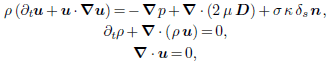
upload_2016-12-2_12-30-26.png


I am following a software paper of "Gerris flow solver written by Prof. S.Popinet"
[Link:http://citeseerx.ist.psu.edu/viewdoc/download?doi=10.1.1.374.5979&rep=rep1&type=pdf]
and he mentions after time discretization he ends with the following equation:

upload_2016-12-2_12-31-35.png

where n-1 is the previous time step, n+1 is the next time step and n+0.5 is mid time for the present time step.

Solving equation implicitly/ explicitly in time means solving for next time data however in the equation there are rather two unknowns un+0.5 and
un+1.

Not sure why he uses different terms at different time intervals. Density at n+0.5, velocity at n, n-1, n+0.5 etc..

Can anyone point me or explain me how he arrives at this specific sort of discretized equation.
 
  • Like
Likes   Reactions: Kaat
Engineering news on Phys.org
The link to the paper doesn't work.
 
I'm not familiar with this particular finite difference scheme, but presumably un+0.5 is already know when you are calculating un+1
 
Sorry for the link.
http://www.sciencedirect.com/science/article/pii/S002199910900240X

@Chestermiller guess that's true. It is being solved by the time step projection method which means an intermediate velocity is computed and later updated to a divergence free velocity by solving the laplace of pressure term as in the mentioned paper.

The notation is a bit strange for me as he uses density at time n+0.5 without solving any advection equation. From what I see density terms at n and n+0.5 should be the same.
 

Similar threads

  • · Replies 18 ·
Replies
18
Views
2K
Replies
2
Views
4K
Replies
20
Views
6K
  • · Replies 4 ·
Replies
4
Views
4K
  • · Replies 1 ·
Replies
1
Views
2K
  • · Replies 3 ·
Replies
3
Views
2K
  • · Replies 2 ·
Replies
2
Views
5K
  • · Replies 11 ·
Replies
11
Views
4K
  • · Replies 6 ·
Replies
6
Views
6K
  • · Replies 3 ·
Replies
3
Views
3K