What effects are bounding a missing mass plot? (with figure)

Click For Summary

Discussion Overview

The discussion revolves around the analysis of missing mass squared in particle decays, specifically focusing on the K+ decay into various final states, including pions and neutrinos. Participants explore the bounds of missing mass plots and the implications of different decay hypotheses, addressing both theoretical and experimental aspects of the measurements.

Discussion Character

  • Exploratory
  • Technical explanation
  • Conceptual clarification
  • Debate/contested

Main Points Raised

  • One participant questions what bounds the missing mass squared at 0.122 GeV², suggesting it relates to the mass difference between the K+ and pion.
  • Another participant later clarifies that the bound is indeed due to the mass difference, specifically (m(K+) - m(pion))².
  • A participant outlines the process of calculating missing mass squared using the 4-momenta of detected particles, emphasizing the assumptions made regarding the mass of the detected pion.
  • Discussion includes the impact of undetected particles, such as the rapid decay of π0 into photons, which may escape detection, affecting the missing mass measurements.
  • Concerns are raised about the interpretation of negative peaks in the missing mass plot, with one participant speculating on their origins related to the mass of muons compared to pions.
  • Another participant discusses the bounds for specific decay channels, noting that the lower limits correspond to the mass of undetected particles and the upper limits depend on momentum transfer considerations.
  • Clarifications are made regarding the assumptions in two-body versus three-body decays and how these affect the reconstruction of missing mass.

Areas of Agreement / Disagreement

Participants express differing views on the interpretation of bounds in the missing mass plots, with some agreeing on the mass difference explanation while others raise additional questions about specific decay scenarios and their implications. The discussion remains unresolved regarding the exact nature of certain bounds and the effects of undetected particles.

Contextual Notes

Participants acknowledge various assumptions in their calculations, including the mass values used and the detection capabilities of their measurement systems. There is also mention of the need for further investigation into certain decay processes and their implications for missing mass calculations.

rjseen
Messages
10
Reaction score
0
Hi,

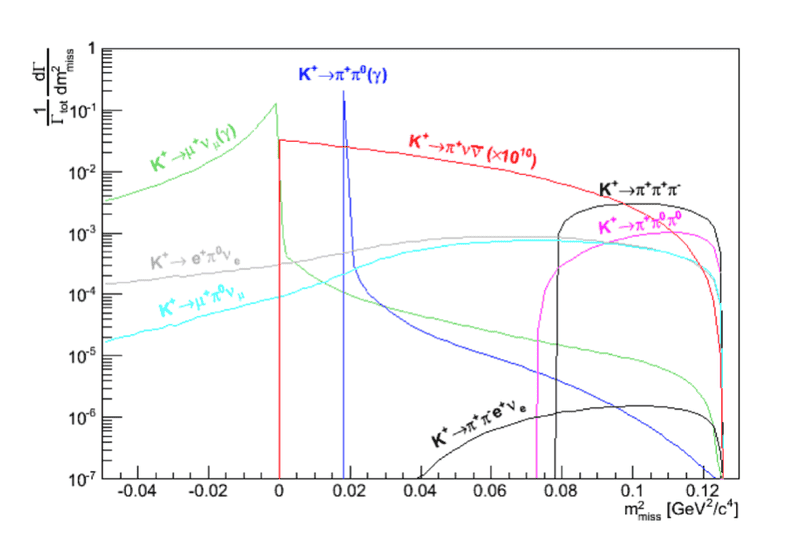
so for example in the figure below the missing mass squared has been calculated under the assumption of the detection of a pi+ particle decaying from a K+. What I am wondering is what is it that's bounding all the decays at 0.122 GeV2?

And for the decays at all, what is e.g. bounding the pi+pi+pi- (black line) decay? I figured the lowest value, around 0.078, is around the squared mass of two pions? Not sure though.

Appreciate any help.

mm2_expected2.png
 
Last edited:
Physics news on Phys.org
O nevermind I figured it out :) I was completely disregarding how I calculated the missing mass. They are of course bounded by 0.122 GeV2=(m(K+)-m(pion))^2, or simply the mass that's missing compared to the assumed mass.
 
Last edited:
So I have been thinking a little more about the problem I had and I'd like to share it for future reference.

The missing mass squared we define using the 4-momenta P as (Pπ-PK)2 where we investigate it under a so called π+ hypothesis, meaning we assume the mass of the particle we detected is that of m(π+)~0.139 GeV/c2.

1. Data is collected from a measurement system which can output the momentum of the particle.
2. We construct the 4-momenta of the initial K+, with an assumed constant absolute momentum of 75 GeV/c and mass of ~0.494 GeV/c2 (this can be refined if you can properly match the decay registered in the detector we use to measure the pion with its mother particle upstream).
3. Likewise we construct the 4-momenta of the particle decays registered in our detector.
4. We calculate (Pπ-PK)2.
5. We construct a histogram with the data.

Few points on the analysis:
-All of the K+ decays are bounded by (m(π+)-m(K+)2=0.122 (GeV/c2)2, which is the response when all decayed particles are measured in our detector.
-The π0 particle rapidly decays, usually into two photons, which commonly escape the detector system, thus the peak at m(π0)2.
-The negative valued peak arise from the μ+ having less mass (~106 GeV/c2) than π+, which under the π+ hypothesis results in the negative value. I assume the maximum value should be located at -(m(μ+))2 ~ -0.0112 (GeV/c2)2, but I am not sure. It could also be at -(m(π0)-m(μ+))2 ~ -0.0011 (GeV/c2)2
-The lower boundaries on K+→π+π0π0 and K+→π+π+π- equal the actual missing mass from only detecting one particle, so (m(2⋅π0))2 and (m(2⋅π+/-))2 respectively. m(π0)~0.135 GeV/c2.
-For the decay K+→π+[itex]\nu \bar{\nu}[/itex] I am also not completely sure, my best guess is that it is bounded in the lower limit by no signal detection or low momentum, and in the upper limit by the full kaon momentum being transferred to the particle and that the neutrinos went off 180 degrees perpendicular to each other. Reasoning like this makes me think that the lower limit would be the latter suggestion, but that wouldn't conform with the earlier hypothesis I had, which is why I will need to investigate this further.

Any clarification on the subject is appreciated.

cheers
rjseen
 
You always measure the charged pion only.
rjseen said:
The missing mass squared we define using the 4-momenta P as (Pπ-PK)2 where we investigate it under a so called π+ hypothesis, meaning we assume the mass of the particle we detected is that of m(π+)~0.139 GeV/c2.
In other words: "if the kaon decayed to the measured pion plus a single other particle, what would be the mass of this single other particle?".

The maximal mass is clearly the difference between kaon and pion mass, but then the pion and the other (imaginary) particle have to have the same velocity as the initial kaon. That is possible in three-body decays only.

If you have a two-body decay, your assumption about a two-body decay is right, so apart from measurement issues your reconstruction will always lead to the mass of the second particle (e. g. the pi0 in K-> pi+ pi0).
 
  • Like
Likes   Reactions: rjseen

Similar threads

Replies
5
Views
2K
  • · Replies 10 ·
Replies
10
Views
4K
  • · Replies 49 ·
2
Replies
49
Views
13K
  • · Replies 17 ·
Replies
17
Views
2K
  • · Replies 1 ·
Replies
1
Views
2K
Replies
4
Views
6K
  • · Replies 29 ·
Replies
29
Views
3K
  • · Replies 7 ·
Replies
7
Views
2K
  • · Replies 157 ·
6
Replies
157
Views
13K
  • · Replies 0 ·
Replies
0
Views
3K