What Forces Act on a Car Negotiating a Bend at Constant Speed?

  • Thread starter Thread starter timarli
  • Start date Start date
  • Tags Tags
    Bend Car Forces
Click For Summary
SUMMARY

The discussion focuses on the forces acting on a vehicle negotiating a bend at constant speed, specifically addressing centripetal acceleration and friction. Key equations include F=mv²/R and Ff=μN, where N is the normal force. Participants clarify the role of gravity, normal force, and friction in achieving centripetal acceleration, and they highlight the importance of correctly interpreting the equations to avoid confusion. The conversation emphasizes the need for a clear understanding of the relationship between these forces and the resulting motion of the vehicle.

PREREQUISITES
  • Understanding of Newton's laws of motion
  • Familiarity with centripetal acceleration concepts
  • Knowledge of static friction and its maximum value
  • Basic trigonometry as applied to forces on inclined planes
NEXT STEPS
  • Study the derivation of centripetal force equations in circular motion
  • Explore the relationship between friction and normal force in detail
  • Learn about the effects of incline on vehicle dynamics
  • Investigate the differences between static and kinetic friction in practical scenarios
USEFUL FOR

Physics students, automotive engineers, and anyone interested in vehicle dynamics and the forces acting on vehicles during motion.

timarli
Messages
11
Reaction score
0
Hi,


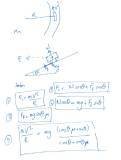
I am confused a little bit with the forces acting on a vehicle when it's negotiating a bend, at constant speed.

Please click the link to see my sketch.
W13638035282205281_1.jpg


On the plan view I see that it's moving with constant speed, along a circular route. That means there is unbalanced force causing central acceleration. F=mv2/R.

Then going to the section I showed the forces acting on the vehicle. Gravity, Normal Force and the friction. These should be the forces causing this F (central acceleration).

Equation 1, 2, 3 and 4 are the ones I have but somehow I couldn't get to the 5 which is given as the overall formula for such movements.

Can you please tell me what I am doing wrong? Thanks in advance.
 
Physics news on Phys.org
timarli said:
Hi,


I am confused a little bit with the forces acting on a vehicle when it's negotiating a bend, at constant speed.

Please click the link to see my sketch.

W13638035282205281_1.jpg


On the plan view I see that it's moving with constant speed, along a circular route. That means there is unbalanced force causing central acceleration. F=mv2/R.

Then going to the section I showed the forces acting on the vehicle. Gravity, Normal Force and the friction. These should be the forces causing this F (central acceleration).

Equation 1, 2, 3 and 4 are the ones I have but somehow I couldn't get to the 5 which is given as the overall formula for such movements.

Can you please tell me what I am doing wrong? Thanks in advance.
Equation #2 is the problem.

\displaystyle F_\text{f}=\mu N

In your equation #5, shouldn't there be a minus sign in the denominator if \displaystyle \ \frac{v^2}{R}>g\tan(\theta)\ ?
 
SammyS said:
Equation #2 is the problem.

\displaystyle F_\text{f}=\mu N

In your equation #5, shouldn't there be a minus sign in the denominator if \displaystyle \ \frac{v^2}{R}>g\tan(\theta)\ ?
Thanks SammyS.

Eq#2: if N=m.g.cos0 is not true then I'm more confused...But equation#5. I hope you are right. That's the main issue that confuses me; every source gives a different formula, some of them take the directions different, some of them find the signs of cos & sin different. I really don't understand how this thing can have so many variations...One other question; instead of breaking down everything along major x and y-axis es, can I use the inclined surface as my x and the perpendicular as y?

Fc.cos0=Ff+m.g.sin0 ?
 
timarli said:
Thanks SammyS.

Eq#2: if N=m.g.cos0 is not true then I'm more confused...


But equation#5. I hope you are right. That's the main issue that confuses me; every source gives a different formula, some of them take the directions different, some of them find the signs of cos & sin different. I really don't understand how this thing can have so many variations...


One other question; instead of breaking down everything along major x and y-axis es, can I use the inclined surface as my x and the perpendicular as y?

Fc.cos0=Ff+m.g.sin0 ?
Yes, you can do that.

Added in Edit:

The perpendicular component then gives:

FC sin(θ) + N = mg cos(θ) .
 
Last edited:
timarli said:
Eq#2: if N=m.g.cos0 is not true then I'm more confused...
If N=m.g.cosθ then there is no net force perpendicular to the plane. But Fc has a component in that direction, so this cannot be true.
Also, it is not true in general that the force of static friction is given by Fsf = Nμs. That's the limiting case, i.e. |Fsf| ≤ Nμs. For the max speed, Fsf = Nμs, assuming Fsf is measured down the plane. But, measuring it the same way, there may also be a minimum speed given by Fsf = -Nμs.
 
Using your sketch showing the vehicle on the inclined roadway, I get the following.

Of course, the magnitude of the force of friction is given by
\displaystyle <br /> F_\text{f}=\mu N​

The sum of the forces in the vertical direction is:
\displaystyle <br /> N\cos(\theta)-F_\text{f}\sin(\theta)-mg=0

Therefore,

\displaystyle N\cos(\theta)-\mu N\sin(\theta)-mg=0​
Solve that for N.


The sum of the forces in the vertical direction is:
\displaystyle <br /> N\sin(\theta)+F_\text{f}\cos(\theta)=ma_c\,, \ where aC is the centripetal acceleration.

That becomes \displaystyle \ \ N\sin(\theta)+\mu N\cos(\theta)=ma_c\ .​
I realize that I didn't use the centripetal force, FC explicitly. I find it's clearer for me to do it this way.
 
haruspex said:
If N=m.g.cosθ then there is no net force perpendicular to the plane. But Fc has a component in that direction, so this cannot be true.
Also, it is not true in general that the force of static friction is given by Fsf = Nμs. That's the limiting case, i.e. |Fsf| ≤ Nμs. For the max speed, Fsf = Nμs, assuming Fsf is measured down the plane. But, measuring it the same way, there may also be a minimum speed given by Fsf = -Nμs.
haruspex makes a good point regarding μN being the maximum possible frictional force.

Therefore, your results are for the maximum speed possible, our equivalently they're for the minimum value of μ needed to negotiate the curve under the specified conditions .
 
haruspex said:
If N=m.g.cosθ then there is no net force perpendicular to the plane. But Fc has a component in that direction, so this cannot be true.
Also, it is not true in general that the force of static friction is given by Fsf = Nμs. That's the limiting case, i.e. |Fsf| ≤ Nμs. For the max speed, Fsf = Nμs, assuming Fsf is measured down the plane. But, measuring it the same way, there may also be a minimum speed given by Fsf = -Nμs.


I couldn't understand the first part. To me, Fc is a resultant force, it's not a force acting on the body so I always thought I can not write it as "m.g.cos0-Fc.sin0 = N". I don't know why because the same thing makes sense to me for the other axis ie. "Fc.cos0=Ff+m.g.sin0". :S

Looks like I am misinterpreting some fundamental rules.


I got it! I understand what you mean now. When I use the secondary axis es (along the slope and perpendicular) and think of the position of the object 2 seconds later I can see the acceleration along both axis es.


Thank you very much SammyS and haruspex! I understand what you are saying about the friction and I will look at the minimum speed version tomorrow - to make sure I understood :) and probably post again if I can't figure that out.

You were really helpful...thanks again.
 

Similar threads

Replies
11
Views
1K
  • · Replies 25 ·
Replies
25
Views
1K
Replies
6
Views
4K
  • · Replies 17 ·
Replies
17
Views
4K
  • · Replies 26 ·
Replies
26
Views
3K
Replies
55
Views
3K
Replies
29
Views
3K
  • · Replies 12 ·
Replies
12
Views
2K
  • · Replies 7 ·
Replies
7
Views
2K
Replies
8
Views
7K