Graduate What happens if photon propagator goes on shell?

Click For Summary
In the forward Compton scattering process, the red photon emitted by an electron becomes a propagator with k^2 = p^2 = 0, leading to divergences in calculations. The photon cannot be on-shell when measuring momentum differences between interacting particles. To compute the cross section accurately, a cutoff must be applied to the detection of soft photons, as the divergence arises from zero-momentum photon exchanges. This divergence is regulated at the cross section level rather than the amplitude level. The discussion highlights the importance of understanding soft and collinear divergences in quantum field theory.
Chenkb
Messages
38
Reaction score
1
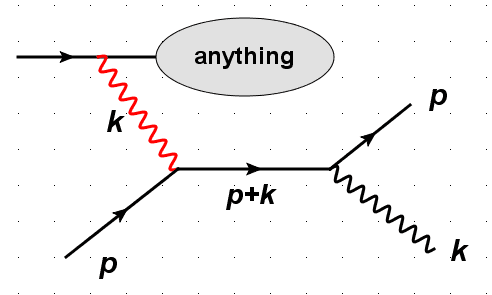
I am thinking about a problem. Consider the forward Compton scattering process e(p)+γ(k) -> e(p)+γ(k), as shown in the following figure.
If we consider the initial red photon is emitted by another electron which then goes to anything, then how can we write down the whole amplitude for this process?
The problem troubles me is that the red photon becomes a propagator with k^2 = p^2 = 0, which is divergent if in the denominator!
hkbd=0&chkpc=&dp-logid=5282071386005119170&dp-callid=0&size=c710_u400&quality=100&vuk=-&ft=video.png
 

Attachments

  • hkbd=0&chkpc=&dp-logid=5282071386005119170&dp-callid=0&size=c710_u400&quality=100&vuk=-&ft=video.png
    hkbd=0&chkpc=&dp-logid=5282071386005119170&dp-callid=0&size=c710_u400&quality=100&vuk=-&ft=video.png
    3.9 KB · Views: 610
Physics news on Phys.org
The photon will not be on-shell for anything where you can measure a momentum difference between the particles it attach to at the top.

For an actual cross section computation you have to put a cutoff on how soft photons you can detect and the divergence in the cross section due to the exchange of zero-momentum photons will be regulated by the emission of soft photons. This occurs at the cross section level, not at the amplitude level.

Formally, if you consider a series of detectors that each can measure lower and lower energy soft photons, the cross section diverges. This should be discussed in any QFT textbook, e.g., the discussion in Peskin-Schröder is in chapter 6.
 
Orodruin said:
The photon will not be on-shell for anything where you can measure a momentum difference between the particles it attach to at the top.

For an actual cross section computation you have to put a cutoff on how soft photons you can detect and the divergence in the cross section due to the exchange of zero-momentum photons will be regulated by the emission of soft photons. This occurs at the cross section level, not at the amplitude level.

Formally, if you consider a series of detectors that each can measure lower and lower energy soft photons, the cross section diverges. This should be discussed in any QFT textbook, e.g., the discussion in Peskin-Schröder is in chapter 6.
Thanks a lot. This reminds me that the red photon no-longer has a definite momentum, and the situation is similar to the case of understanding soft or collinear divergences.
 

Similar threads

  • · Replies 3 ·
Replies
3
Views
2K
Replies
1
Views
2K
  • · Replies 8 ·
Replies
8
Views
2K
  • · Replies 7 ·
Replies
7
Views
4K
  • · Replies 21 ·
Replies
21
Views
4K
  • · Replies 1 ·
Replies
1
Views
2K
  • · Replies 13 ·
Replies
13
Views
2K
  • · Replies 17 ·
Replies
17
Views
4K
  • · Replies 2 ·
Replies
2
Views
2K
  • · Replies 1 ·
Replies
1
Views
3K