What happens to energy in a gyro vs. flywheel problem?

  • Context: Graduate 
  • Thread starter Thread starter Ryoko
  • Start date Start date
  • Tags Tags
    Flywheel Gyro
Click For Summary
SUMMARY

The discussion centers on the dynamics of a gyro and flywheel system, specifically analyzing the conservation of angular momentum and energy during gyroscopic precession. The gyro has an angular moment of inertia of 0.25 slug-ft² and spins at 1000 rad/sec, while the flywheel has an angular moment of inertia of 80 slug-ft². When the gyro's gimbal is released, it precesses, causing the flywheel to lose angular momentum, which is compensated by the gyro tilting forward approximately 18.7 degrees. The final angular velocity of the gyro increases slightly to 1000.16 rad/sec, demonstrating that energy is transferred from the flywheel to the gyro during this process.

PREREQUISITES
  • Understanding of gyroscopic motion and precession
  • Familiarity with angular momentum and energy conservation principles
  • Knowledge of torque and its effects on rotational systems
  • Basic mathematics for calculating angular velocities and moments of inertia
NEXT STEPS
  • Explore the mathematical derivation of gyroscopic precession
  • Study the effects of varying moments of inertia on rotational dynamics
  • Investigate the relationship between torque and angular momentum in frictionless systems
  • Examine real-world applications of gyroscopic principles in engineering
USEFUL FOR

Physics students, mechanical engineers, and anyone interested in the principles of rotational dynamics and energy transfer in gyroscopic systems.

Ryoko
Messages
145
Reaction score
10
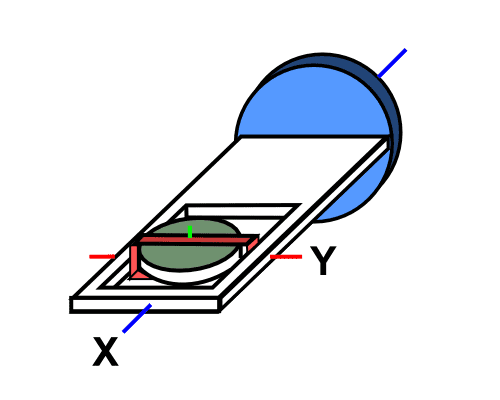
I have a problem which got me thinking, but I'm unable to solve to my satisfaction. The problem involves a gyro attached to a platform which in turn is attached to a flywheel. (See image below)
gyro.png


The constraints are as follow: The platform & flywheel are solidly attached to each other and can only rotate about the global X-axis. The gyro gimbal has one axis of freedom about the local Y-axis. There is no friction.

The system has the following properties: The gyro has an angular moment of inertia of 0.25 slug-ft^2 and is spinning at 1000 rad/sec (angular momentum of 250 lbf-ft-sec). The platform/flywheel has an angular moment of inertia of 80 slug-ft^2.

The initial conditions are that the gyro is spun up with its gimbal is locked in place. The platform is then spun about the x-axis to an angular velocity of 1 rad/sec. The gyro's gimbal is released when the gyro's spin axis is exactly vertical (aligned with the z-axis). What happens to the system?

I know that the gyro will immediately precess. But I'm having trouble with conserving both angular momentum and total energy. As I understand it, if the gyro precesses, it will take angular momentum away from the flywheel so that the total angular momentum along the x-axis is conserved. However, if any momentum is taken from the flywheel, it's energy drops. Where does this energy go? I seem to remember that precession doesn't change the angular momentum of the gyro, which means the gyro didn't gain the energy lost from the flywheel when it's momentum changed. What am I overlooking? How do I conserve both angular momentum and energy?
 
Physics news on Phys.org
Ryoko said:
I seem to remember that precession doesn't change the angular momentum of the gyro, [...]

Hang on - the state of precessing motion is a state where the total angular momentum is changing all the time. During gyroscopic precession the gyroscope wheel is subject to a torque, and that torque is continuously changing the total angular momentum.

The thing that doesn't change in the friction-free case is the magnitude of the total angular momentum. In the case of friction-free gyroscopic precession the magnitude of the spin rate does not change and the magnitude of the precession rate does not change.

I'm just responding to this detail. I haven't looked whether this affects the outcome of your reasoning.
 
One way to think about this is what would happen if the flywheel were rotated but the gyro was not spun up at all...
 
If the gyro was not spinning, then nothing of interest would happen. The flywheel would just continue to spin without any changes.

Hang on - the state of precessing motion is a state where the total angular momentum is changing all the time.

The direction of the angular momentum vector is changing, but it's magnitude remains constant. The direction of the angular momentum vector is changing because the precession is producing a torque reaction which is being countered by the gimbal mount. However ...

I do think I have solved the problem. If I did the math correctly, it looks like the gyro tilts forward about 18.7 degrees, gains the energy from the flywheel turning it into additional spin momentum, and the flywheel comes to a stop. I know I said that the gyro doesn't gain spin momentum from a precession. And that's true for a simple circular movement. But in this case, the gyro is being forced to move in a somewhat complicated motion which allows torque to be applied to the spin axis.
 
Ryoko said:
I do think I have solved the problem. If I did the math correctly, it looks like the gyro tilts forward about 18.7 degrees, gains the energy from the flywheel turning it into additional spin momentum, and the flywheel comes to a stop. I know I said that the gyro doesn't gain spin momentum from a precession. And that's true for a simple circular movement. But in this case, the gyro is being forced to move in a somewhat complicated motion which allows torque to be applied to the spin axis.

If finally only gyro spins and flywheel stops how is total angular momentum conserved?
 
The gyro tilts forward so its angular momentum along the x-axis replaces the missing momentum from the flywheel.
 
Ryoko said:
The gyro tilts forward so its angular momentum along the x-axis replaces the missing momentum from the flywheel.

What was your answer for final rpm of gyro?
 
The gyro angular velocity only increased a little to 1000.16 r/s. The reason is that the flywheel had very little energy compared to the gyro.
 
Ryoko said:
The gyro angular velocity only increased a little to 1000.16 r/s. The reason is that the flywheel had very little energy compared to the gyro.

Right. An interesting modification is to see whether the flywheel would stop rotating at all combinations of Moments of Inertia and angular velocities?
 
  • #10
If I understand what's happening correctly, if the flywheel has more angular momentum than the gyro, the flywheel will continue turning (albeit slower) and the gyro will align itself with the flywheel's rotational axis (x-axis).
 

Similar threads

  • · Replies 16 ·
Replies
16
Views
1K
  • · Replies 3 ·
Replies
3
Views
456
  • · Replies 12 ·
Replies
12
Views
3K
  • · Replies 60 ·
3
Replies
60
Views
6K
  • · Replies 8 ·
Replies
8
Views
3K
  • · Replies 67 ·
3
Replies
67
Views
24K
  • · Replies 43 ·
2
Replies
43
Views
6K
  • · Replies 5 ·
Replies
5
Views
2K
  • · Replies 9 ·
Replies
9
Views
3K
  • · Replies 3 ·
Replies
3
Views
2K